
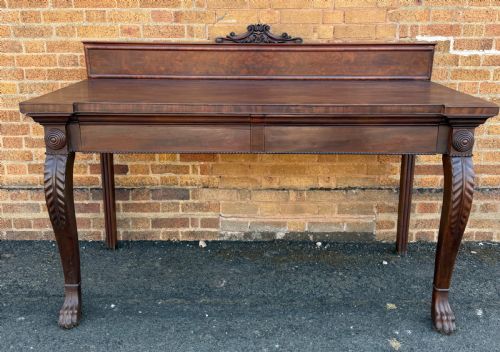


Irish Regency Sideboard
An irish regency sideboard brings architectural weight and bold native carving to a room, offering deep timber tones and grand proportions.
Irish Regency Sideboard
An irish regency sideboard encompasses grand serving tables, console tables, and secretaire desks dating from the early nineteenth century. These forms reflect the heavy architectural influences and distinctive regional cabinet-making traditions of the period.
Mahogany dominates the surviving examples, often selected for strong figuring and deep natural warmth. Pieces frequently adopt serving table or console formats rather than the enclosed cellarette cupboards common in English workshops of the same era.
Makers working in Dublin and regional centres produced these items with bold proportions and confident carving. The surviving record shows pieces attributed to prominent Irish cabinet-makers alongside workshop productions bearing distinctive local character.
How They Were Made
Cabinet-makers relied heavily on solid mahogany and flame veneers, occasionally introducing burr elm for contrasting panels and decorative grain effects. Timber selection focused on rich figuring that responded to hand-applied polish.
Brass fittings and mounts provided structural contrast and functional detail on drawers and mounts. Metalwork complemented the dark timber tones without overpowering the substantial wooden framework.
Some nineteenth-century workshops in Kilkenny signed their heavy mahogany furniture with straightforward pride, leaving permanent marks of local identity.
What Varies in Quality
The confidence of the carving sets the finest examples apart from standard workshop output. Crisp execution in foliage, scrollwork, or lion mask motifs distinguishes ambitious Irish pieces from plainer contemporaries.
Proportion and scale dictate the visual success of the piece. Superior examples maintain balanced architectural lines across large dimensions, whereas lesser items can appear heavy or awkward in their structural rhythm.
Robert Strahan and Co·Mack Williams and Gibton·Gillington of Dublin·The Woodworkers Ltd Kilkenny
The Irish Regency Sideboard Glossary
- Serving table
- A long freestanding table designed for dining rooms to hold dishes before service. It lacks the enclosed cupboards of later fitted sideboards.
- Console table
- A table fixed or placed against a wall, often supported by scroll brackets or carved legs. In Irish pieces, these often double as serving tables.
- Flame mahogany
- Timber cut to expose the undulating grain pattern resembling flickering flames. Cabinet-makers reserved this veneer for primary focal points like drawer fronts.
- Secretaire
- A cabinet or desk incorporating a pull-down writing drawer fitted with small compartments. Examples from this period integrate the writing function into the main sideboard or console form.
Irish Regency Sideboard: Frequently Asked Questions
How do I spot an Irish piece?
Look for bolder carving, heavier architectural presence, and specific regional timber choices. Irish makers often favoured open serving table formats over enclosed cabinets.
Local workshops frequently incorporated distinct decorative motifs such as deep scrolling and native hardwood framing.
Where should I place a serving table?
These large tables suit principal dining rooms or spacious hallways where their scale commands attention. Ensure adequate wall space to display the proportional width.
Keep them away from direct heat sources to protect nineteenth-century mahogany and veneer from drying out.
How do I clean mahogany safely?
Dust regularly with a dry, soft lint-free cloth to prevent particle buildup on the polished surface. Avoid modern silicone sprays that damage historic finishes.
Apply a traditional beeswax polish sparingly when the wood appears dry, buffing gently to restore the natural sheen.
What is the difference between George III and Regency?
George III furniture leans towards classical restraint and refined geometric proportions. Regency work introduces bolder archaeological influences and heavier structural mass.
Irish cabinet-making during the transition often blended these traditions into exceptionally robust designs.