
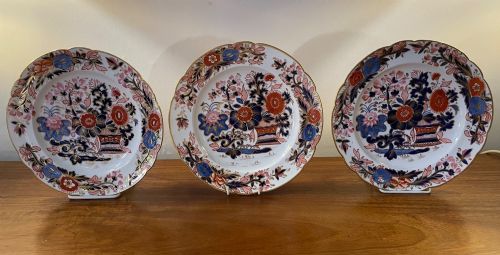
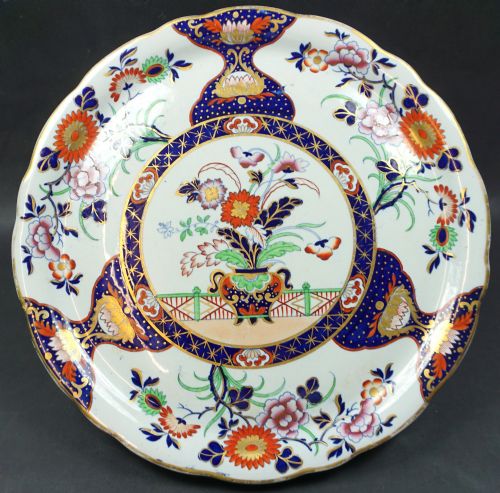
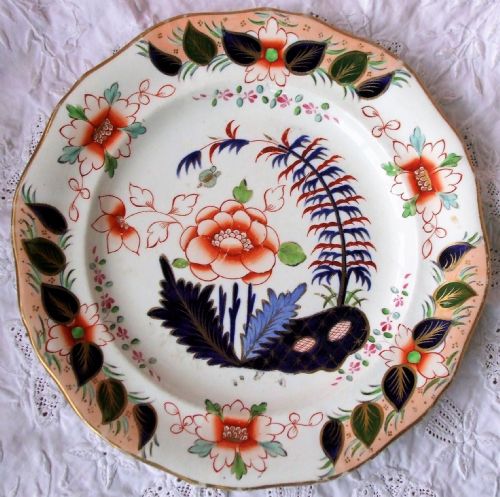
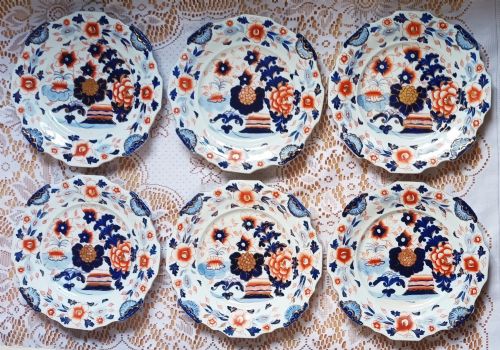


Floral Patterned Imari Plate
These floral patterned imari plate examples bring together rich cobalt blue and iron-red ceramic artistry to anchor a traditional table.
Floral Patterned Imari Plate
A floral patterned imari plate offers a striking combination of underglaze blue and overglaze enamel iron-red pigments, often highlighted with gilding or gold leaf. When you search for this phrase, you encounter both imported Japanese wares and English interpretations produced during the Georgian, Regency, and Victorian periods.
The selection on this page ranges from Japanese imari plates with scalloped edges to English ironstone and earthenware adaptations. You find decorative plates, serving platters, and dinnerware sets spanning the nineteenth century up to the early twentieth century.
Makers working in Staffordshire and beyond adopted the distinctive Japanese palette, creating robust ironstone china alongside finer porcelain and stoneware pieces. Each form serves as both a functional dish and a vibrant decorative element for the home.
How they were made
Potters built these plates using durable ceramic bodies such as ironstone, porcelain, earthenware, and stoneware. Craftsmen then applied underglaze blue cobalt designs before firing, followed by hand-coloured enamel details in iron-red.
Many examples incorporate gold leaf and gilding to accentuate the intricate floral and geometric motifs across the surface. Glaze layers seal the decoration, providing a glossy finish that protects the pigments through decades of use.
Collectors occasionally track down nineteenth-century patterns delightfully named 'Crazy Cow' or 'Bengal Tiger' alongside traditional floral arrangements.
What varies in quality
The precision of the hand-coloured brushwork dictates the visual clarity of the floral motifs. Crisp cobalt lines paired with carefully applied enamel and gold leaf elevate the piece above simpler production wares.
The underlying ceramic body also sets examples apart, moving from heavier ironstone and earthenware to refined porcelain and stoneware. Weight, resonance, and the crispness of moulded edges like scalloped borders reveal the maker's skill.
Hicks & Meigh·John Davenport of Longport·Masons·John Ridgway·Minton
The Floral Patterned Imari Plate Glossary
- Imari palette
- A decorative scheme utilising cobalt blue, iron-red, and gold. This combination originates from Japanese porcelain traditions and was widely copied by European potteries.
- Ironstone
- A dense, durable type of earthenware patented in the nineteenth century. It resists chipping and served as a sturdy base for colourful transfer-printed and hand-painted patterns.
- Enamel
- Opaque glass used for overglaze painting. It fires at lower temperatures to yield bright reds, greens, and yellows that sit slightly raised on the ceramic surface.
- Gilding
- The application of gold leaf or gold dust to ceramic decoration. It highlights borders and central motifs to catch the light.
- Ashet
- A Scottish term for a large serving platter or dish. These robust pieces match the dinner services and dinnerware sets of the nineteenth century.
Floral Patterned Imari Plate: Frequently Asked Questions
Are these plates safe for daily dining?
Many nineteenth-century ironstone and porcelain pieces remain robust enough for regular use. Hand washing preserves the delicate overglaze enamels and gold leaf.
Older earthenware plates benefit from gentle handling to protect the ceramic body and historic glaze finishes from thermal shock and abrasive detergents.
How do I distinguish Japanese from English imari?
Japanese plates often feature lightweight porcelain bodies with traditional hand-painted motifs and unglazed foot rims. English versions frequently utilise heavy ironstone or stoneware with distinct maker marks.
English interpretations also lean into Regency and Victorian shaping, such as moulded scalloped edges and transfer-printed outlines beneath the hand-coloured enamel.
What periods do these plates represent?
The pieces span the nineteenth century, including Georgian and Regency eras, extending into the Victorian period and early twentieth-century Japanese production. Each era brings distinct ceramic formulations and stylistic touches.
Staffordshire potteries produced robust ironstone variations during the 1800s and 1850s, while later Japanese imports maintained traditional hand-painted techniques.
How should I display a decorative plate?
Wall mounting requires secure plate hangers with rubber-coated grips to protect the ceramic rim. Cabinet display keeps pieces safe from accidental knocks while allowing clear visibility of the rich cobalt and iron-red palette.
Grouping plates by pattern style or maker creates a striking visual arrangement that highlights the variety of floral motifs.