
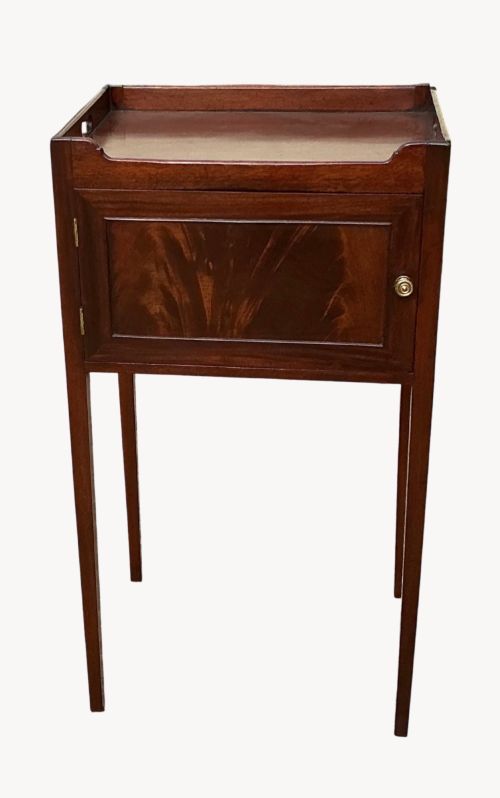
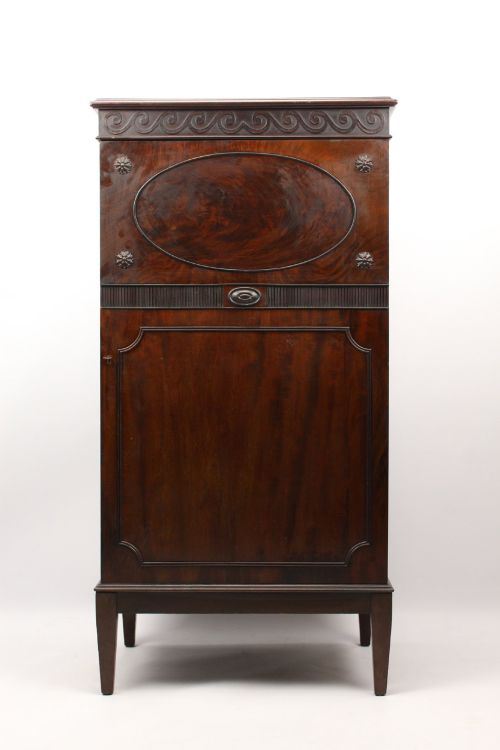
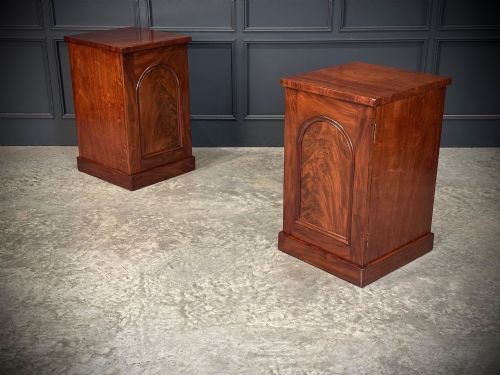
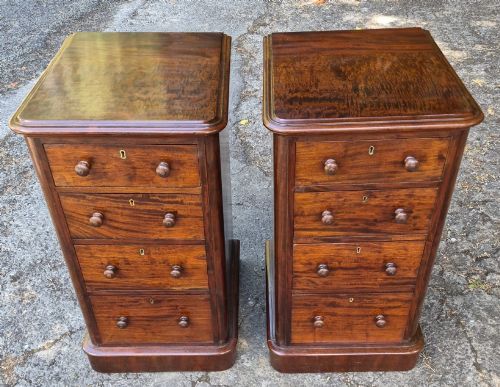
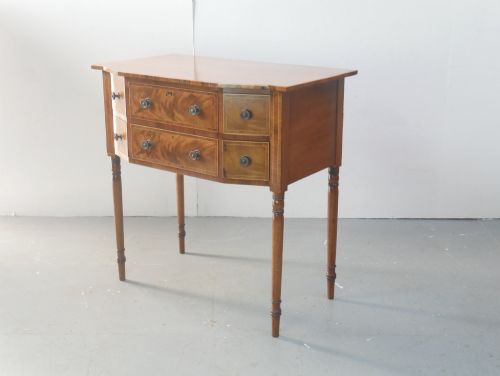
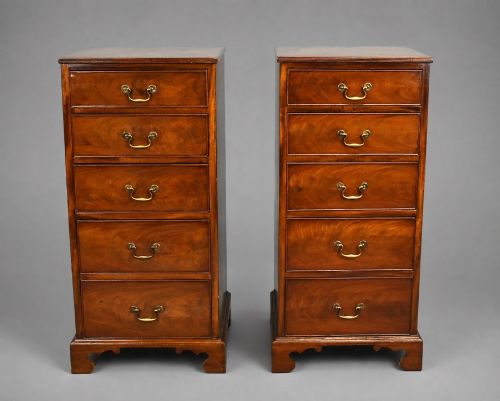
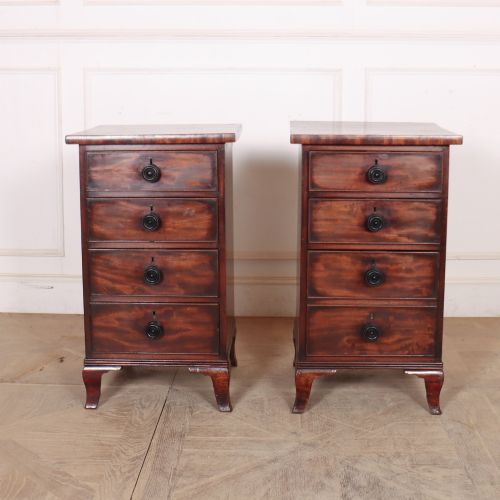
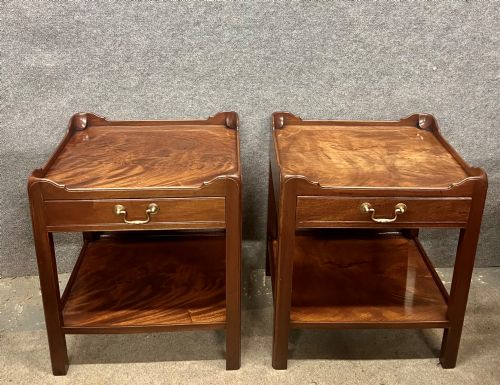
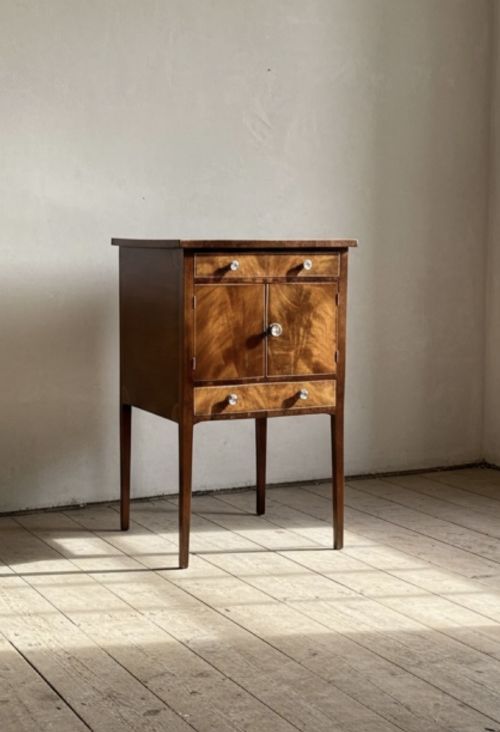
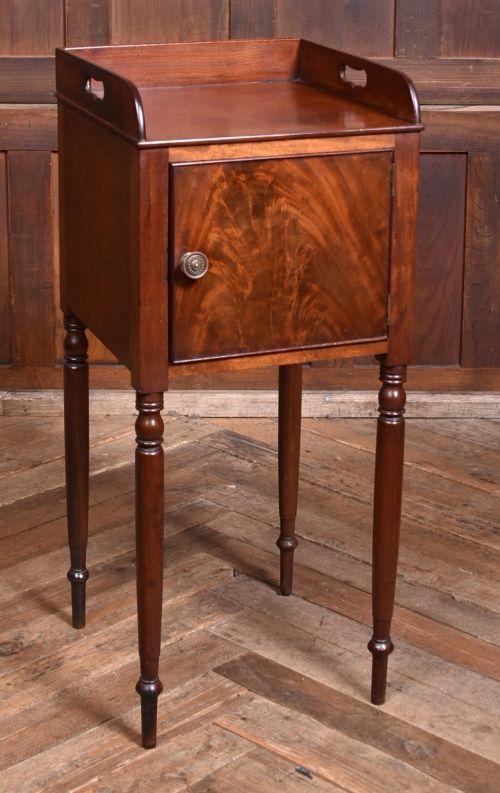
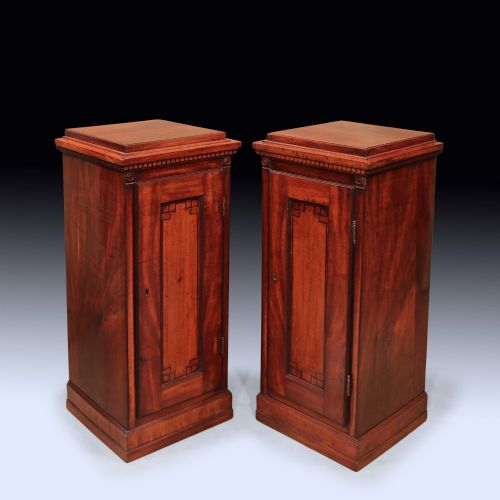
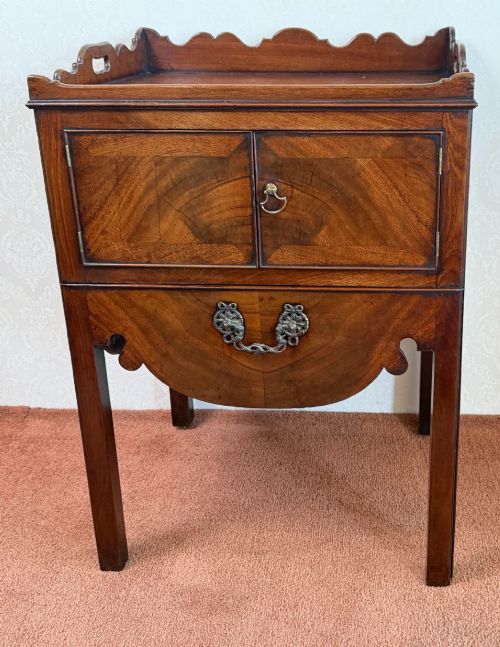
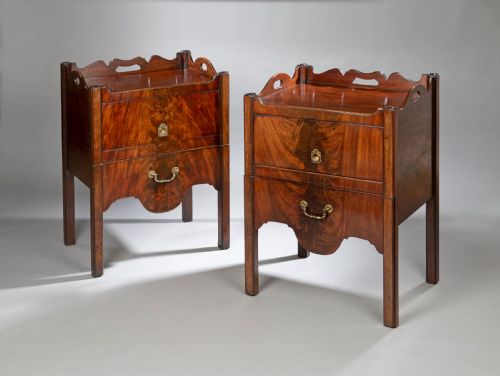
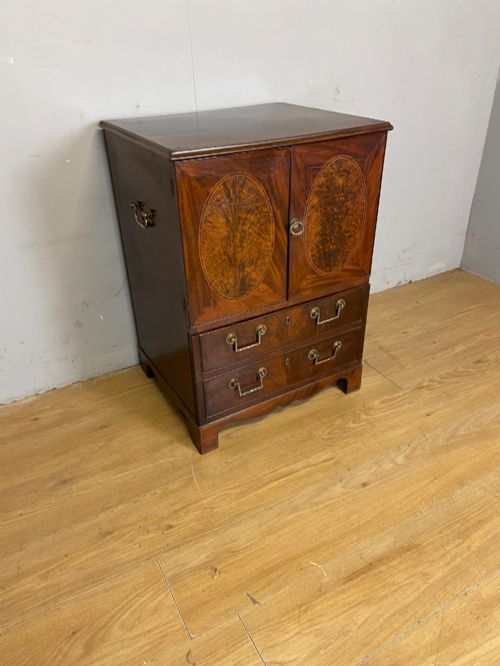

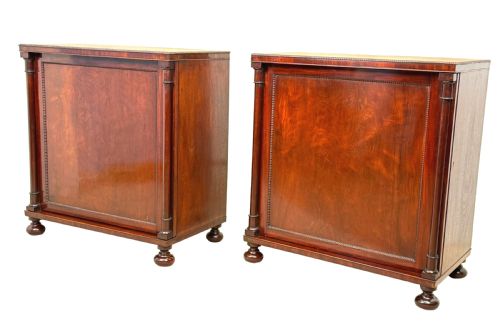
Flame Mahogany Bedside Cabinet
A flame mahogany bedside cabinet brings rich timber grain and compact storage to a bedroom.
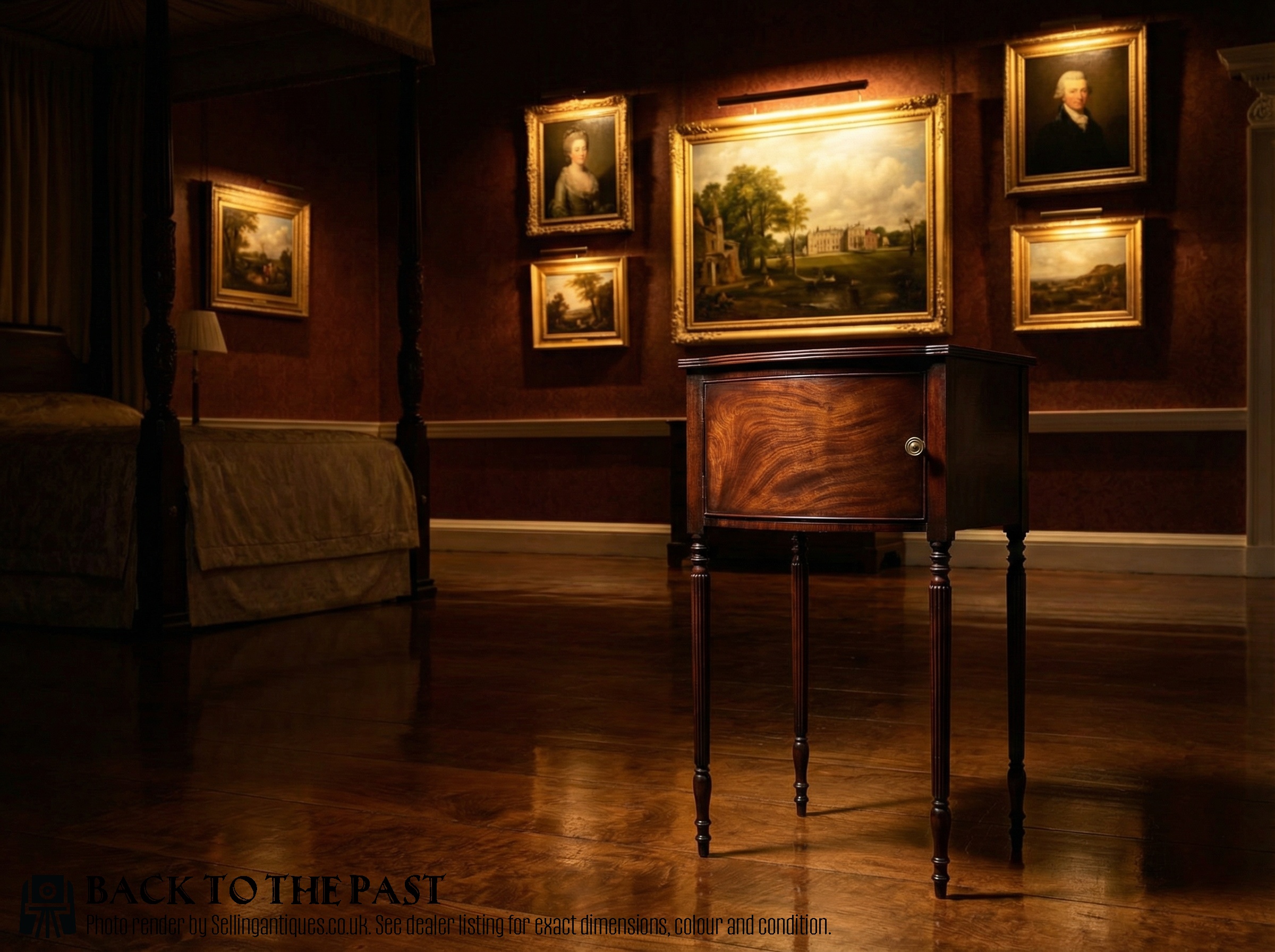
Flame Mahogany Bedside Cabinet
A flame mahogany bedside cabinet is a small enclosed storage piece designed to sit beside a bed, taking the form of a pedestal cupboard, commode or small chest. The selection spans from the Georgian and Regency eras through the Victorian period and into the early twentieth century.
Buyers most frequently encounter 19th-century and Victorian examples alongside Georgian pieces, often found as matched pairs or single pedestals. The internal configuration typically includes a single door concealing a shelf or chamber pot compartment, sometimes paired with a tray top or drawer above.
How they were made
Cabinetmakers constructed these pieces using solid mahogany carcases overlaid with figured flame mahogany veneer to create dramatic, swirling wood grain patterns on the doors and top surfaces. Secondary timbers such as oak frequently form the internal drawer linings and structural framing.
Details such as brass handles, boxwood stringing inlay, and occasionally white marble tops complete the construction, depending on the period and regional workshop traditions.
Flame Mahogany Bedside Cabinet Retail Price Guide 2026
Typical asking prices for flame mahogany bedside cabinet among the pieces listed under this phrase on Sellingantiques today, from the lower quarter to the upper quarter. They describe what is for sale here now, not the wider market.
Some Victorian variations include shoe box cabinet ottomans designed to keep footwear out of sight at the foot of the bed.
What varies in quality
The standard of a flame mahogany bedside cabinet rests upon the selection and bookmatching of the veneer panels, where symmetrical figuring creates a striking visual centrepiece. Fine craftsmanship shows in the tightness of the drawer dovetails, the smoothness of the door hanging, and the subtlety of inlaid stringing.
Proportion and architectural integrity dictate the upper tier of pieces, distinguishing standard utilitarian workshop production from finer cabinet work attributed to notable periods like the George III or Regency eras.
Denby and Spinks·Gillows of Lancaster
The Flame Mahogany Bedside Cabinet Glossary
- Flame mahogany veneer
- A thin slice of timber cut from where branches join the main trunk, producing a rippling, flame-like grain pattern. This decorative veneer sits on top of a stable secondary wood carcase.
- Tray top
- A raised moulded rim around the top surface of a cabinet or table designed to prevent items from rolling off. It is particularly common on 18th-century and Georgian night tables.
- Pot cupboard
- A small enclosed bedside cabinet originally built to house a chamber pot. These pieces usually feature a single cupboard door and sometimes an internal shelf.
- Pedestal cupboard
- A freestanding vertical cabinet standing on a plinth or feet, enclosing shelf space behind a single hinged door. They form a standard proportion for bedside storage.
- Stringing
- A narrow strip of contrasting timber inlaid into the surface of the mahogany to form geometric borders and lines. Boxwood and ebony are frequent choices for this decorative banding.
Flame Mahogany Bedside Cabinet: Frequently Asked Questions
What is a flame mahogany bedside cabinet used for?
These cabinets serve as bedside storage units with enclosed cupboard space for personal items and a surface for a lamp or clock.
Historically, many versions functioned as night tables or commodes to conceal washing equipment or chamber pots within a compact footprint.
How do I identify a Georgian bedside cabinet?
Georgian pieces display classical proportions, subtle mouldings, and often feature tray tops or delicate bracket feet. The timber selection relies on rich, dense mahogany with minimal heavy ornamentation.
Internal construction uses hand-cut dovetails in oak or pine drawers, distinguishing them from later mass-produced Victorian or Edwardian alternatives.
Are these cabinets usually sold in pairs?
Many listings feature pairs because matching bedside storage became desirable in larger bedrooms during the 19th century. Single cabinets also appear frequently for tighter spaces or asymmetric room layouts.
Pairs often originate from larger bedroom suites or were matched together later based on similar height, timber, and style.
How do I care for flame mahogany veneer?
Protect the polished surface by placing the cabinet away from direct sunlight and sudden temperature changes that can dry out the timber. Regular dusting with a soft, dry cloth preserves the French polish and veneer stability.
Avoid using silicone-based sprays or harsh chemical cleaners, applying a traditional beeswax polish sparingly when the wood appears dry.