
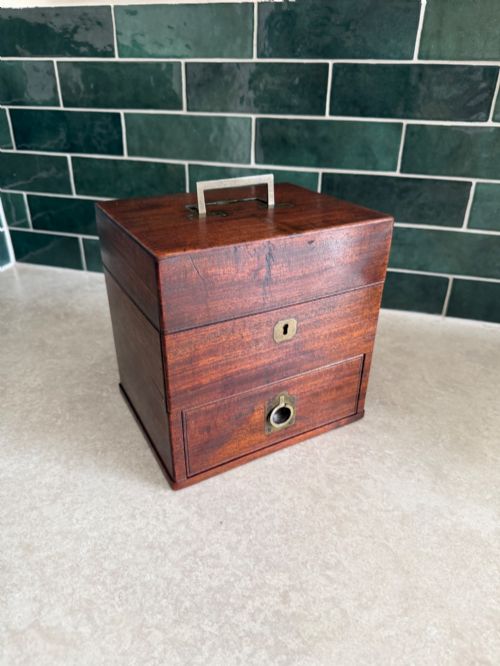
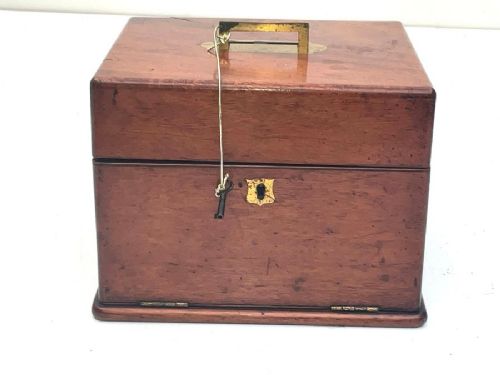


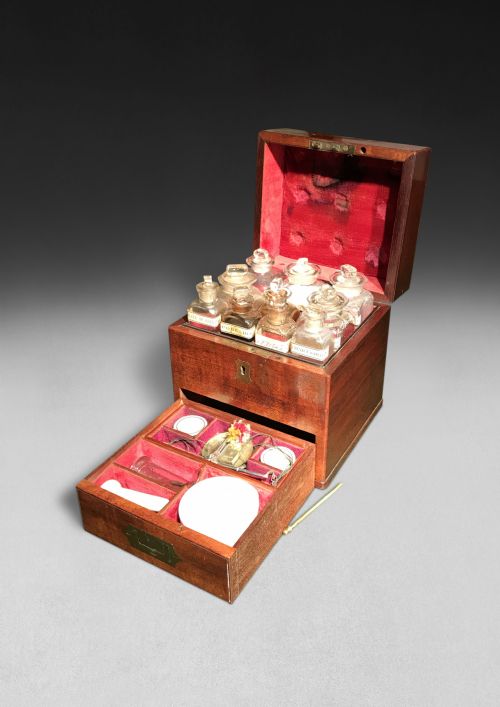


Fitted Mahogany Medicine Box
A fitted mahogany medicine box is a robust travel companion built to carry remedies safely across Georgian and Victorian roads.
Fitted Mahogany Medicine Box
A fitted mahogany medicine box is a compact chest designed for storing and transporting medical remedies, frequently described in listings as an apothecary box, cabinet, or travelling case. These pieces date from the Georgian, Regency, and Victorian periods, spanning the eighteenth and nineteenth centuries.
Materials and construction
Craftsmen built these cases using solid mahogany, often enhancing the exterior with brass carrying handles, escutcheons, and reinforcement corners suitable for campaign use. Selected specimens incorporate fine stringing or inlay work into the timber surface.
Inside the box, fitted wooden dividers create precise slots for glass bottles and jars, occasionally accompanied by hidden drawers. Delicate linings of velvet, leather, and paper protect the glass vessels and small scales during transit.
Listings for a fitted mahogany medicine box span the Georgian, Regency, and Victorian periods, utilising materials such as brass, glass, velvet, and mahogany.
Quality differences
The distinction between standard examples and superior pieces rests largely on the preservation of original internal contents and the complexity of the internal arrangement. Boxes that retain their complete complement of original bottles and glass containers demonstrate a higher degree of historical integrity.
Fine workmanship appears in the precision of the joinery, the quality of the brass hardware, and the inclusion of secret drawers or miniature accessories. Simpler travelling cases offer utilitarian storage, whereas elaborately fitted Georgian and Regency cabinets display superior cabinet-making skills.
The Fitted Mahogany Medicine Box Glossary
- Apothecary box
- A fitted wooden chest designed to hold medical bottles, scales, and remedies for personal or professional use. These portable pharmacies date primarily from the Georgian and Victorian eras.
- Campaign case
- A sturdy portable chest fitted with brass hardware, built for military officers or travellers on long journeys. Such pieces needed to withstand rough transport without damaging the contents.
- Escutcheon
- A protective brass plate surrounding a keyhole on the exterior of the box. It prevents the wood from splitting around the lock during daily use.
- Stringing
- A narrow strip of contrasting wood inlay used to decorate the exterior surfaces of mahogany furniture. This decorative technique appears on select Georgian and Victorian boxes.
Fitted Mahogany Medicine Box: Frequently Asked Questions
What is a fitted mahogany medicine box?
A fitted mahogany medicine box is a portable wooden chest made to hold glass bottles, powders, and medical instruments securely during travel. These pieces date from the eighteenth and nineteenth centuries.
They served doctors, travellers, and households requiring a ready supply of remedies. Today, collectors value them for their ingenious internal compartments and surviving glassware.
How were these medicine chests used?
Owners used them to store liquid remedies, pills, and mixing equipment while at home or on long journeys. The fitted interior kept fragile glass bottles from colliding.
Many examples travelled with military officers or wealthy families on campaign. The lower drawers often contained scales, pestles, and measuring papers.
How do I identify a Georgian box?
Georgian boxes typically date between the mid-eighteenth century and the early nineteenth century, displaying characteristic mahogany grain and brass campaign hardware. Their construction reflects the cabinet-making standards of the period.
Earlier examples may feature simpler lines, whilst later Regency pieces incorporate more refined veneers and interior layouts. Examining the brass fittings and wood ageing helps confirm the era.
Do these boxes still contain original bottles?
Some fitted medicine boxes retain their original glass bottles and stoppers, whilst others survive as empty cabinets. Listings specify whether the bottles are present.
Finding a box with its complete set of original glass adds significantly to its character. Empty boxes remain popular for display and alternative storage.