



Fishing Vessel Oil Painting
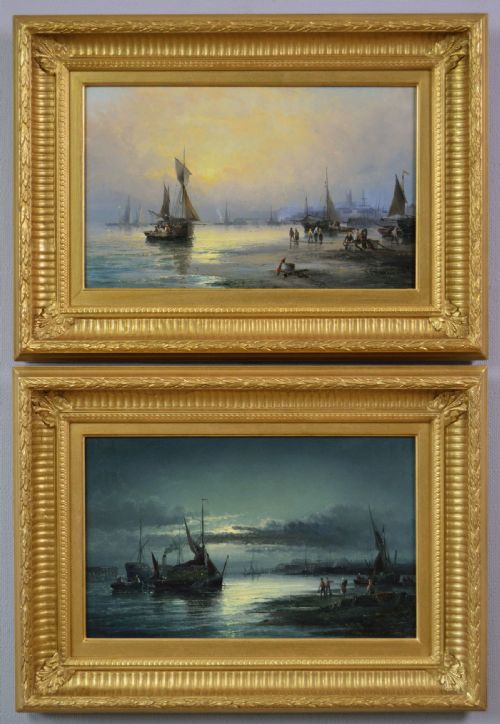
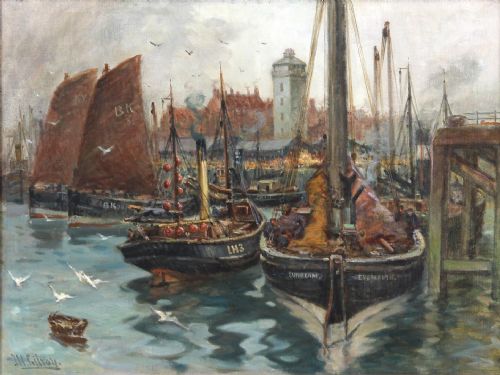
These fishing vessel oil paintings capture maritime labour and coastal waters across several centuries.
Fishing Vessel Oil Painting
A fishing vessel oil painting depicts maritime scenes featuring working boats, harbours and coastal waters. The pieces seen here span from the Georgian period and the Victorian era through the nineteenth century to mid-century modern works from 1950 and 1960.
Buyers encounter works executed in styles ranging from impressionism and maritime realism to nineteenth-century British and Dutch school traditions. The subjects focus on single fishing boats, trawlers and boat yards.
Canvas serves as the primary support, frequently housed within gilt wood frames accompanied by fabric slips.
Materials and construction
Artists apply oil paint directly onto canvas supports, building texture and depth with traditional brushwork. This medium allows for subtle tonal gradations in sky and sea.
The finished works are set within wooden frames, often enhanced with gilded wood finishes and fabric slips to complement the maritime subject matter.
Listings feature works executed on canvas using oil paint, dating from the Georgian period up to 1960.
Distinguishing quality
Quality rests in the handling of light, water and atmospheric conditions, alongside the fidelity of the vessel depiction. Works aligned with recognised nineteenth-century Dutch or British school traditions often demonstrate superior brush control.
The surrounding frame contributes to the overall presentation, with gilt wood and fabric slips adding to the integrity of the piece.
George SHAW·William Shayer·Hubert Thornley·John W. Gilroy·Bernard Page
The Fishing Vessel Oil Painting Glossary
- Oil paint
- Pigment suspended in a drying oil medium, typically linseed oil. This allows for rich colour saturation and blended application on canvas.
- Canvas
- A heavy woven fabric stretched across a wooden frame to act as a painting surface. It remains the standard support for maritime oils across multiple centuries.
- Gilt wood
- Wood coated with a thin layer of gold leaf or gold paint. This technique creates ornate frames suited to traditional seascapes.
- Fabric slip
- A narrow band of material placed between the canvas and the outer frame moulding. It provides a soft visual border for the artwork.
Fishing Vessel Oil Painting: Frequently Asked Questions
What periods do these paintings cover?
The available selection spans from the Georgian and Victorian eras through the nineteenth century to mid-century examples from 1950 and 1960.
Each period brings distinct stylistic approaches to maritime subjects and framing techniques.
Which framing materials appear most often?
Frames are predominantly constructed from wood, frequently featuring gilt finishes and fabric slips.
These elements work together to enclose and complement the oil on canvas works.
How do styles differ across the selection?
Styles range from nineteenth-century British and Dutch school realism to mid-century modern and impressionist interpretations.
Artists capture harbour scenes, trawlers and coastal weather using varied brushwork and colour palettes.
Are these works painted on canvas?
Canvas functions as the primary support material across the documented pieces.
Oil paint is applied directly to this woven surface to create the maritime scenes.