






Famille Rose Baluster Urns
Famille rose baluster urns are enamelled porcelain vessels combining robust Chinese forms with intricate polychrome decoration, prized for their vibrant palettes and historical depth.
Famille Rose Baluster Urns
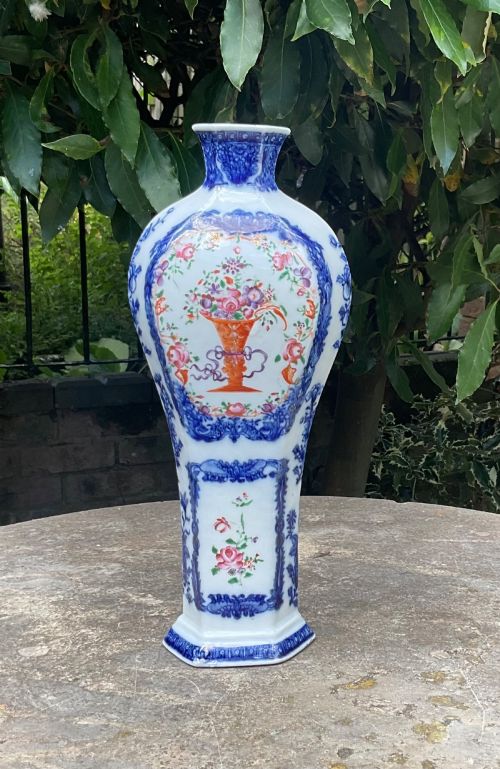
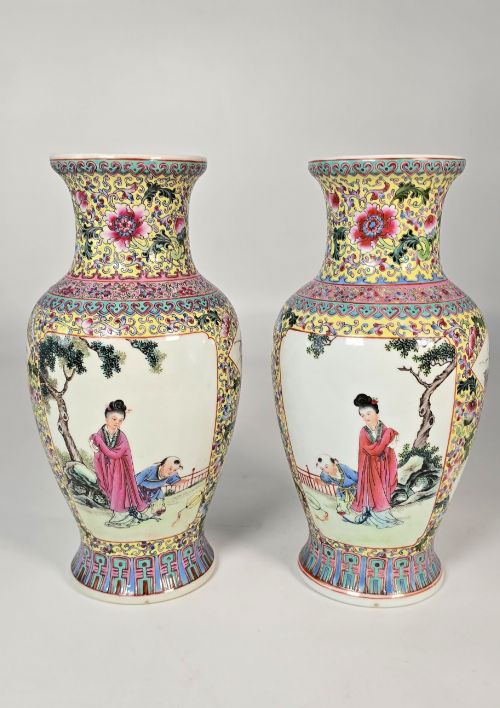
Famille rose baluster urns are classic Chinese porcelain vases defined by an elegant curvaceous profile that sweeps outward towards the centre before tapering gracefully. When searching for famille rose baluster urns, collectors encounter pieces spanning the Qing Dynasty, Chinese Export traditions, and the later Chinese Republic Period. The selection frequently includes matched pairs, hand-painted examples, and functional conversions such as table lamps.
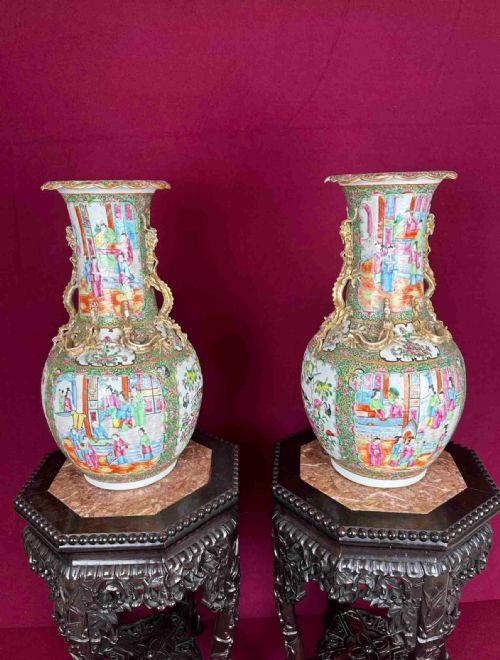
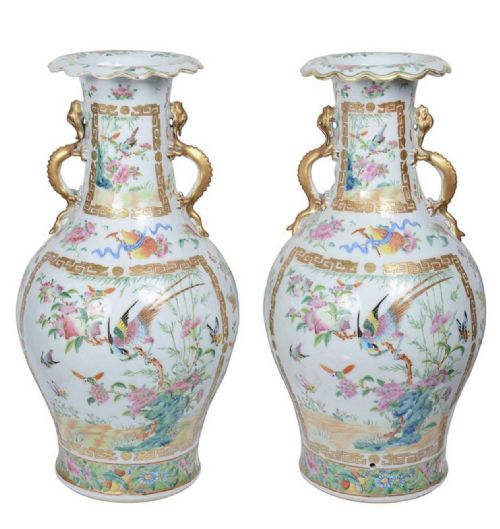
The physical evidence on this page ranges from eighteenth-century Qianlong examples down to Victorian, late nineteenth-century, and twentieth-century interpretations, including Samson porcelain. Forms appear variously as decorative vases, Rose Medallion patterns, and Canton porcelain. Buyers navigate a diverse chronological landscape where traditional Chinese export wares sit alongside later revival pieces.
The aesthetic vocabulary encompasses distinct regional styles such as Chinoiserie and Chinese Export Porcelain, alongside related decorative schemes like famille verte. Forms vary from monumental ninety-two-centimetre vases to domestic lamps, demonstrating the versatile adaptation of these traditional vessels across different periods of manufacture.
Materials and technique
These vessels rely fundamentally on white porcelain bodies shaped into distinct baluster silhouettes. Artisans applied vitreous enamel glazes to create the characteristic opaque pink and polychrome colour schemes that define the ware.
Decoration is executed through meticulous hand-painting, frequently enhanced with gold leaf, gilt, and gold gilt accents. Many pieces incorporate detailed enamel glaze work over porcelain, sometimes mounted on wood bases or subsequently adapted for electrical wiring.
Several towering examples reach up to ninety-two centimetres, ensuring these robust ceramic bodies command immediate attention in any room.
Assessing quality in the range
Quality separates through the precision and complexity of the hand-painted enamel work across the porcelain body. Finer examples display meticulous brushwork and balanced compositions within the overarching Qing Dynasty and Canton traditions, whereas simpler pieces show broader application.
The integration of gilt and gold leaf highlights contributes significantly to the visual hierarchy of the urns. Preservation of the original enamel glaze and the crispness of the decorative motifs distinguish exceptional nineteenth-century pieces from later or more commercial iterations.
The Famille Rose Baluster Urns Glossary
- Baluster
- A vertical architectural form resembling a vase or pillar, characterised by a rounded lower body tapering to a narrower neck. This specific silhouette provides the foundational shape for these urns.
- Famille Rose
- A prominent palette of Chinese porcelain enamels introduced in the eighteenth century, distinguished by its dominant opaque pink or rose colour derived from colloidal gold. The style permits subtle tonal gradations not possible in earlier ceramic decoration.
- Canton Porcelain
- Ceramic wares produced in the Guangdong province specifically for export to Western markets. These pieces are typically characterised by dense, colourful panel decorations depicting figures, birds, and flowers.
- Rose Medallion
- A distinct pattern style featuring segmented panels alternating between scenes of court figures and birds, butterflies, and flowers. The central motif is usually a medallion design.
- Samson Porcelain
- Nineteenth-century European production, principally from Paris, that replicated historic ceramic styles including Chinese export porcelain. These pieces offer insight into Western emulation of Eastern aesthetic traditions.
Famille Rose Baluster Urns: Frequently Asked Questions
What is a baluster urn?
A baluster urn is a vase featuring a curved, swelling lower body that tapers toward the top, creating a stable and balanced profile.
This specific form has been utilised for centuries across Chinese ceramic traditions for ornamental display within interior spaces.
How do I date these vases?
Dating relies on examining the characteristics of the porcelain body, the specific palette of the enamel glaze, and stylistic markers associated with periods like the Qing Dynasty or the Chinese Republic.
Secondary evidence such as mounting techniques, wood bases, or later lamp conversions also helps establish the approximate era of production.
Were these pieces made for export?
Many of these vessels, particularly Canton and Rose Medallion types, were manufactured specifically for trade with Western markets under the banner of Chinese Export Porcelain.
These pieces were tailored to European and American aesthetic preferences while retaining traditional craftsmanship techniques.
Can I live with converted lamp bases?
Converted lamp bases integrate historic porcelain bodies with electrical fittings, allowing traditional urns to function as modern lighting.
Many examples on the market show this adaptation, bridging historical decorative arts with contemporary domestic interiors.