
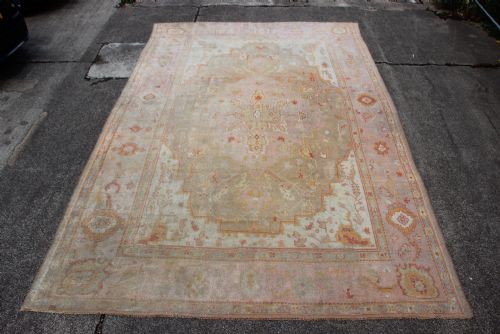



Faded Rug
A faded antique rug brings softened colour and worn character into a room through centuries of heritage.
Faded Rug
A faded antique rug is a woven floor covering originating from various traditions across the nineteenth and early twentieth centuries. When searching for a faded antique rug, buyers encounter carpets, runners, and kilims that show the gentle softening of dye over decades of use and sunlight. These textiles hail from Persian, Turkish, Caucasian, and Central Asian workshops and tribal regions, spanning periods from the nineteenth century up to the 1920s.
The most common examples on this page are large Oushak and Ushak carpets alongside room-sized Persian room carpets like Kirman, Sarouk, and Tabriz. Alongside these grand formats, the selection includes smaller tribal runners and specific regional pieces such as Kazak, Shirvan, and Qashqai rugs. Each style brings distinct regional patterns, from large medallions to intricate all-over floral or geometric motifs.
How they were made
Makers constructed these rugs predominantly using hand-spun wool and cotton foundations, with occasional examples incorporating soft angora wool. Weavers knotted the pile by hand onto cotton or wool warp and weft threads, creating dense, flexible structures designed to withstand decades of foot traffic. Natural dyestuffs derived from plants, roots, and insects provided the original rich palettes that subsequently mellowed into pastel pinks, pale blues, and soft reds.
Certain pieces utilised flatweave techniques, such as the Uzbek suzani kilim woven in separate strips and joined together. The combination of durable animal fibres and reactive natural dyes meant that time and wear produced the distressed patinas and muted tones valued by modern decorators. Foundation materials remain visible at the reverse and edges, showing the honest structural construction of each era.
Listings span nineteenth century origins through the 1920s, featuring wool, cotton, and angora wool across Ottoman, Persian, and Caucasian traditions.
What varies in quality
Quality in these textiles depends on the fineness of the knot density and the precision of the wool preparation. Superior pieces utilise high-grade hand-spun wool that retains a supple hand and natural lanolin, ensuring the pile ages gracefully rather than shedding excessively. The integrity of the foundational weave and the original proportions of the design dictate the overall structural soundness of the carpet.
Artistic execution also separates standard production from exceptional examples, visible in the balance of the central medallions and the subtlety of the colour transitions. While wear and fading are anticipated characteristics of age, the remaining pile should retain enough depth to support the integrity of the original design scheme.
Maples
The Faded Rug Glossary
- Oushak
- A Turkish carpet style originating from the town of Ushak, known for large-scale floral motifs and soft pastel colour palettes. These rugs frequently feature generous room dimensions and open, relaxed compositions.
- Kilim
- A flatwoven textile produced without a knotted pile, resulting in a lightweight rug with distinct geometric patterns. Artisans often utilise slit-weave techniques that create sharp lines between colour blocks.
- Runner
- A long, narrow carpet format designed specifically for hallways, staircases, or narrow corridors. They display repeating vertical motifs adapted to restricted spatial dimensions.
- Patina
- The surface appearance acquired by materials through age, wear, and exposure to light. In these textiles, it manifests as a softening of primary dye colours into gentle secondary tones.
- Warp
- The vertical foundation threads stretched tightly on the loom before knotting begins. Cotton or wool warp threads form the structural skeleton upon which the entire carpet is built.
Faded Rug: Frequently Asked Questions
How do I clean an antique rug?
Professional specialist cleaning is essential for antique textiles to protect delicate natural dyes and aged wool fibres. Domestic cleaning methods and harsh chemical agents can permanently damage the foundation and accelerate deterioration.
Gentle surface vacuuming without a beater bar removes everyday dust between specialist washes. Keeping these rugs out of direct, harsh sunlight helps preserve the soft patinas achieved over generations.
Are these rugs suitable for high traffic?
Many of these carpets were built for heavy domestic use, employing dense wool piles and sturdy cotton foundations. Placing a quality underlay beneath the rug absorbs impact and reduces friction against the floor.
Runners and heavy wool room carpets handle hallway and living room placement well if the remaining pile depth is sufficient. Checking the structural integrity of the edges and foundation ensures the textile can support daily footfall.
How can I tell Oushak from Persian rugs?
Oushak carpets typically display larger, more relaxed floral designs with a distinct fondness for pale blues, soft pinks, and warm terracotta washes. Their wool is often looser and softer to the touch compared to standard Persian weaves.
Persian rugs, such as Tabriz, Kirman, or Sarouk, generally present tighter knot densities and more intricate, controlled floral or medallion compositions. Regional colour choices also differ, with Persian workshops frequently favouring deeper reds, indigos, and detailed ivory borders.
What does a distressed patina mean?
A distressed patina indicates that the rug has experienced significant wear, washing, or sun exposure over its lifetime, reducing the intensity of the original dyes. This process softens bright primary colours into subtle pastel shades and muted earth tones.
Rather than representing a structural defect, this aged finish creates a faded aesthetic that integrates easily into contemporary and traditional interiors. The level of distress varies from gentle softening to areas where the foundation threads become partially exposed.