






English Regency Side Cupboards
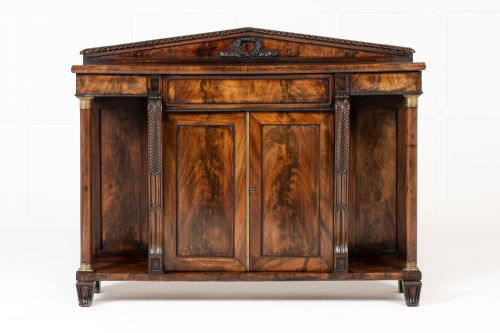
English regency side cupboards are handsome timber storage pieces that bring architectural refinement and practical surface space to any room.
English Regency Side Cupboards
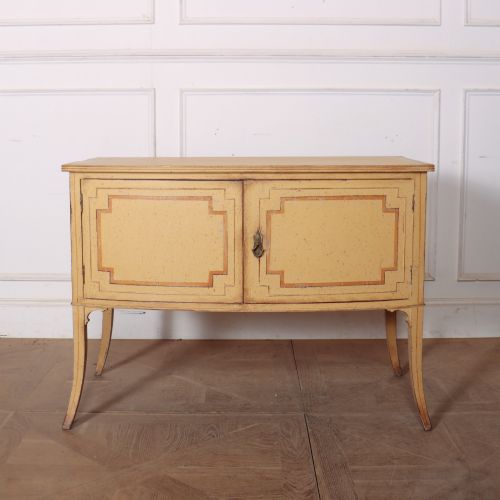
English regency side cupboards encompass a variety of low-profile storage forms, including chiffoniers, side cabinets, and pier cabinets designed for formal reception rooms. These pieces originate predominantly from the Regency era, with related examples spanning the nineteenth century, the Victorian period, and circa eighteen hundred.
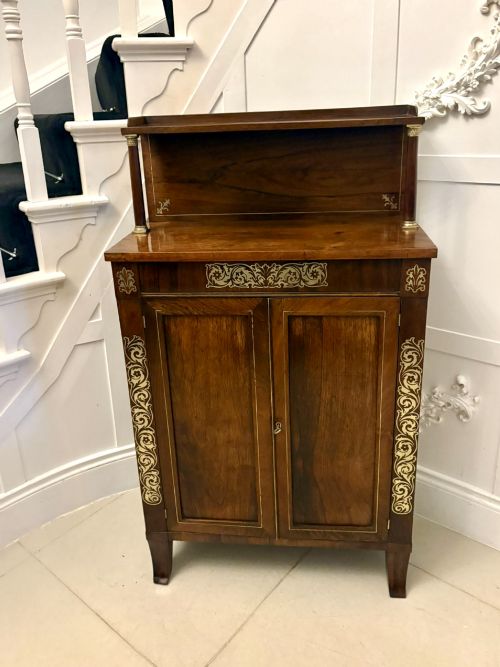
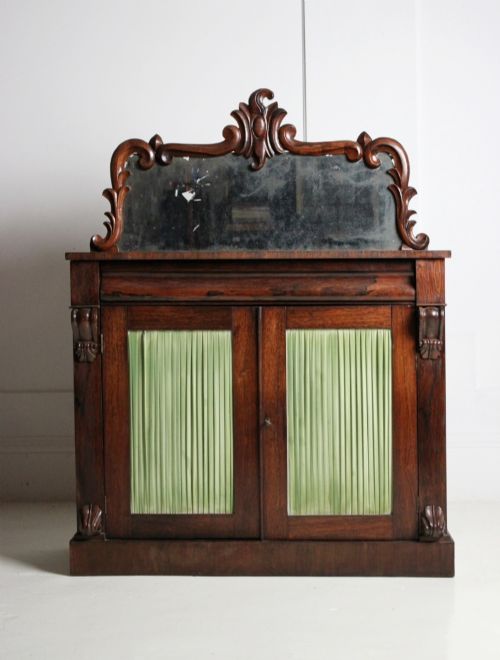
The version most commonly met on this page is the rosewood or mahogany side cabinet, often detailed with brass inlay, glass, or fabric panels. Buyers encounter these forms in pairs as well as individual neat-sized formats, reflecting the domestic requirements of English country houses.
Makers and workshops of the period, such as Gillows of Lancaster and London cabinet makers like S. Jamar, produced these forms to high standards. Pieces emerge in styles ranging from Grand Regency and English Country House to George the Fourth, William the Fourth, and English Empire.
Factors of Quality
The distinction between standard commercial output and superior cabinet work rests in the precision of the joinery and the selection of figured timber veneers. Workshops associated with notable makers invested greater care in matching grain patterns and finishing concealed structural elements.
Refinement in quality appears in the execution of decorative elements, from finely cast brass mounts to intricate boxwood inlay and well-balanced proportions. The handling of secondary woods and the integrity of original ormolu and glass components further separate master-built pieces from ordinary production.
Gillows of Lancaster·S Jamar London
The English Regency Side Cupboards Glossary
- Chiffonier
- A low sideboard or cabinet featuring a combination of drawers and shelving enclosed by doors, popular throughout the Regency period.
- Ormolu
- Gilded bronze used for decorative mounts and feet on high-status furniture.
- Pier Cabinet
- A narrow display cupboard designed specifically to fit the wall space between windows.
- Deception Table
- A specialised form of cabinet furniture designed to disguise its true function through clever concealment.
- Boxwood Inlay
- Contrasting light-coloured wood inserted into darker timber veneers to create geometric or floral patterns.
English Regency Side Cupboards: Frequently Asked Questions
How do I spot a true Regency piece?
Authentic Regency pieces typically display characteristic architectural proportions, classical motifs, and timber choices specific to the early nineteenth century. Examination of the construction methods and secondary woods confirms the period of origin.
Makers of the era employed distinct joinery techniques that evolved from late Georgian practices into the bolder styles associated with George the Fourth and William the Fourth.
Where should I place a side cabinet?
These low cabinets suit dining rooms, drawing rooms, or hallways where surface space and discreet storage are required. Their compact footprint allows them to sit comfortably against walls without dominating the room.
Pairing matching cabinets on either side of a fireplace or architectural feature creates a balanced arrangement typical of historic English interiors.
Are pairs difficult to find?
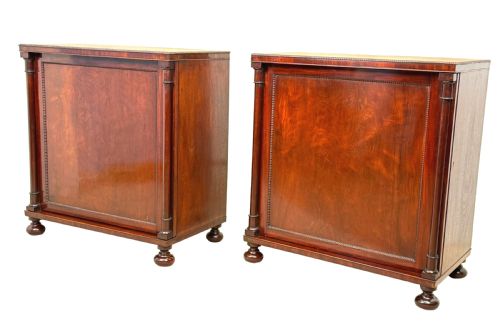
Matching pairs of nineteenth-century side cupboards appear less frequently than single examples due to the dispersal of original furniture sets over time. When available, they offer a symmetrical solution for interior schemes.
Surviving pairs often share identical timber graining, brass inlay patterns, and dimensions, indicating they were commissioned together for a specific room.
What is the difference between a chiffonier and a side cabinet?
A chiffonier generally incorporates a raised shelf or superstructure on top of a low enclosed cupboard, designed for serving and displaying plate. Standard side cabinets focus purely on lower storage with a flat top surface.
Both forms served similar functions in Regency entertaining, though chiffoniers often included fabric-backed door panels or glass to soften their visual impact.