


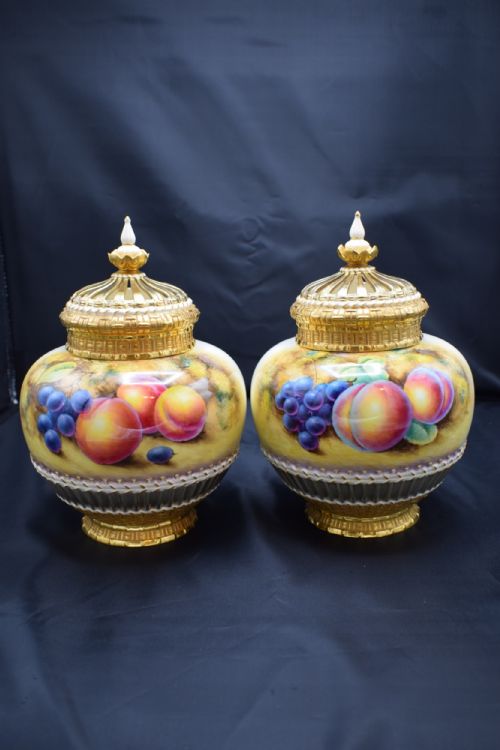


English Gilded Pot Pourri
English gilded pot pourri pieces bring together fine porcelain, painted fruit or wildlife, and rich gilding to scent and ornament a room.
English Gilded Pot Pourri
When you search for english gilded pot pourri, you encounter decorative pots, jars, vases, and urns created across the twentieth century, with notable examples spanning from nineteen hundred to nineteen sixty. These vessels take the form of covered jars, crown top pieces, and three-piece sets designed to hold dried scented plant material.
The objects most frequently met on this page originate from Royal Worcester, encompassing traditional English styles, Edwardian designs, and twentieth-century interpretations. Painters such as Ayrton, John Smith, C Baldwyn, Davis, Kitty Blake, Hadley Ware, and Jas Stinton signed the most distinctive pieces.
Forms range from simple bowed vases to elaborate urns with covers. The decorative schemes frequently feature fruit, flying swans, and intricate gilding applied over fine porcelain and bone china.
Materials and methods
Makers shaped these vessels from bone china and porcelain, building smooth surfaces suited for detailed painting and the application of gold leaf. Potters formed intricate lids, crown tops, and matching urn bodies to contain the pot pourri.
Artisans applied enamel colours and gilding by hand, depicting fruit, birds, and botanical subjects across the ceramic body. Skilled painters then signed their work directly onto the surface before final firing.
Listings span the twentieth century from nineteen hundred to nineteen sixty, utilising porcelain, bone china, gold leaf, enamel, and gilding.
Assessing quality
The standard of an english gilded pot pourri rests on the fineness of the hand-painted detail and the crispness of the gilding. Works bearing signatures by known artists demonstrate superior brushwork and compositional depth.
Completeness dictates distinction, particularly in multi-piece sets and vessels with original covers or crown tops. The preservation of the enamel and gold leaf across the contours of the vase determines the visual weight of the piece.
Royal Worcester·Hadley Ware
The English Gilded Pot Pourri Glossary
- Pot pourri
- A mixture of dried petals and spices placed in a vessel to perfume a room. The container requires a pierced cover or open top to release the scent.
- Bone china
- A type of soft-paste porcelain containing bone ash. It provides a durable, bright white body ideal for detailed painting.
- Gilding
- The application of gold leaf or gold powder onto the surface of the ceramic. This technique highlights rims, handles, and decorative motifs.
- Enamel
- Opaque or translucent glass fused to the porcelain body through firing. It creates the vibrant, permanent colours seen in fruit and bird scenes.
- Crown top
- A pierced lid configuration resembling a crown. This shape allows the enclosed fragrance to disperse evenly.
English Gilded Pot Pourri: Frequently Asked Questions
How were these vessels used?
Owners placed the pots in living spaces and drawing rooms to release pleasant fragrances from dried flowers and spices. The pierced or crown tops allowed the scent to permeate the surrounding air.
Beyond their function as air fresheners, they served as prominent decorative ornaments on mantelpieces and tables.
How do I date these pieces?
Dating relies on recorded production eras, stylistic markers, and artist signatures spanning from nineteen hundred to nineteen sixty. Edwardian and traditional English designs provide contextual clues alongside specific ceramic body types.
Makers' marks and individual artist signatures help place a piece within its specific decade of creation.
Who painted these pieces?
Noted artists such as Ayrton, John Smith, C Baldwyn, Davis, Kitty Blake, and Jas Stinton decorated these vessels. Their hand-painted scenes often feature detailed fruit and flying swans.
Signatures usually appear on the body of the vase, marking the work of individual studio painters.