




English Coastal Artwork
English coastal artwork captures harbours, fishing boats, and shorelines across the nineteenth and twentieth centuries.
English Coastal Artwork
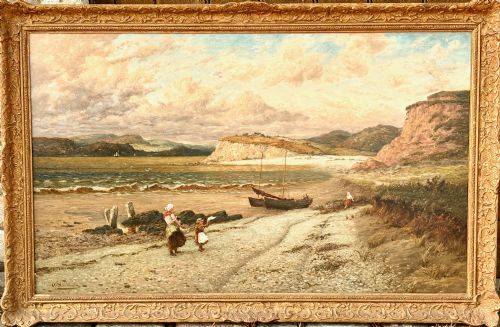
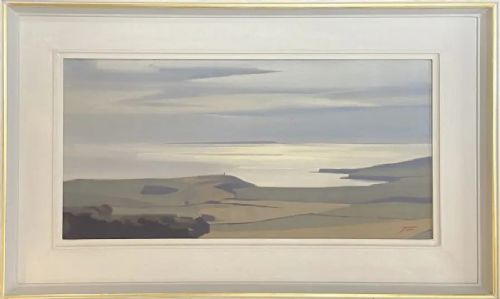
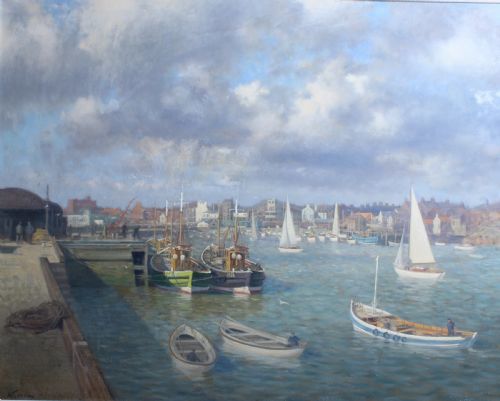
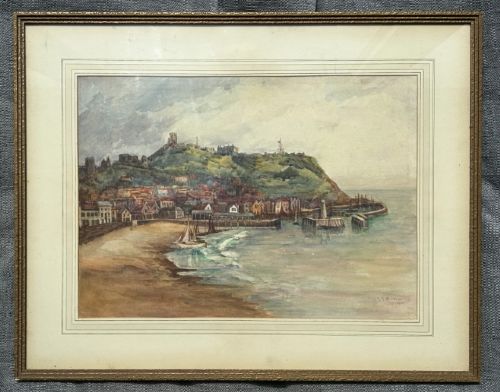
English coastal artwork comprises paintings and watercolours depicting the maritime heritage, fishing communities, and shores of Britain. These pieces record specific locations such as Whitby, St Ives, and Scarborough during periods ranging from the Victorian era through the mid-twentieth century.
The works most commonly encountered on this page are watercolours on paper and oil paintings on canvas or board. They capture harbours, estuaries, and cliffs through Victorian marine traditions and later British impressionist or modern interpretations.
Subjects frequently focus on working vessels, local luggers, and harbour life rather than purely idyllic views. Artists recorded the changing light on tidal mudflats, sandy bays, and stormy seas along the English coastline.
Materials and techniques
Artists employed watercolour pigment on paper for luminosity and directness, often capturing the transient effects of coastal weather. Oils on canvas or board allowed for heavier impasto applications, particularly in mid-twentieth century depictions of harbours and estuaries.
Supports varied according to the period and scale, ranging from heavy artist canvas and wood panels to card and watercolour paper. Pigments were applied with brushes and sometimes palette knives to build texture in stormy seas or sandy cliffs.
Listings feature works spanning the nineteenth century, Victorian era, and mid-twentieth century.
Distinctions in quality
Quality rests upon the artist's handling of light, atmosphere, and spatial depth rather than the mere identification of a named location. Superior examples demonstrate confident brushwork and an authentic sense of maritime scale, weather, and movement.
The relationship between the subject and the execution separates accomplished works from routine topographical views. Stronger paintings convey the specific character of the coast through assured draftsmanship and harmonious colour palettes.
James Orrock·William Banks Fortescue·Charles Napier Hemy·Thomas Bush Hardy·Lawrence Stephen Lowry
The English Coastal Artwork Glossary
- Watercolour
- A painting method where fine pigment is suspended in a water-soluble binder, traditionally applied to paper.
- Impasto
- Paint laid thickly on a surface so that brush or palette knife marks remain visible, adding physical texture to the artwork.
- Lugger
- A traditional small sailing vessel with one or more masts carrying lug sails, frequently seen in nineteenth-century maritime scenes.
- Estuary
- The tidal mouth of a large river, where the tide meets the stream, forming a distinct coastal subject for artists.
English Coastal Artwork: Frequently Asked Questions
What periods do these coastal paintings cover?
The works span from the nineteenth century through the Victorian era and into the mid-twentieth century.
Selections include early Victorian watercolours and post-war impressionist oil paintings of harbours.
Which mediums are most common?
Watercolour on paper and oil paint on canvas or board appear frequently across the collection.
Artists also utilised pen and ink alongside impasto oil techniques on wooden panels.
How were these coastal scenes used historically?
These artworks were created to document familiar British ports, fishing fleets, and seaside resorts for domestic interiors.
Many captured the working life of maritime communities before modern industrial changes altered the harbours.
How should I frame and display works on paper?
Watercolours require conservation framing behind glass with neutral mounts to protect the paper from ultraviolet light and humidity.
Keeping them away from direct sunlight preserves the original pigments and prevents fading.