35,313  PAGES BROWSED TODAY PAGES TODAY 155  ANTIQUES UPLOADED TODAY NEW ARRIVALS
ID #SA1226509
FOR SALE
£7,500
Email
Save
James Fry Kimmeridge Bay
Darnley Fine Art
Id #SA1226509
PDF SHARE
SAVE

James Fry Kimmeridge Bay

1940 - 1960
For Sale by Darnley Fine Art
Description

Oil on canvas, monogrammed bottom right, inscription and artist label on stretcher

Image size: 12 x 24 inches (30.5 x 61 cm)

Original frame

Provenance

Collection of Mrs Fairchild, London

Fry was a dedicated painter of the landscapes and coast of his native Dorset, where he regularly returned to the rugged beauty of the cliffs and pools on the coastline for inspiration for his paintings. Friends called Fry ‘the last of the English Impressionists’, because of his fascination with the play of sunshine and reflections of water. When they complained to him that he charged too little for his pictures, he replied, ‘I charge what I think is right. I couldn’t live with myself if I charged more’.
Fry moved from London to the Isle of Purbeck and lived in Corfe Castle from 1954, with a studio on East Street. The painting is a view of Kimmeridge Bay, famous for its fossils. To the left of the frame the dark structure is the four story Clavell Folly built in 1830 in the Tuscan style on the Hen Cliff. During the 19th century, it was used as a coastguard lookout, who secured the stays of their flagpole to four Napoleonic cannons.

This iconic Dorset landmark features in works by Thomas Hardy and P.D. James. Eliza Bright Nichol, the daughter of a Kimmeridge coastguard, was the first serious love of Thomas Hardy, who used an illustration of the tower as the frontispiece of his ‘Wessex Poems’ (1898). Clavell Tower was also the inspiration for P.D. James’ 1975 novel ‘The Black Tower’, and the setting in the 1985 six-part TV adaptation of the novel.

One could be forgiven for crediting Fry with a noticeable degree of artistic license as regards the slope of the land falling away to the right of the tower. However, one must factor in that coastal erosion has nibbled away at Hen Cliff since Fry painted it, increasing the angle of descent to the sea. As this erosion threatened the integrity of the tower, in 2006 the owners, The Landmark Trust, had the tower moved 82ft (25mts) further inland.

James Fry

James Fry was a British artist who worked in pastel, oils and photography. He was born in London and later studied at Watford School of Art under Arthur Scott. During World War II Fry was a committed conscientious objector who worked in forestry alongside the German and Italian prisoners of War.

Fry was later employed as a retoucher on the magazine ‘Picture Post’ and also designed neck ties for Liberty. In 1954, disenchanted with commercial life in London, he moved to Corfe Castle, in Dorset, where he set up his studio. He lived here with his wife Ivy as a committed environmentalist, teetotal, living frugally eating a vegetarian diet, shunning television, the telephone and newspapers. Based in Corfe Castle he would travel around the Purbeck hills on his bicycle carrying a camera loaded with colour transparency film, which he would later project to complete a painting on canvas.

When Ivy died, seven years after James, a collection of nearly 7,400 slides taken in and around the Purbecks were found, 295 of those being donated to The Dorset County Museum by a family member. It still holds several of his paintings and in 1999 included him in the published series ‘Dorset Worthies’.

We are grateful to Ken Guest for his help in identifying the painting and artist’s history.

Physical Dimensions
Height
30.5cm (12.01")
Width
61cm (24.02")
Declaration

Darnley Fine Art has dated this James Fry Landscape Painting to the 1950s.

Reference Numbers
Sellingantiques Reference
SA1226509
Description
Oil on canvas, monogrammed bottom right, inscription and artist label on stretcher

Image size: 12 x 24 inches (30.5 x 61 cm)

Original frame

Provenance

Collection of Mrs Fairchild, London

Fry was a dedicated painter of the landscapes and coast of his native Dorset, where he regularly returned to the rugged beauty of the cliffs and pools on the coastline for inspiration for his paintings.

Friends called Fry ‘the last of the English Impressionists’, because of his fascination with the play of sunshine and reflections of water.
Darnley Fine Art

When they complained to him that he charged too little for his pictures, he replied, ‘I charge what I think is right. I couldn’t live with myself if I charged more’.

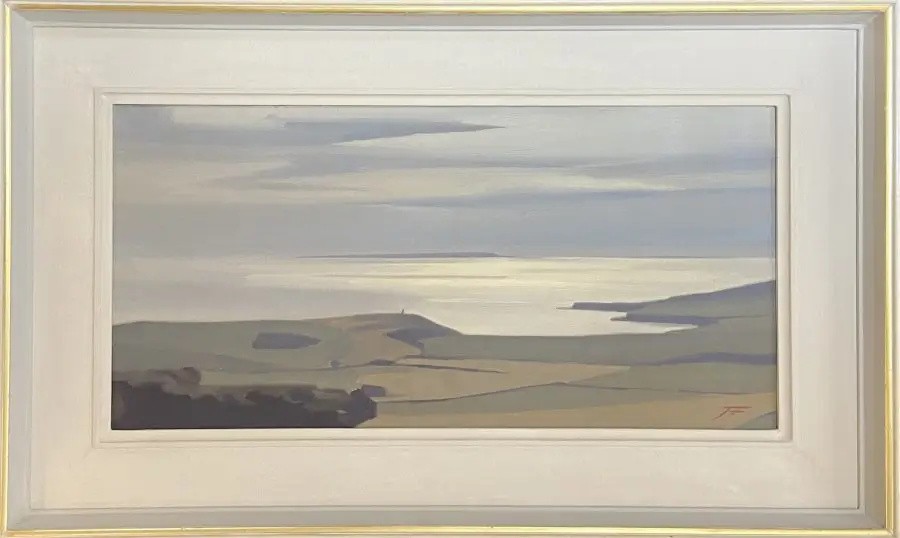
fig 1. A horizontal framed oil painting depicting Kimmeridge Bay with rolling muted green hills leading to a calm grey sea under an overcast sky.
fig 1. James Fry Kimmeridge Bay

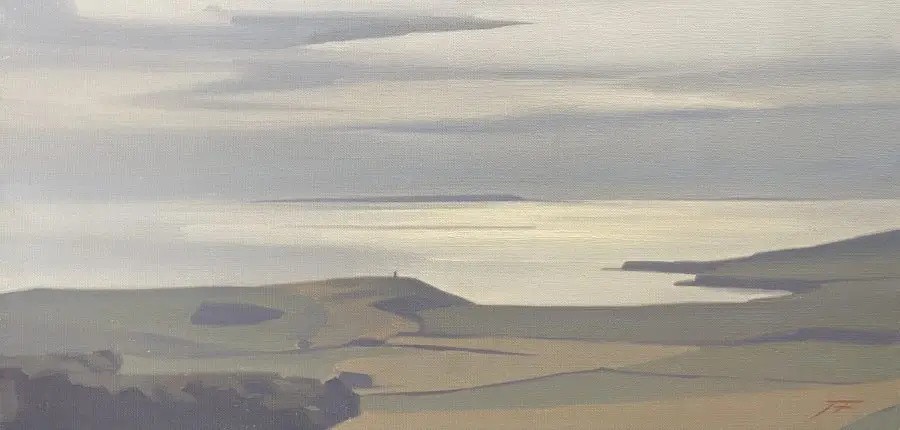
Fry moved from London to the Isle of Purbeck and lived in Corfe Castle from 1954, with a studio on East Street. The painting is a view of Kimmeridge Bay, famous for its fossils. To the left of the frame the dark structure is the four story Clavell Folly built in 1830 in the Tuscan style on the Hen Cliff. During the 19th century, it was used as a coastguard lookout, who secured the stays of their flagpole to four Napoleonic cannons.

This iconic Dorset landmark features in works by Thomas Hardy and P.D. James. Eliza Bright Nichol, the daughter of a Kimmeridge coastguard, was the first serious love of Thomas Hardy, who used an illustration of the tower as the frontispiece of his ‘Wessex Poems’ (1898). Clavell Tower was also the inspiration for P.D. James’ 1975 novel ‘The Black Tower’, and the setting in the 1985 six-part TV adaptation of the novel.

One could be forgiven for crediting Fry with a noticeable degree of artistic license as regards the slope of the land falling away to the right of the tower. However, one must factor in that coastal erosion has nibbled away at Hen Cliff since Fry painted it, increasing the angle of descent to the sea. As this erosion threatened the integrity of the tower, in 2006 the owners, The Landmark Trust, had the tower moved 82ft (25mts) further inland.

James Fry

James Fry was a British artist who worked in pastel, oils and photography. He was born in London and later studied at Watford School of Art under Arthur Scott. During World War II Fry was a committed conscientious objector who worked in forestry alongside the German and Italian prisoners of War.

Fry was later employed as a retoucher on the magazine ‘Picture Post’ and also designed neck ties for Liberty. In 1954, disenchanted with commercial life in London, he moved to Corfe Castle, in Dorset, where he set up his studio. He lived here with his wife Ivy as a committed environmentalist, teetotal, living frugally eating a vegetarian diet, shunning television, the telephone and newspapers. Based in Corfe Castle he would travel around the Purbeck hills on his bicycle carrying a camera loaded with colour transparency film, which he would later project to complete a painting on canvas.

When Ivy died, seven years after James, a collection of nearly 7,400 slides taken in and around the Purbecks were found, 295 of those being donated to The Dorset County Museum by a family member. It still holds several of his paintings and in 1999 included him in the published series ‘Dorset Worthies’.

We are grateful to Ken Guest for his help in identifying the painting and artist’s history.

Height
30.5cm (12.01")
Width
61cm (24.02")
Date of Manufacture

Darnley Fine Art has dated this James Fry Landscape Painting to the 1950s.

Reference Numbers
Sellingantiques Ref
SA1226509
Darnley Fine Art
Sellingantiques verified Since Jul 2026
Dealer Profile

You can view the stock and full dealer information on the Darnley Fine Art Profile Page
PDF SHARE
SAVE
A horizontal framed oil painting depicting Kimmeridge Bay with rolling muted green hills leading to a calm grey sea under an overcast sky.
1 / 2
Archive I A horizontal framed oil painting depicting Kimmeridge Bay with rolling muted green hills leading to a calm grey sea under an overcast sky.

James Fry Kimmeridge Bay

Archive II A horizontal framed oil painting depicting Kimmeridge Bay with rolling muted green hills leading to a calm grey sea under an overcast sky. View II
Enlarged Archival View
Telephone 0207 379 0499
Location
2-4 Cecil Court
London
WC2N 4HE
United Kingdom

Opening Times
Monday to Saturday: 10:30 - 5:30
(excluding Bank Holidays)
Dealer Profile Page sellingantiques.co.uk/dfa
Verified Since Jul 2026
Items For Sale 76
Darnley Fine Art
Verified Since Jul 2026
View Dealer Info
Location: 2-4 Cecil Court, London, WC2N 4HE, United Kingdom, , Opening Times, Monday to Saturday: 10:30 - 5:30, (excluding Bank Holidays)
Verified
Jul 2026
For Sale
76
A horizontal framed oil painting depicting Kimmeridge Bay with rolling muted green hills leading to a calm grey sea under an overcast sky.
James Fry Kimmeridge Bay
Ref: SA1226509
A horizontal framed oil painting depicting Kimmeridge Bay with rolling muted green hills leading to a calm grey sea under an overcast sky.
Detail View 1
Archival Detail
Every single antique dealer on our platform is individually approved by our internal team. We verify their professional trade history, ethical standards, and photographic quality to ensure a secure, high-standard buying environment. Upon joining, every dealer agrees to a strict 9-point code of conduct. While issues can occasionally arise, our dealers typically resolve them swiftly and directly with the buyer. In fact, since our founding in 2002, Sellingantiques has only had to step in to help resolve an issue on roughly five occasions—a true testament to the quality of our dealers and their dedication to your happiness.
Our dealers are highly experienced in packing and shipping fragile, high-value antiques. Because you are in direct contact with the dealer, you will be able to easily go through all available shipping and insurance options together to ensure your item arrives safely.
Antiques are the ultimate green purchase. By choosing historical pieces over newly manufactured goods, you completely eliminate the carbon footprint of modern mass production while preserving exceptional, timeless craftsmanship.

Modern British landscape painting features simplified forms, muted colour palettes, and a focus on atmospheric lighting, capturing the topography of the British coastline and countryside during the mid to late twentieth century.

These artworks generally feature oil paint applied to canvas or hardboard, housed within layered wooden frames that frequently incorporate painted slips and subtle gilded highlights.

Authentic works usually bear the artist signature in the lower corner, display characteristic tonal brushwork in muted earth tones, and frequently retain original framing or gallery inscriptions on the reverse.

Position the horizontal artwork as a focal point above a sideboard, console table, or fireplace, pairing it with neutral textiles and natural timber furniture to accentuate the landscape tones.

Display the painting away from direct sunlight, heat sources, and high humidity to prevent board movement, and dust the frame lightly with a clean, dry microfibre cloth.
items
Add keywords to the filter
Price
£100
£250000
Era
Movements
Material
Origin
Stock Location
Freshness
Online Payments
Categories