


English Chinoiserie Table
An english chinoiserie table brings painted landscapes and gilded motifs into a room, offering both surface utility and decorative presence.
English Chinoiserie Table
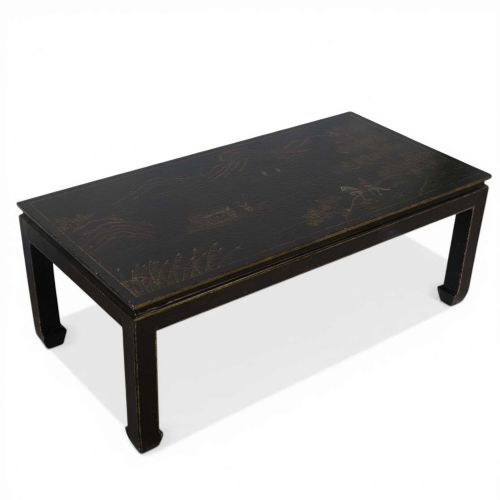
An english chinoiserie table encompasses forms such as side tables, coffee tables, tray tables, and occasional pieces decorated with orientalist painted scenes. These works emerge across various periods including the 18th century, the Regency era, and the Victorian epoch.
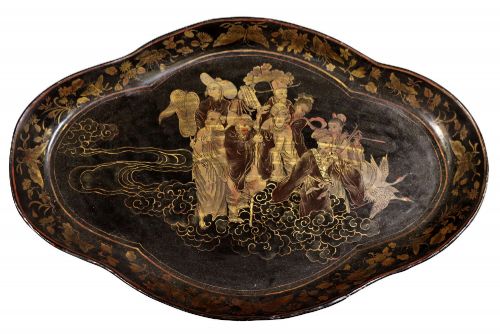
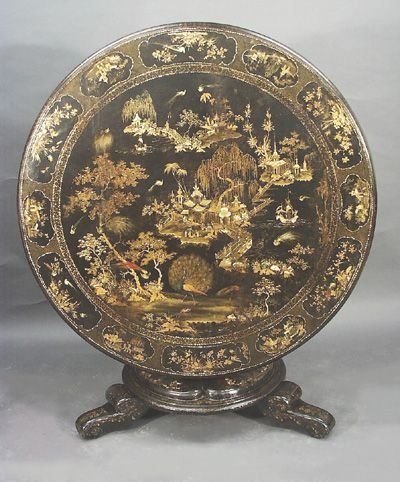
The most common examples on this page are low tables, tray tables on stands, and side pieces featuring dark lacquer or ebonised finishes. Makers drew inspiration from Asian export goods, adapting traditional motifs onto native forms like bamboo-turned legs or folding supports.
Earlier examples display Georgian Rococo or Sheraton proportions, while later Victorian and 20th-century pieces utilise papier-mâché or simpler wood constructions. Each iteration demonstrates how British cabinetmakers reinterpreted foreign aesthetic traditions for domestic parlours and drawing rooms.
Materials and Construction Methods
Makers utilised wood, papier-mâché, and bamboo as primary structural bases, applying multiple layers of lacquer to achieve deep, lustrous surfaces. Lacquered finishes provided a durable ground for intricate decorative schemes.
Artisans applied gold leaf and gilt paint by hand to render figures, pavilions, and botanical details across the table tops. Brass fittings, occasional ironstone elements, and original paint further defined the construction of these decorative items.
Some tables even managed to double as tea trays, proving that 19th-century hosts took multitasking very seriously indeed.
Judging Quality in Chinoiserie Tables
The distinction between tiers rests upon the precision of the painted decoration and the depth of the lacquer work. Master hands achieved subtle shading and fine linework in gold leaf, whereas lesser pieces rely on crude stencils or flat applications.
Structural integrity also separates examples, seen in the stability of folding mechanisms, the condition of ebonised surfaces, and the survival of original paint such as ochre grounds. Pieces retaining their untouched decorative schemes command greater regard among collectors.
James Smith·Hicks and Meigh·Miles Mason
The English Chinoiserie Table Glossary
- Chinoiserie
- European decorative art influenced by Chinese and East Asian artistic traditions. This style manifested in painted landscapes, figures in traditional costume, and architectural motifs.
- Japanning
- A European imitation of East Asian lacquerwork involving layered varnishes and heat-cured finishes. The technique produced hard, dark surfaces suited to gold decoration.
- Papier-mâché
- A composite material made from paper pulp or reinforced paper sheets mixed with glue and resin. Pressed into moulds, it created lightweight yet resilient tabletops.
- Faux bamboo
- Wood turned and carved to resemble natural bamboo stalks. This detail appeared frequently on Regency and Victorian furniture.
- Sutherland table
- A narrow drop-leaf table with hinged flaps supported by swinging legs. The design allowed the piece to fold flat for storage.
English Chinoiserie Table: Frequently Asked Questions
What is an english chinoiserie table?
An english chinoiserie table is a piece of furniture decorated with European interpretations of East Asian art, typically featuring painted figures, pagodas, and landscapes.
These items range from formal 18th-century side tables to Victorian papier-mâché tray tables and later coffee tables.
How do I date an antique chinoiserie table?
Dating relies on examining the underlying furniture form, the construction techniques, and the materials used in the base. Georgian pieces show classical proportions, while Victorian examples often utilise ebonised wood or papier-mâché.
Paint analysis and hardware styles also help narrow down the period of manufacture.
Where were these tables used?
These tables served primarily in drawing rooms, parlours, and reception spaces as decorative surfaces for tea service or display.
Smaller folding or tray versions allowed for movable utility within domestic interiors.
How should I care for lacquered surfaces?
Lacquered and painted surfaces require gentle dusting with a soft, dry cloth to prevent scratching the delicate finish. Avoid exposure to direct sunlight and excessive moisture to protect the gold leaf and varnish.
Wax polishes should be used sparingly and only if compatible with the historic finish.