


Enamel Dressing Jar
An enamel dressing jar brings refined colour and tactile weight to a dressing table, combining precious metals with vitreous glass coatings.
Enamel Dressing Jar
An enamel dressing jar is a utilitarian container designed for powders, pins, or unguents on a nineteenth or twentieth-century dressing table. The items on this page span from Victorian and Edwardian examples to Art Deco and mid-century pieces, reflecting changing tastes in personal grooming accessories.
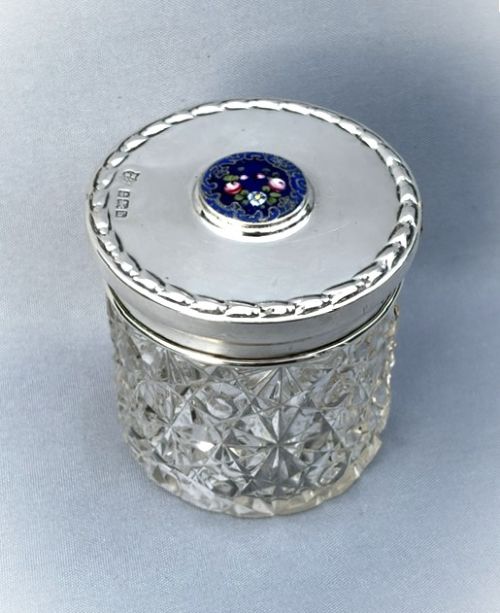
The most common form met here pairs a sterling silver lid, often decorated with translucent enamel, with a heavy glass, cut glass, or porcelain base. Collectors encounter everything from small trinket pots and scent bottles to larger dressing table bowls and matched sets.
Origins range across English workshops in Birmingham, Chester, and London alongside nineteenth-century French pieces mounted in ormolu. These containers survived because they served as decorative dressing room ornaments as well as practical storage.
How they were made
Craftsmen shaped the bodies from blown glass, cut glass, Bristol blue glass, cranberry glass, or porcelain, often adding detailed acid-etched or wheel-cut patterns. These glass and ceramic foundations provide the heavy weight expected of quality vanity items.
Lids and mounts utilise sterling silver, sometimes gilded, which was stamped, cast, or pierced by silversmiths. Assay office hallmarks stamped into the metal reveal the exact year of manufacture and the city of origin.
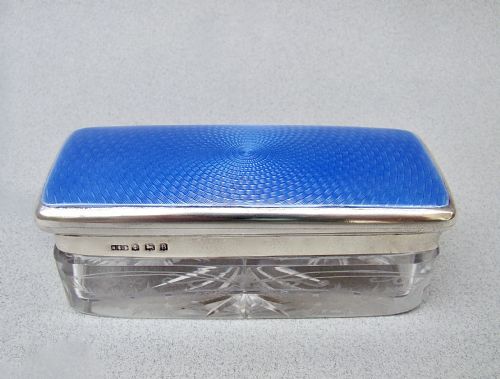
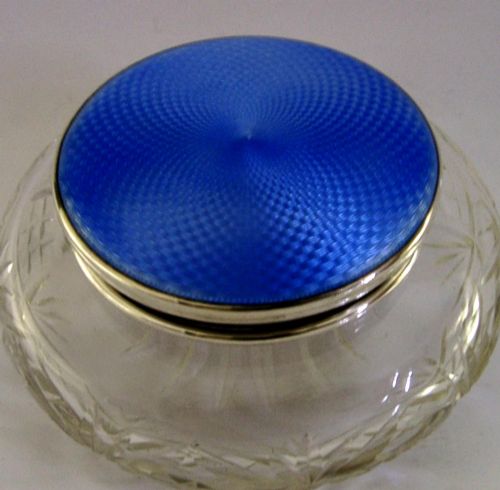
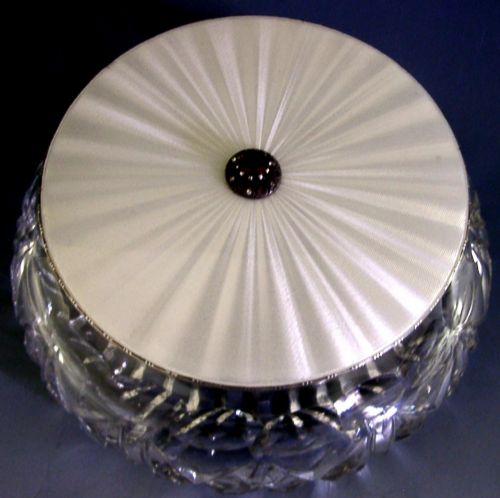
Enamel surfaces incorporate vitreous paste fused to the metal under high heat. Many twentieth-century examples display guilloché work, where precise geometric engine-turning beneath translucent enamel creates a shimmering pattern.
Some Edwardian lids hide a tiny mirror tucked underneath, designed for surreptitious powder checks between dances.
What varies in quality
Quality rests upon the crispness of the engine-turning beneath the enamel and the clarity of the colour itself. Deeper, evenly saturated translucency combined with complex guilloché patterns separates superior pieces from plain, flat enamel surfaces.
The weight and thickness of the glass base also determine grade. Cut glass with deep, sharp faceting indicates higher production standards than thin, moulded glass alternatives.
The presence of a known silversmith mark elevates a piece, as does the survival of matching sets or complicated dual-colour enamel schemes. Integration between the silver collar and the glass container shows precision in assembly.
Henry Clifford Davis·James Deakin & Sons·Henry Matthews·The Adie Brothers·W. Neale·Mappin & Webb·Deakin & Francis·W.G. Sothers·Goldsmith's and Silversmith's Co.
The Enamel Dressing Jar Glossary
- Guilloche Enamel
- A decorative technique involving mechanical engraving beneath translucent enamel. The underlying pattern creates shifting reflections as the light changes.
- Sterling Silver
- An alloy of silver containing ninety-two point five percent pure silver and seven point five percent other metals. Most English lids and mounts carry hallmarks confirming this standard.
- Ormolu
- Gilded bronze or brass mounts used extensively on nineteenth-century French pieces. It provides a warm, golden contrast to coloured glass bodies.
- Bristol Blue
- A deep, vibrant blue glass produced in England during the eighteenth and nineteenth centuries. It remains a prized material for vanity containers.
- Hallmark
- Official marks stamped into silver components indicating the maker, assay office, and year of production. They allow precise dating of English dressing items.
Enamel Dressing Jar: Frequently Asked Questions
How were enamel dressing jars used?
These vessels held face powders, hair pins, cream, or perfume on nineteenth and twentieth-century dressing tables. They kept personal items tidy while adding decorative colour to the room.
Many doubled as trinket boxes for rings and brooches at the end of the day. Their decorative lids made them suitable to leave permanently on display.
How do I date an enamel dressing jar?
Silver mounts carry hallmarks that indicate the assay office, date letter, and maker. English pieces from Birmingham, Chester, and London can be dated precisely through these stamps.
Unmarked pieces rely on stylistic clues such as French ormolu mounts, Victorian glass colours, or geometric Art Deco guilloché patterns.
How do I clean enamel dressing jars?
Use a soft, dry cloth to remove dust from the glass and enamel surfaces. Avoid harsh abrasives or liquid cleaners that might seep under the silver bezel.
Silver mounts respond gently to traditional polishing cloths, keeping the metal bright without touching the vitreous enamel.
What glass types are most common?
Clear cut glass appears frequently in twentieth-century pieces, catching the light beneath translucent enamel lids. Coloured options include Bristol blue, cranberry, green, and amber glass.
Some nineteenth-century examples utilise porcelain or opaque white glass painted with delicate floral designs.