

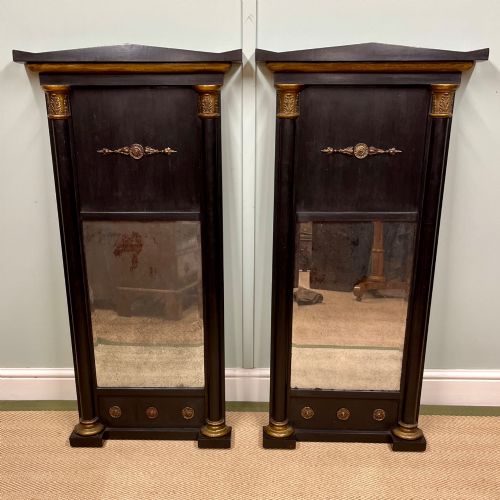


Empire Style Pier Mirror
An empire style pier mirror brings grand architectural symmetry and classical proportions to a room.
Empire Style Pier Mirror
An empire style pier mirror sits traditionally between two windows on a pier wall, often positioned above a matching console table or cabinet. These vertical wall glasses reflect light deep into a room while anchoring the interior scheme with monumental presence.
The pieces appearing here span from the early nineteenth century through to later revival periods, originating from French, Swedish, Danish, and Italian workshops. Mahogany and figured woods form the structural backbone of these designs, frequently contrasted with rich gilding and ebonised details.
How they were made
Cabinetmakers utilised dense timbers like mahogany and walnut to construct the primary frames, often applying finely figured veneers over solid carcases. Ebonised wood and applied gesso ornamentation provided sharp tonal contrast against warm wood grains.
Gilding and ormolu mounts bring the characteristic metallic brilliance to these frames, requiring skilled metal casting and leaf application. Hand-silvered glass plates reflect the surrounding interior, housed securely within robust wooden rebates.
Some tall mirrors stretch to eight feet, requiring sturdy walls and ambitious delivery logistics.
What varies in quality
The depth and crispness of the applied gesso and carved detail separate standard production from superior pieces. Crisp definition in floral or classical motifs indicates a hand-worked surface rather than a hurried cast.
Timber selection and veneer matching dictate the visual harmony of the frame. Superior examples display carefully chosen wood grain that flows naturally around the vertical proportions of the mirror.
The Empire Style Pier Mirror Glossary
- Pier glass
- A tall wall mirror designed specifically to hang on the narrow wall space between windows. It frequently matches a console table placed directly beneath it.
- Giltwood
- Timber that has been coated with a thin layer of gold leaf over a prepared base of gesso and size. This technique creates a luminous, warm metallic finish.
- Ormolu
- Gilded bronze mounts applied to furniture and mirror frames for decorative accent. The technique involves a mercury amalgam process used extensively in the nineteenth century.
- Ebonised wood
- Timber treated with a dark stain or finish to imitate ebony. This process provides a striking black contrast against gilt elements and warm mahogany.
- Trumeau
- A decorative wall mirror featuring an upper painted or carved panel above the glass plate. These panels often depict classical scenes or pastoral landscapes.
Empire Style Pier Mirror: Frequently Asked Questions
Where should I hang a pier mirror?
These vertical glasses suit narrow wall spaces between windows or above low console tables and cabinets.
Positioning them opposite a window maximises natural light reflection across the room.
How do I distinguish regional styles?
French examples often feature rich ormolu mounts and architectural trumeau panels.
Swedish and Danish pieces tend to favour clean mahogany grains paired with restrained gilded highlights.
Did these mirrors have tables?
Many pier mirrors were designed to sit directly above matching marble-topped console tables.
The vertical glass and the table beneath formed a unified architectural unit for the room.
What is ebonised wood?
Ebonised wood is timber treated to achieve a dense, glossy black finish resembling ebony.
Craftsmen used this dark treatment to create sharp visual contrast against giltwood and bronze mounts.