




Empire Style Centre Table
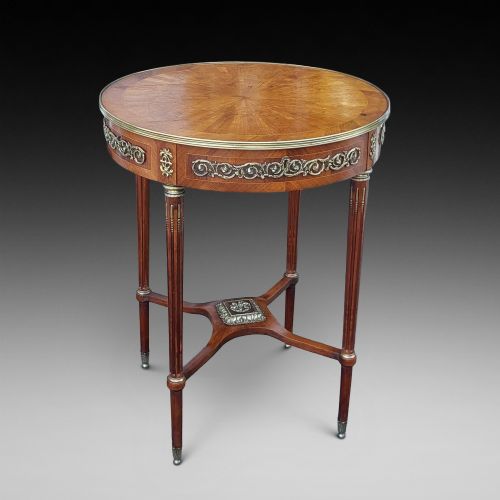
An empire style centre table anchors a room with classical dignity, offering a striking circular or oval surface supported by substantial pedestals.
Empire Style Centre Table
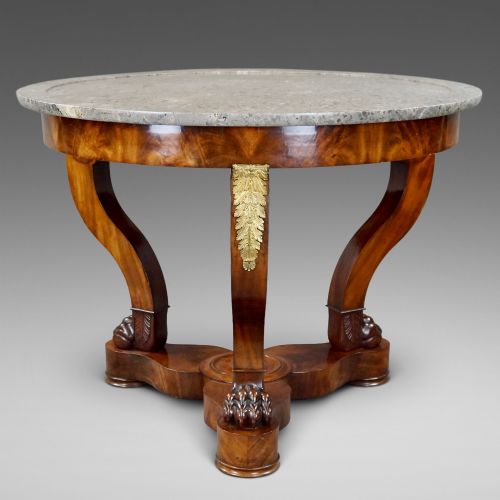
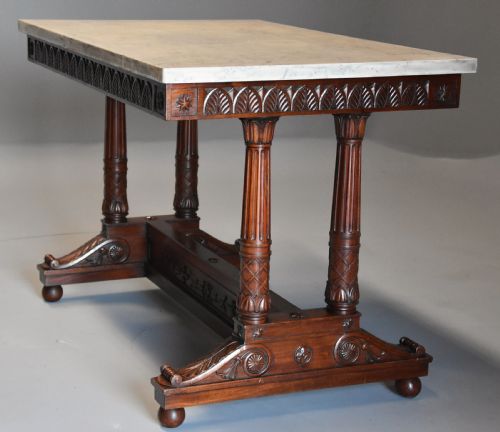
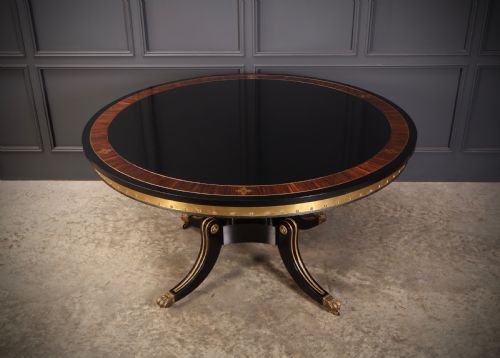
An empire style centre table serves as a dramatic freestanding focal point in a principal room, historically designed to sit in the middle of a chamber rather than against a wall. These pieces frequently manifest as round guéridons or pedestal tables, often topped with heavy stone and supported by architectural columns or figurative mounts.
Buyers browsing this selection encounter numerous examples originating from the nineteenth century alongside later revivals, predominantly reflecting French and Scandinavian neoclassical design aesthetics. Mahogany, walnut, and kingwood dominate the framework, frequently paired with contrasting marble surfaces in white, black, or porphyry tones.
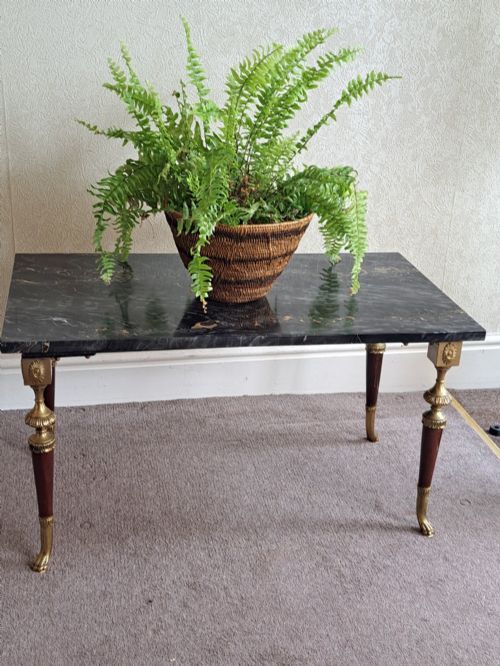
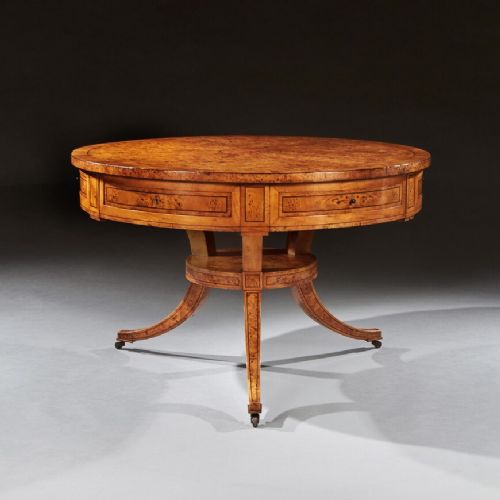
Alternative forms appearing within the category include occasional, coffee, drum, and sofa tables, demonstrating how the classic vocabulary adapted for diverse domestic settings over subsequent decades.
How they were made
Cabinetmakers constructed these tables using dense hardwoods like mahogany and walnut as a stable carcass, often applying figured veneers such as burr root maple or kingwood to create rich surface patterns. Structural integrity relied on solid timber pedestals, frequently taking the form of central columns or tripod bases designed to bear the considerable weight of inset stone slabs.
Decorative enrichment involved meticulous metalwork and surface finishing, utilising cast or chased ormolu, gilt bronze, brass inlay, and parcel-gilding to accentuate structural lines. Artisans also integrated carved figural elements, including swans, rams' heads, and dolphins, directly into the wooden framework or metal mounts.
Empire Style Centre Table Retail Price Guide 2026
Typical asking prices for empire style centre table among the pieces listed under this phrase on Sellingantiques today, from the lower quarter to the upper quarter. They describe what is for sale here now, not the wider market.
Carved wooden swans and gilded dolphins frequently peer out from beneath marble table tops, serving as silent aquatic guardians of the parlour.
What varies in quality
The sophistication of the cast bronze or ormolu mounts largely dictates the tier of craftsmanship, where sharply detailed, fire-gilded elements separate superior workshop output from simpler cast brass alternatives. Natural materials also introduce significant variation, particularly in the selection of marble tops with complex veining and the choice of heavily figured wood veneers.
JACOB·Linke
The Empire Style Centre Table Glossary
- Gueridon
- A small round freestanding table, typically supported by a central column or pedestal. This French form frequently incorporates a marble top and featured prominently in nineteenth-century interiors.
- Ormolu
- Finely chased and gilt bronze used for decorative mounts and furniture trim. The technique involves applying a gold amalgam to a bronze base before heating.
- Porphyry
- An extremely hard igneous rock characterised by distinct purple or red crystals embedded in a fine-grained groundmass. It was highly prized for luxury table tops.
- Parquetry
- Geometric wood-mosaic work used for surfacing tabletops. Artisans arranged contrasting veneers in repeating patterns like checkerboards or cubes.
- Drum table
- A circular library table with a deep top resembling a drum body, usually fitted with drawers around the perimeter. These pieces often stand on a single turned pillar above splayed legs.
Empire Style Centre Table: Frequently Asked Questions
Where should an empire style centre table go?
These pieces function best as freestanding objects placed in the middle of a generous hallway, reception room, or library where people can walk around them. Because they were historically built to be viewed from all sides, placing them away from walls allows the pedestal base and mount details to be fully appreciated.
Pairing the table with a central ceiling fixture or a hanging chandelier enhances its visual weight. Ensure adequate clearance around the perimeter to maintain smooth traffic flow in the room.
How do I care for a marble top?
Marble surfaces require gentle cleaning using a soft cloth dampened with warm water and mild, neutral soap. Avoid acidic cleaners, vinegar, or harsh chemicals that can etch the polished stone finish.
Using coasters under glasses and placing protective pads under decorative objects helps prevent scratches and ring marks. Periodic sealing provides additional protection against accidental spills.
What is the difference between a guéridon and a centre table?
A guéridon specifically denotes a small, round, pedestal-supported table of French origin. While all guéridons function as centre tables, a broader centre table category also encompasses rectangular, oval, drum, and sofa table shapes.
Guéridons typically emphasise vertical presence through a central column, whereas other centre table forms may utilise four legs or complex trestle supports.
How do I distinguish nineteenth century pieces from later revivals?
Examining the construction methods, timber ageing, and secondary woods inside drawers or underneath tabletops reveals clues about a piece's era. Nineteenth-century examples often exhibit hand-cut joinery and aged patina consistent with early manufacturing techniques.
Later revival pieces from the twentieth century may show machine-standardised fixings, modern adhesives, or timber conditioning characteristic of twentieth-century workshops.