
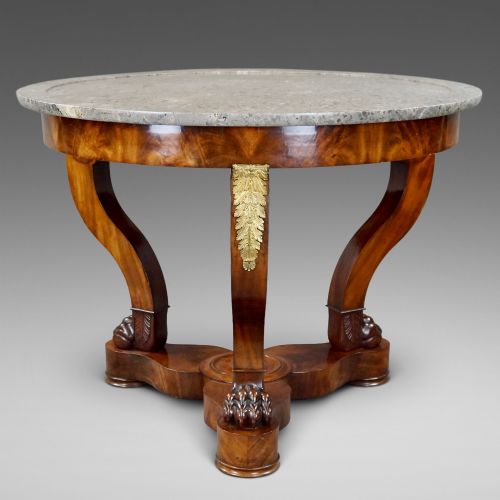


Grey Marble Gueridon
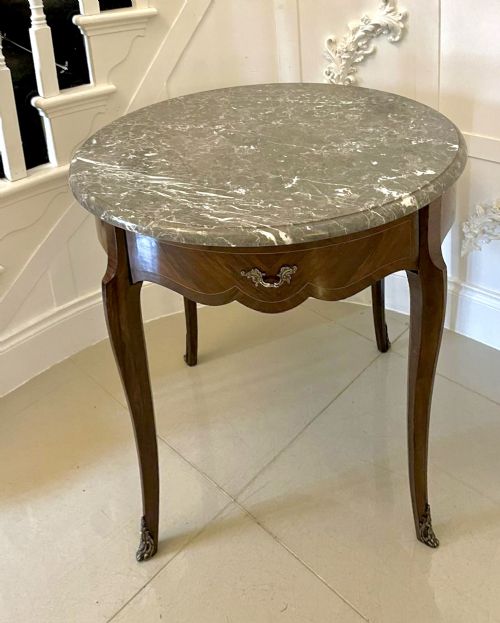
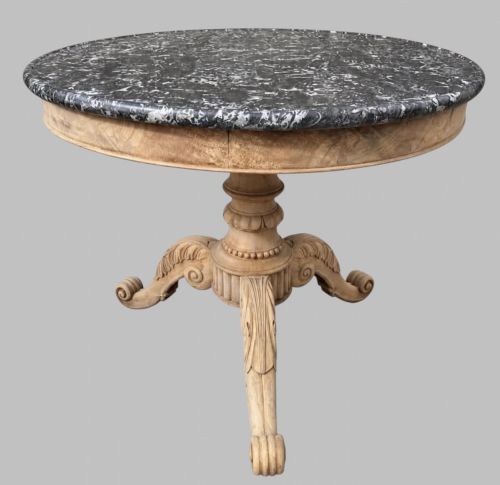
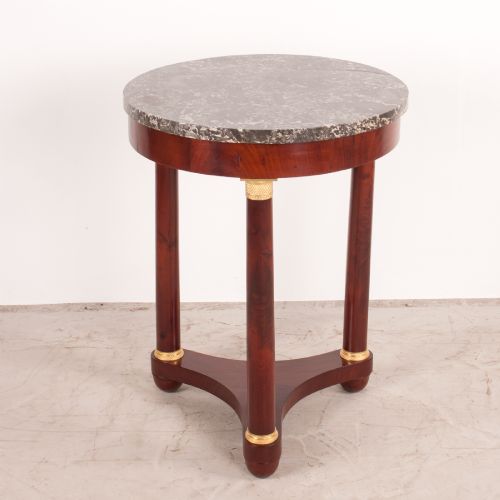
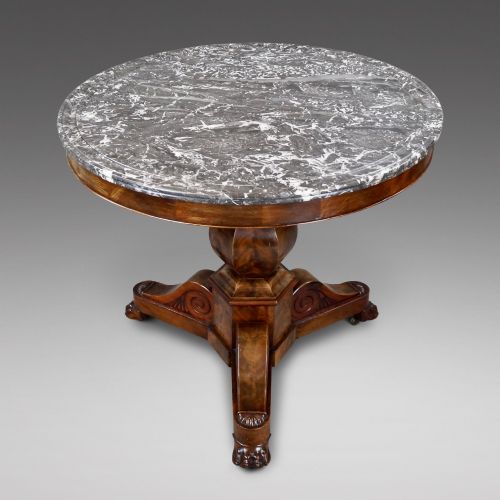
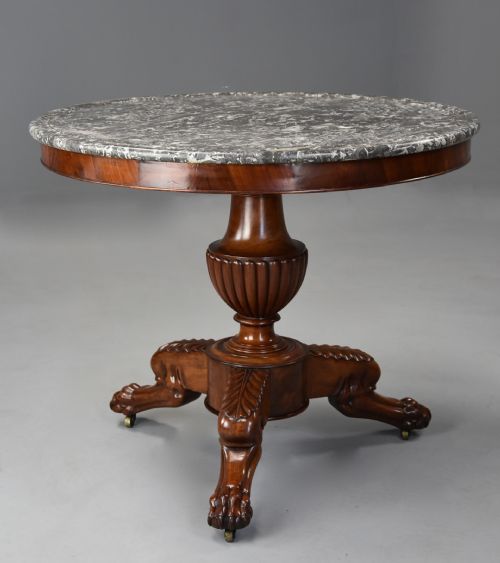
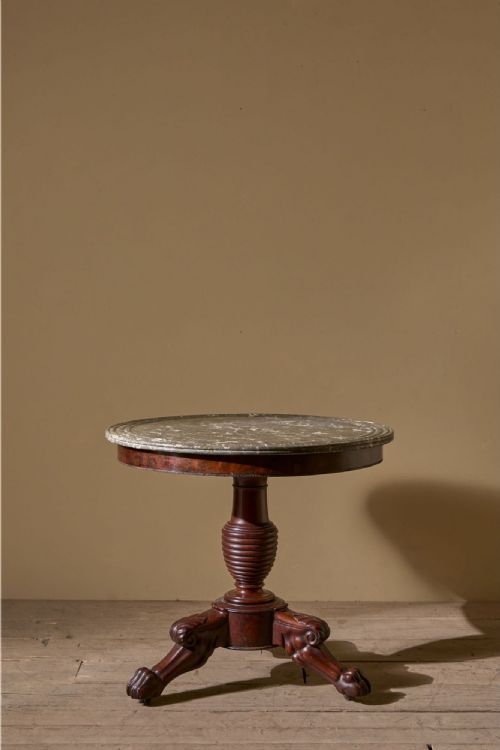
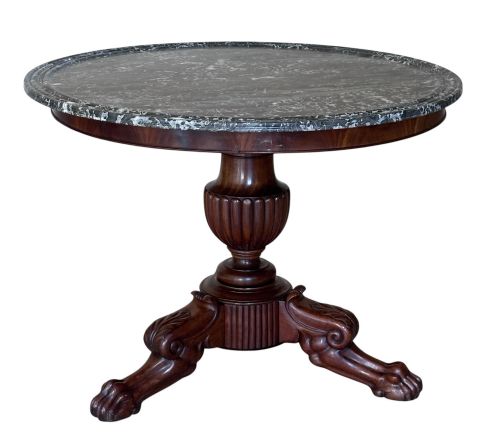
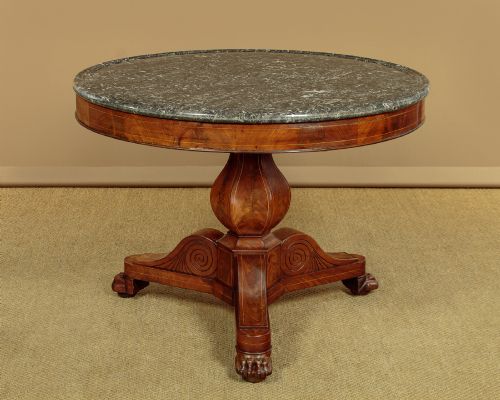
A grey marble gueridon brings neoclassical French elegance to a room, serving as a striking centre table with a solid stone top.
Grey Marble Gueridon
When you search for a grey marble gueridon, you are looking at round or occasionally octagonal pedestal tables originating primarily from nineteenth-century France. These pieces function as centre tables, occasional tables, or lamp tables, supported by a central column and tripod base.
The versions you will most commonly meet on this page date from the Victorian era and the middle decades of the nineteenth century. They combine French Empire, Louis Philippe, and Restauration styles with domestic English Victorian interpretations.
Makers and workshops of the period utilised timber and stone to create freestanding items suited for drawing rooms and reception spaces. The primary form remains consistent, featuring a heavy stone slab inset into or resting upon a timber frame.
How they were made
Cabinet makers built the structural frames using dense timbers such as mahogany, walnut, and kingwood, frequently applying flame mahogany veneers over a softer wood core. These timbers were shaped into columnar pedestals and curved tripod legs, often incorporating brass, ormolu, or gilt-bronze mounts.
The defining feature is the inset grey marble top, selected for its natural veining and polished to a smooth finish. Stone masons cut and polished these marble slabs to fit precisely within the wooden rims or to sit flat upon the structural aprons.
Some nineteenth-century tables arrive with stubborn ink stains tucked beneath the marble edge, left by a long-dead writer who forgot to use blotting paper.
What varies in quality
The distinction between standard examples and the finest work lies in the selection of materials and the crispness of the carving. Superior tables employ highly figured flame mahogany or rich walnut alongside heavy, finely chased gilt-bronze mounts rather than plain brass.
Construction methods also dictate quality, visible in the stability of the central pedestal joint and the precision with which the marble top fits the wooden frame. Tables produced by documented Parisian workshops display greater refinement in the turning of the timber and the polish of the stone.
Zwiener Jansen Sucesseur
The Grey Marble Gueridon Glossary
- Gueridon
- A small circular table on a central pillar, originating in France during the seventeenth century. These tables evolved from candle stands into general-purpose centre and occasional furniture.
- Ormolu
- Gilded bronze used for decorative mounts and accents on nineteenth-century furniture. The technique involves applying a gold amalgam to bronze before heating.
- Restauration
- A French design period spanning the early decades of the nineteenth century, characterised by restrained neoclassical lines and dark veneers. Pieces from this era often favour architectural simplicity over heavy ornamentation.
- Flame mahogany
- Mahogany timber cut at the junction where a branch meets the main trunk, producing a distinctive fire-like grain pattern. Cabinet makers used this veneer on prominent surfaces to create visual movement.
Grey Marble Gueridon: Frequently Asked Questions
How were gueridon tables used?
These tables served primarily as decorative centre pieces in grand reception rooms and parlours, often holding lamps, vases, or books. Their freestanding design allowed placement in the middle of a room rather than against a wall.
In domestic settings, they functioned as versatile occasional tables for tea service or displaying ornaments. The sturdy stone top provided a stable, heat-resistant surface for various daily tasks.
How do I identify a French empire gueridon?
French Empire examples typically feature architectural forms with heavy mahogany columns, patinated bronze mounts, and sometimes figural supports like rams' heads. The aesthetic draws heavily on classical Greek and Roman motifs.
These pieces often display a strong symmetry and an imposing presence, reflecting the imperial taste of the early nineteenth century. The timber choice is predominantly dark mahogany with minimal superfluous carving.
Are marble top tables fragile?
While the marble slabs are heavy and durable, the stone can chip along the edges if struck hard by heavy objects. The underlying wooden pedestals require careful handling to maintain structural stability.
Normal daily use presents little risk to the stone, provided the table is lifted rather than dragged when moved. Periodic waxing of the timber frame helps preserve the wood surrounding the marble insert.
What is the difference between a centre table and an occasional table?
Centre tables are traditionally finished on all sides and designed to stand in the middle of a room as a focal point. They tend to be larger and heavier than typical side or occasional tables.
Occasional tables are smaller, more portable pieces intended for specific, temporary uses around the home. However, nineteenth-century nomenclature often used these terms interchangeably for gueridon forms.