
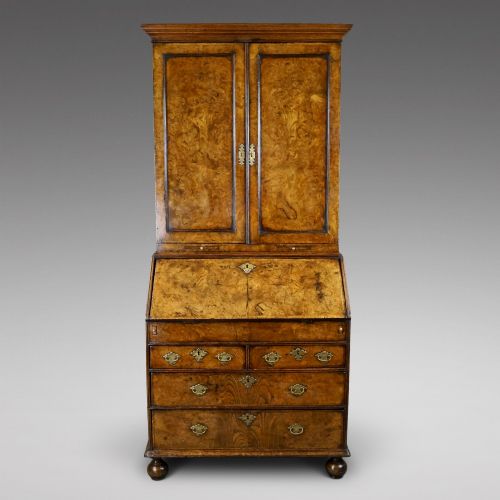


Elm Slant Front Desk
An elm slant front desk offers rich native grain and a practical fall-front writing surface grounded in seventeenth, eighteenth and early twentieth century traditions.
Elm Slant Front Desk
An elm slant front desk provides a dedicated writing surface that drops down to reveal internal compartments, pigeonholes and small drawers. These pieces range from substantial bureau bookcases down to compact tabletop desks and child-sized variants.
The selections here span centuries of British and international cabinet making, moving from seventeenth century William and Mary forms through Georgian masterworks to early twentieth century revivals. Elm and burr elm frequently appear alongside supporting timbers like oak, walnut and yew.
Georgian and eighteenth century examples form the core of what is available, showing the characteristic fitted interiors and patinated timber surfaces prized by collectors. Buyers encounter everything from provincial clerks desks to high-status Anglo-Indian and Queen Anne style creations.
How they were made
Cabinet makers utilised solid elm and figured burr elm veneers over secondary woods, laying down timber grain patterns that catch the light across the fall-front flap. The natural twisting and figuring of elm required great skill from the joiner to stabilise and plane.
Brass hardware such as escutcheons, hinges and drawer pulls complete the construction, often original to the piece to secure the writing flap and internal drawers. Structural rigidity came from traditional jointing methods handed down through generations of workshop practice.
Current selections demonstrate that elm is frequently paired with contrasting timbers like oak, walnut and yew across Georgian and early twentieth century periods.
What varies in quality
The desirability of an elm slant front desk rests upon the liveliness of the timber grain, particularly where burr elm or contrasting walnut and yew veneers are deployed. Rich surface patination achieved through decades of wax polishing elevates an example far above dull or heavily stripped timber.
Internal complexity dictates the upper tiers of quality, where fitted pigeonholes, secret compartments and well-proportioned small drawers demonstrate the cabinet maker's ambition. Scale also plays its part, with smaller child desks and bureau bookcases commanding distinct attention for their proportion.
The Elm Slant Front Desk Glossary
- Bureau
- A writing desk featuring a sloping hinged lid that opens to form a desk surface and encloses compartments. This term is frequently used interchangeably with desk in older British cabinet making.
- Slant Front
- The angled writing flap characteristic of these desks that folds down for use and locks vertically when closed to conceal the interior. It serves as the primary visual and functional feature of the form.
- Escutcheon
- A protective plate surrounding the keyhole of a drawer or fall-front, usually cast in brass and styled to match the period aesthetic. Georgian examples often feature delicate pierced brass designs.
- Pigeonhole
- A small, open compartment fitted within the interior of the desk to sort papers, letters and writing materials. These internal nests often feature tiny secret drawers hidden beneath.
Elm Slant Front Desk: Frequently Asked Questions
How do I date an elm bureau?
Dating an elm bureau involves examining the construction methods of the internal drawers, the profile of the mouldings and the style of the brass hardware. Seventeenth century pieces often display William and Mary proportions, while eighteenth century Georgian examples feature refined bracket feet and fitted pigeonholes.
Later revival pieces from the early twentieth century mimic these earlier styles but typically reveal machine-cut elements and modern timber seasoning. Comparing the secondary woods, such as oak or walnut used inside, further clarifies the period of manufacture.
Were these desks used standing or sitting?
Most domestic bureaus were designed to be used while sitting on a chair, paired with the sloping front to provide a comfortable writing angle. Clerks desks and certain provincial variants were sometimes built taller to accommodate standing work in offices and counting houses.
The height of the writing flap determines the correct seating posture, with smaller child-sized desks and tabletop versions offering alternative scales for specific spaces.
How do I care for antique elm furniture?
Care for antique elm requires maintaining a stable indoor humidity and avoiding direct sunlight that can dry out and fade the timber. Regular dusting with a soft cloth keeps the surface clean without abrasive chemical interference.
Applying a traditional beeswax polish occasionally nourishes the historic grain and preserves the warm patination built up over centuries. Avoid placing these desks near heat sources to prevent the elm from splitting or warping.