





Edwardian Snooker Scoreboard
These edwardian snooker scoreboard pieces are timber wall-mounting tallies that keep a proper count during a quiet evening frame.
Edwardian Snooker Scoreboard
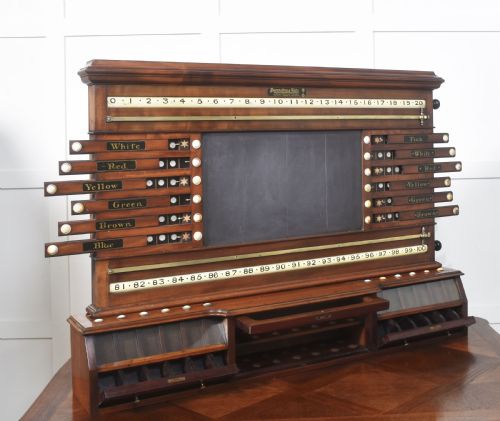
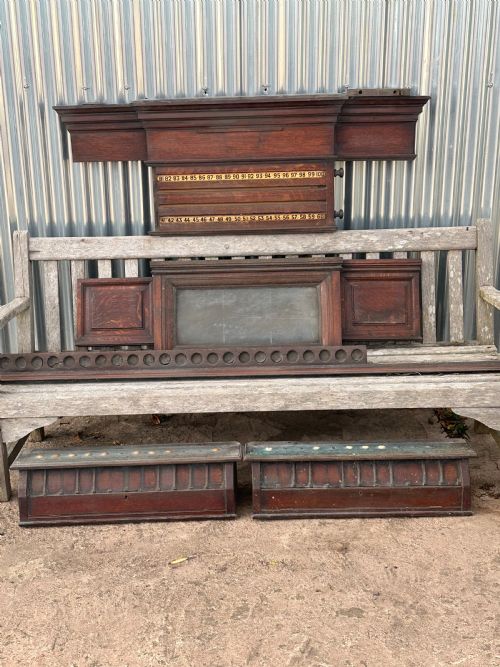
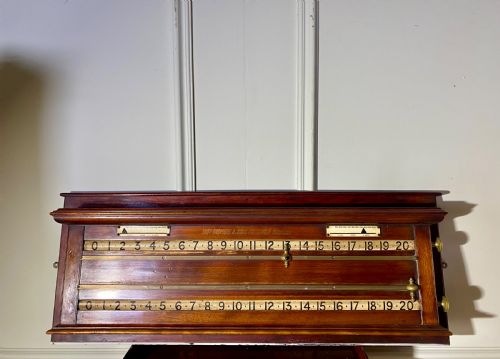
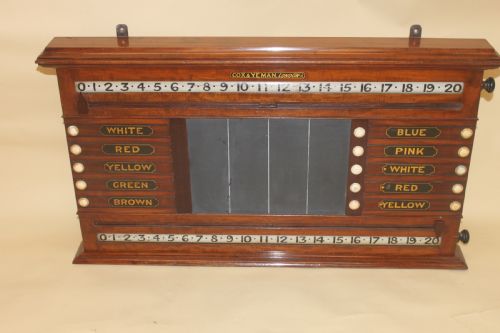
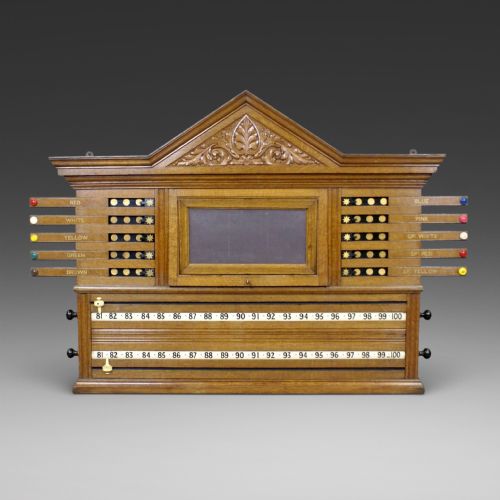
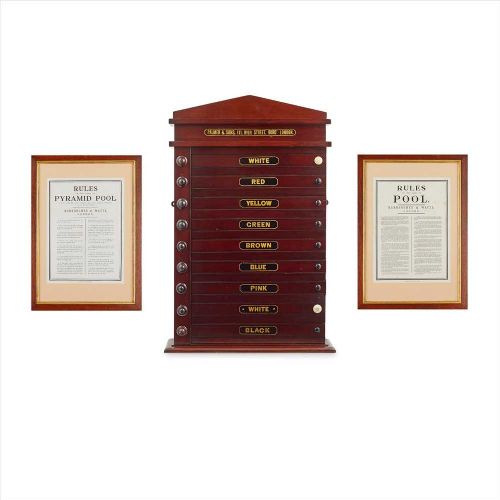
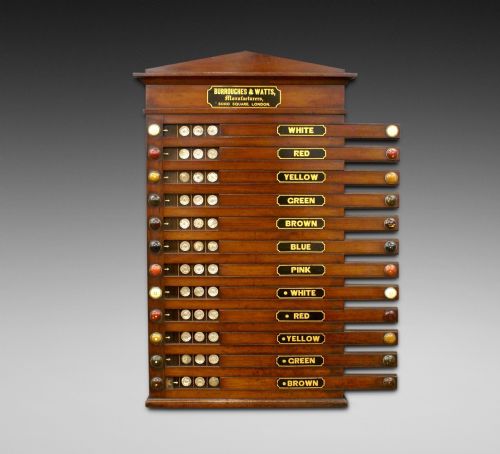
An edwardian snooker scoreboard is a wall-hung timber cabinet or board designed to record the breaks and game points in billiard rooms. Most examples you will encounter date from the Edwardian era or the latter part of the nineteenth century, built to serve the booming popularity of cue sports in homes and clubs.
The format usually includes sliding wooden pointers moving along numbered brass tracks, alongside revolving roller dials for higher breaks and game tallies. Larger pieces take the form of score cabinets with lockable doors, offering storage for chalk, rules, and sometimes prints.
How they were made
The makers relied primarily on dense hardwoods such as mahogany, oak, and English walnut, selected for stability and rich grain. These timbers were joined with sturdy cabinetry techniques to support the weight of brass runners and heavy slate or wooden backing boards.
Fittings combine cast brass for the pointers and numbers with turned bone, ivory, or celluloid for the small scoring buttons and roller indices. Glass panels occasionally feature in the cabinet doors to protect the scoring faces and internal scorecards.
Some boards include little brass hooks originally intended for hanging the players' pocket watches during a fierce frame.
What varies in quality
Quality rests in the precision of the brass scalework and the calibre of the timber framing. Plain boards made of simple softwood or thin veneers sit at the basic end, whilst heavy mahogany and quarter-sawn oak cabinets with crisp maker plaques represent the finer tier.
The inclusion of auxiliary scoring dials for life pool or pyramid games, alongside original sliding markers and intact bone numerals, elevates the status of the piece significantly.
Orme and Sons Manchester·Thurston and Co·Burroughes and Watts·G Wright and Co·Palmer and Sons
The Edwardian Snooker Scoreboard Glossary
- Sliding pointer
- A small brass indicator that moves horizontally along a numbered track to tally individual game points. These run in rows to accommodate multiple players.
- Roller dial
- A rotating cylindrical counter used to record cumulative frame wins or high breaks. They turn smoothly on central iron or brass spindles.
- Life pool
- A variation of cue sports where players each have a coloured ball and lose lives upon being potted, requiring dedicated scoring tracks on the board. The scoreboards often include extra pointers for this specific game.
- Scoring cabinet
- A larger wall-hung enclosure featuring cupboard doors that conceal the tally board when not in use. They provide space inside for accessories and prints.
Edwardian Snooker Scoreboard: Frequently Asked Questions
Are the scoring mechanisms still fully functional?
Most sliding brass pointers and wooden rollers continue to move freely along their original tracks after a light clean. Timber shrinkage can occasionally cause pointers to stick slightly in dry household conditions.
Applying a tiny amount of beeswax or furniture polish to the wooden runners usually restores smooth movement without altering the original patina.
How do I tell Victorian from Edwardian boards?
Victorian examples tend to feature heavier, darker timber frames with elaborate carved flourishes and simpler numerical layouts. Edwardian pieces often display a lighter oak or mahogany tone with cleaner, more restrained architectural lines.
Maker stamps and brass plaques can also help narrow down the production decade when stylistic cues overlap.
Can I store accessories inside a score cabinet?
Cabinets fitted with cupboard doors below or beside the tally tracks were originally built to hold chalk, rule books, and small accessories. The shallow depth is ideal for keeping score sheets, chalk blocks, and cue tips close at hand.
Avoid storing overly damp items inside enclosed antique timber to prevent warping the internal panels.