




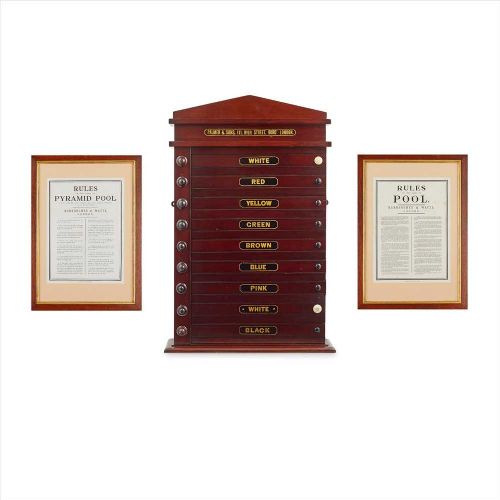
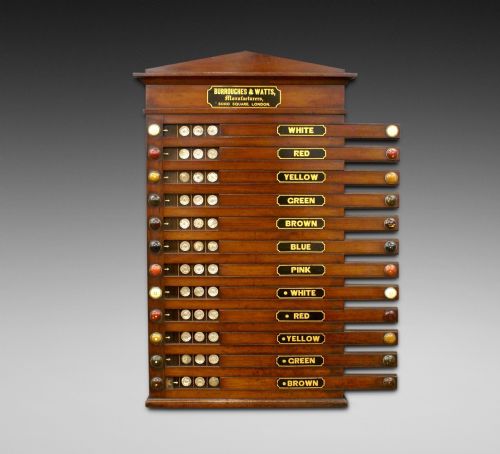
Mahogany Billiard Scoreboard
These mahogany billiard scoreboards are solid Victorian and Edwardian timber pieces built to keep score in the games room.
Mahogany Billiard Scoreboard
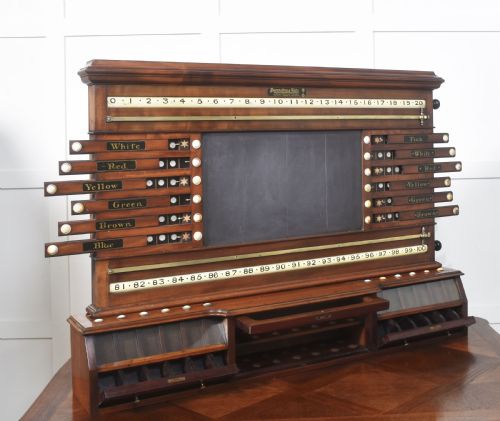
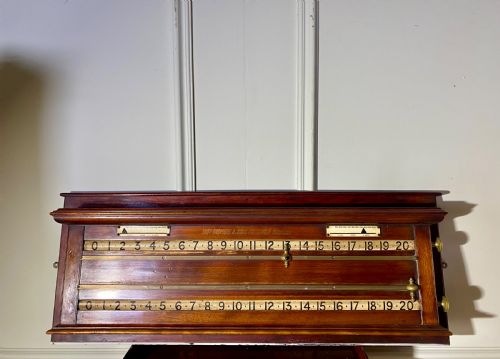
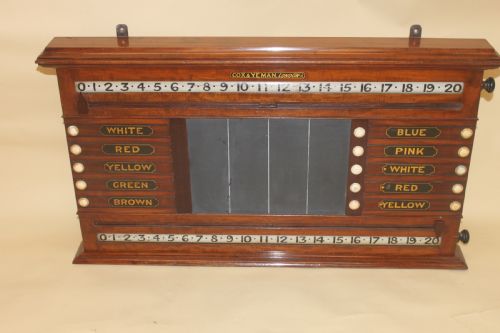
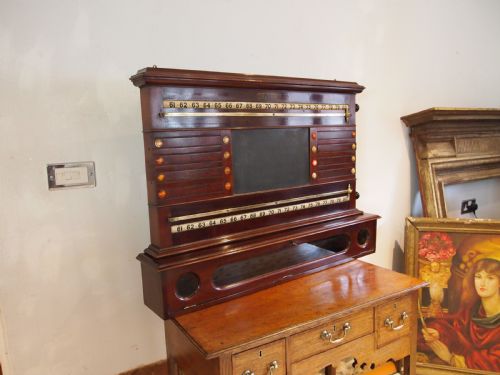
A mahogany billiard scoreboard is a timber wall-mounted games room accessory designed for keeping track of points during snooker, billiards, pool, and life pool matches. Buyers searching this phrase will encounter pieces predominantly from the Victorian era and the nineteenth century, alongside later Edwardian examples.
The objects take the form of wooden boards fitted with sliding markers, brass pointers, and sometimes slate or paper elements for recording complex scores. Most pieces seen on this page date from the 1860s through to 1910, reflecting the peak of domestic and club cue sports popularity.
Makers such as Orme & Sons, Thurston & Co Ltd, Cox & Yeman, and Burroughes and Watts dominate the better examples found in the evidence. These scoreboards range from simple single-game markers to large multi-game boards accommodating billiards, life pool, and snooker on a single mahogany frame.
How they were made
Makers utilised solid mahogany for the main frames and backboards, pairing the rich timber with polished brass fittings, sliding indicators, and brass rods. Slate panels or inset slate scoring surfaces appear alongside bone or ivory pointers and markers in the construction.
Paper scales, glass viewing panels, and printed inserts were integrated into the wooden carcasses to display specific rules or player statistics. The joinery relies on traditional Victorian cabinet-making techniques to house the sliding mechanisms securely within the dense timber surrounds.
Some scoreboards include little brass pointers that have faithfully clicked along their wooden tracks for over a century.
What varies in quality
The distinction between a standard scoreboard and a superior piece lies in the complexity of the games accommodated and the presence of a recognised maker's signature. Multi-game boards featuring dedicated scoring rows for billiards, life pool, and snooker demonstrate higher ambition than single-game markers.
The refinement of the brass hardware, the smoothness of the sliding mechanisms, and the integration of specialised materials like slate and bone separate workshop-produced boards from utilitarian items. Signed nameplates from prominent firms elevate the standing of a scoreboard considerably.
Orme & Sons Manchester·Thurston & Co Ltd·Cox & Yeman London·Burroughes and Watts
The Mahogany Billiard Scoreboard Glossary
- Mahogany
- A dense, durable tropical hardwood prized for its deep reddish-brown colour and stability, used for the primary frames of these scoreboards.
- Life Pool
- A variation of cue sports requiring specialised scoring boards with additional dials or sliding markers to track individual player lives.
- Slate
- A fine-grained metamorphic rock utilised in some scoreboards for writing surfaces or panels within the timber frame.
- Victorian
- The period spanning the reign of Queen Victoria, covering the majority of the nineteenth-century pieces recorded in the evidence.
Mahogany Billiard Scoreboard: Frequently Asked Questions
What games do these scoreboards track?
These boards are designed to record scores for snooker, billiards, pool, and life pool. Many examples accommodate multiple games simultaneously.
The inclusion of different scoring rows reflects the varied cue sports played in nineteenth and early twentieth-century billiard rooms.
How are these scoreboards mounted?
Most scoreboards are built as wall-hanging units with timber frames designed to be secured directly to a games room wall. Their weight requires sturdy fixings to support the dense mahogany and brass components.
Some larger boards incorporate decorative backplates or framing that complements billiard room interior woodwork.
What materials are used besides mahogany?
Brass is widely used for the sliding pointers, rods, and maker's plates attached to the timber frame. Slate, bone, glass, and paper also appear as secondary materials for scoring panels and indicators.
These contrasting materials help distinguish the numerical tracks and player rows across the wooden board.
How do I identify the period of a scoreboard?
Dating relies on the construction style, timber characteristics, and maker attribution associated with Victorian and Edwardian cabinet-making. Pieces from the 1860s often display specific brass hardware configurations typical of that decade.
Signed plates from firms like Thurston or Burroughes and Watts help narrow the date of manufacture.