




Billiard Room Wall Scoring
These billiard room wall scoring boards are the traditional timber markers that keep score over the baize, built to last a century in smoky houses.
Billiard Room Wall Scoring
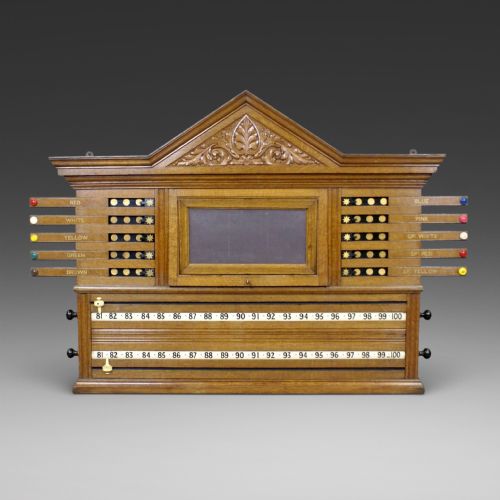
When you search for billiard room wall scoring boards, you are looking at timber scoreboards designed to hang on the wall of a games room. The examples you meet on this page come from the nineteenth century, including Victorian pieces dated between 1860 and 1900.
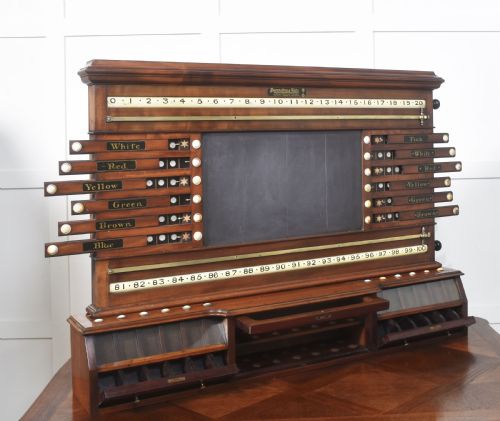
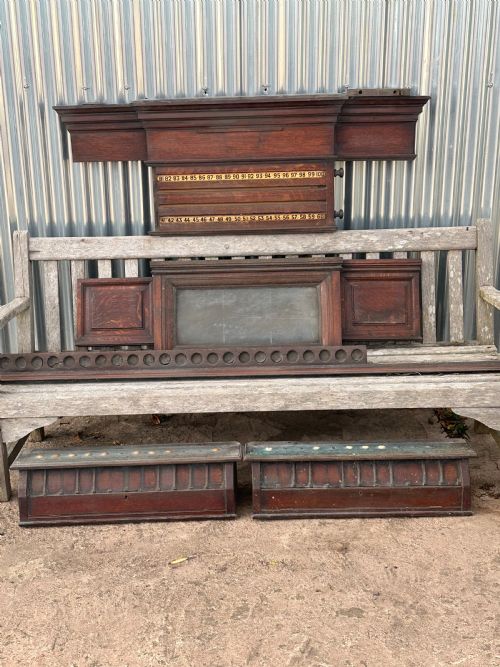
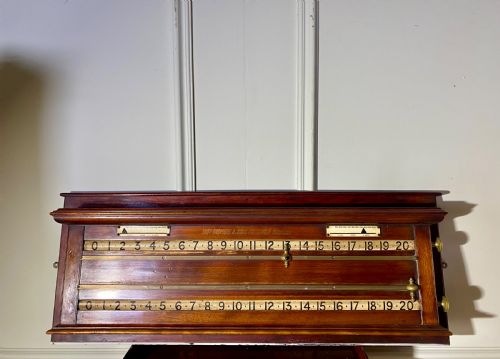
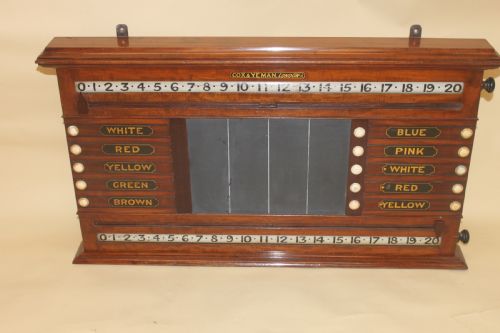
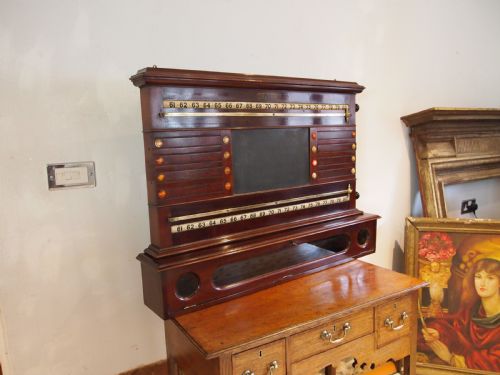
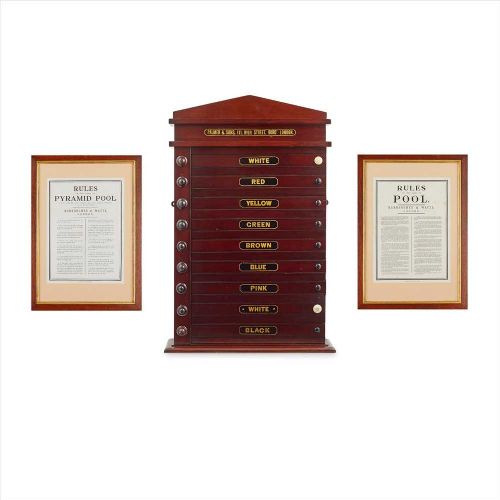
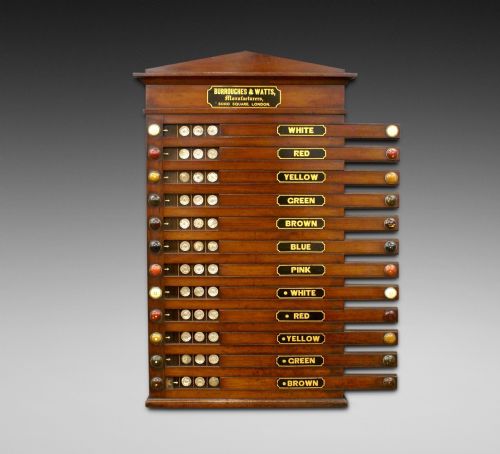
Most entries take the form of wall-mounted scoreboards made for billiards, snooker, and pool. These boards range from simpler mahogany scoreboards to large oak pieces used to track complex games.
Construction and materials
These boards utilise solid timbers such as mahogany and oak as their primary structural base. Workshops mounted sliding wooden markers and dials alongside inset panels.
Detailing often incorporates brass fittings, bone pointers, slate panels, and glass elements. Paper details and labels occasionally appear on the surface of the boards.
Every listed scoreboard on this page originates from the nineteenth century, utilising mahogany, oak, brass, and bone.
Judging quality
Quality rests upon the choice of timber and the complexity of the scoring mechanism. Better examples employ substantial oak or richly grained mahogany rather than basic softwood framing.
The distinction between standard pieces and finer examples also lies in the makers' signatures and the integration of materials like brass and bone for the indicators.
Orme & Sons Manchester·Thurston & Co of London·Cox & Yeman London·Palmer & Sons·Burroughes and Watts
The Billiard Room Wall Scoring Glossary
- Mahogany
- A dense reddish-brown tropical hardwood commonly utilised for nineteenth-century cabinet work and games room furniture. It provides a durable and stable foundation for wall-mounted scoreboards.
- Oak
- A hard and heavy timber seen in pale and dark tones across Victorian scoring boards. It offers a robust structure suited to heavy domestic use.
- Slate
- A fine-grained metamorphic rock occasionally incorporated into the face or panels of boards. It provides a dark, matte surface that contrasts with wooden pointers.
- Bone
- A natural material shaped to create small sliding pointers or markers on the board. These components add a tactile element to the scoring process.
Billiard Room Wall Scoring: Frequently Asked Questions
How do wall scoreboards work?
These boards use sliding pointers or rotating wooden dials to track scores for various cue sports. Players move markers along designated tracks set into the timber face.
Larger boards include multiple scoring rows to handle games involving several players, such as life pool or snooker.
What periods do these boards cover?
The listings consist entirely of nineteenth-century pieces, spanning the Victorian era from the 1860s through to 1900. Styles from this timeframe reflect the golden age of billiard room furnishings.
Maker attribution often helps narrow down the exact decade of production within the Victorian period.
Which woods were used?
Cabinet makers predominantly utilised mahogany and oak for the body of these wall boards. Both timbers provided the necessary rigidity to support mechanical sliding parts.
Lighter pale oak finishes appear alongside traditional deep red mahogany tones depending on the workshop and date.
How do I hang a heavy board?
Due to the dense timber construction, these boards require secure wall fixings capable of supporting substantial weight. Using appropriate brackets or screws into wall studs ensures safety.
Consider the height of the board so players can easily reach the top sliding pointers during a match.