




Edwardian Moorland Art
Edwardian moorland art captures wide upland terrain through oil paint and watercolour, offering a piece of open landscape for your wall.
Edwardian Moorland Art
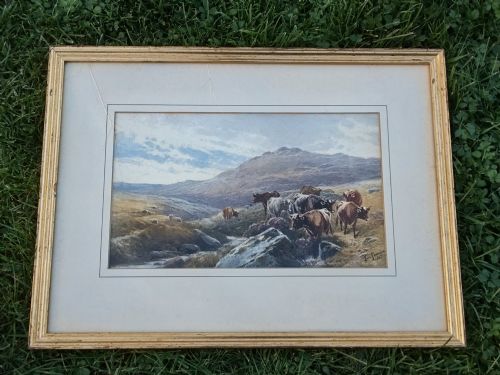
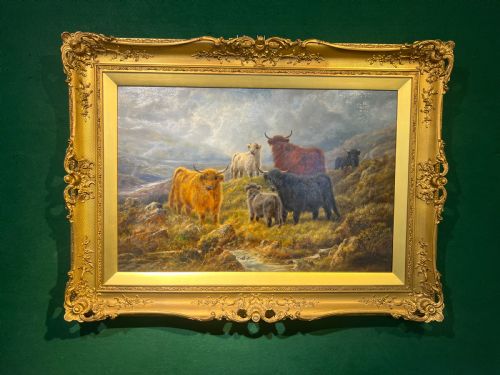
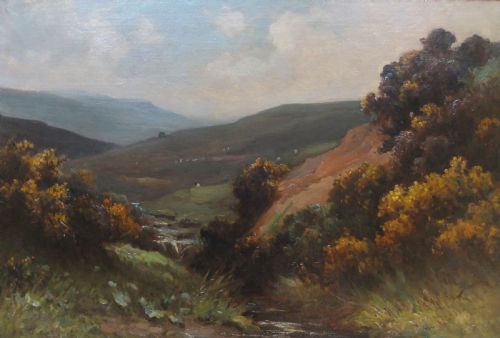
Edwardian moorland art encompasses framed paintings and watercolours depicting British upland landscapes, cattle, sheep, and sporting scenes. These works capture vast open terrain through the lens of British Impressionism, Edwardian, and Victorian pastoral styles.
You are most likely to encounter framed watercolour paintings and oil on canvas works dating from the 1900 and 1910 periods, alongside Victorian examples. Common subjects include droving sheep, cattle, and rural streams set against broad moorland horizons.
The objects take the form of individual paintings and paired watercolours, executed on paper or canvas. They reflect the late nineteenth and early twentieth century fascination with rural British scenery and pastoral life.
How they were made
Artists utilised traditional oil paint on canvas and watercolour pigment on paper to render these upland scenes. Works were typically mounted within decorative frames, often incorporating gilt elements to complement the composition.
The physical construction relies on stretched canvas over wooden frames or watercolours fixed to paper supports. These materials were chosen for their permanence and ability to capture natural light across open landscapes.
Several canvases feature diligent sheep dogs keeping stubborn flocks moving across damp hillsides.
What varies in quality
Quality rests upon the artist's ability to handle light and atmosphere across expansive terrain rather than the mere presence of livestock or hills. Brushwork in oil paintings and wash control in watercolours dictate the visual depth of the landscape.
The skill of the framing, particularly the condition of gilt elements and paper preservation, separates standard decorative pieces from finer examples. Handling of canvas tension and pigment stability further distinguishes the upper tier of works.
Thomas Rowden·Robert Watson·F.J. Snell·Owen Bowen·John Charles Tunnard·Edmund Morris Wimperis·Ernest Higgins Rigg·Peter Jackson·Arthur H Enock·Charles James Adams
The Edwardian Moorland Art Glossary
- Watercolour pigment
- A colour medium suspended in a water-soluble vehicle, applied to paper to create translucent washes. It allows artists to capture the fleeting light characteristic of upland weather.
- Oil on canvas
- Pigment mixed with drying oil applied to stretched woven fabric. This technique permits rich texture and deep colour saturation suitable for dramatic moorland skies.
- Gilt frame
- A wooden housing treated with gold leaf or metallic gilt finish. It serves to isolate the pastoral scene from the surrounding room and enhance ambient brightness.
- British Impressionism
- A painting style focusing on light and spontaneous brushwork. It emerged in the late nineteenth century to record everyday rural and coastal views.
Edwardian Moorland Art: Frequently Asked Questions
What subjects appear in these paintings?
The works depict cattle, sheep, drovers, and sporting dogs within expansive upland settings. Scenes often focus on streams, meadows, and rolling terrain across British locations.
Artists aimed to record the distinct atmosphere and changing light of open moorland country.
How should I hang these watercolours?
Watercolours require placement away from direct sunlight to prevent fading of the pigment on paper. Proper framing under glass protects the delicate surface from moisture and dust.
Ensure wall fixings match the weight of the wooden frame and gilt mount.
Are these works painted on canvas?
Some pieces utilise oil paint applied directly onto stretched canvas over wooden supports. Others consist of watercolour pigment on paper supports.
Both formats reflect the predominant landscape techniques of the nineteenth and twentieth centuries.
How do I identify an Edwardian piece?
Dating relies on recorded artist lifespans, stylistic markers of British Impressionism, and period materials such as paper and canvas. Signatures and inscribed titles often provide direct confirmation of the year.
Many works carry specific dates within the early nineteen hundreds or late Victorian era.