
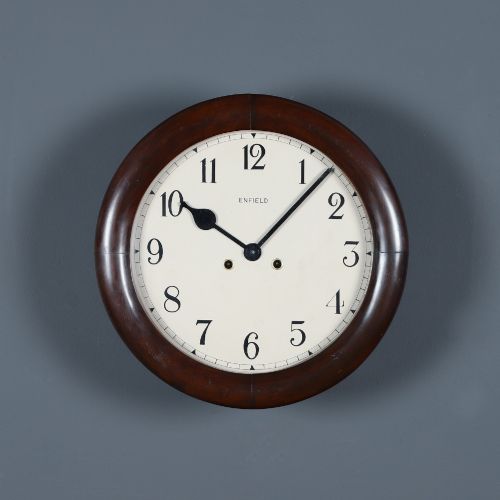
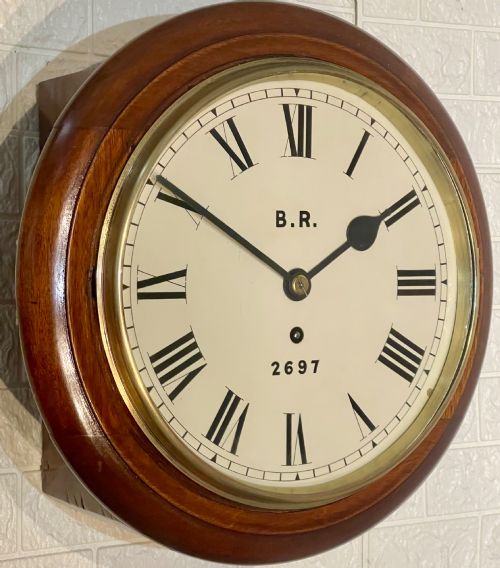
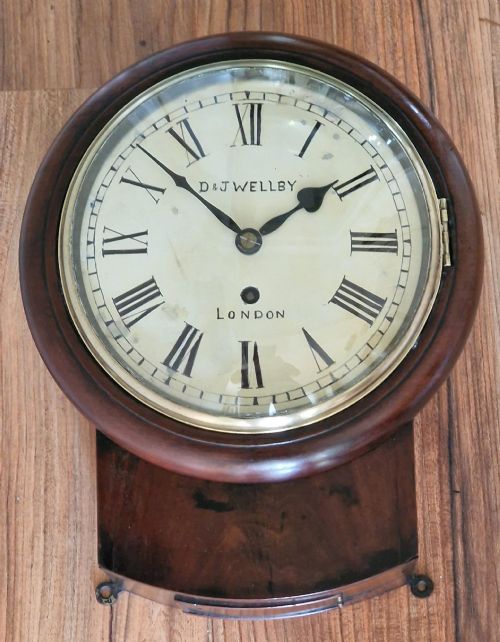
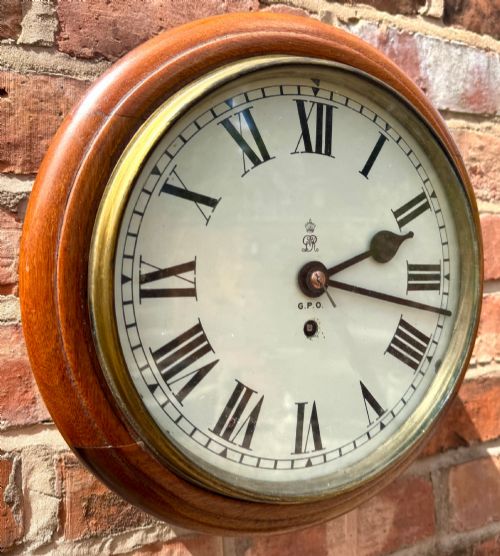
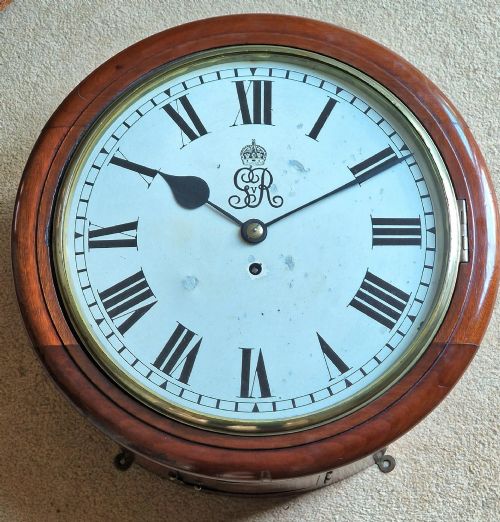


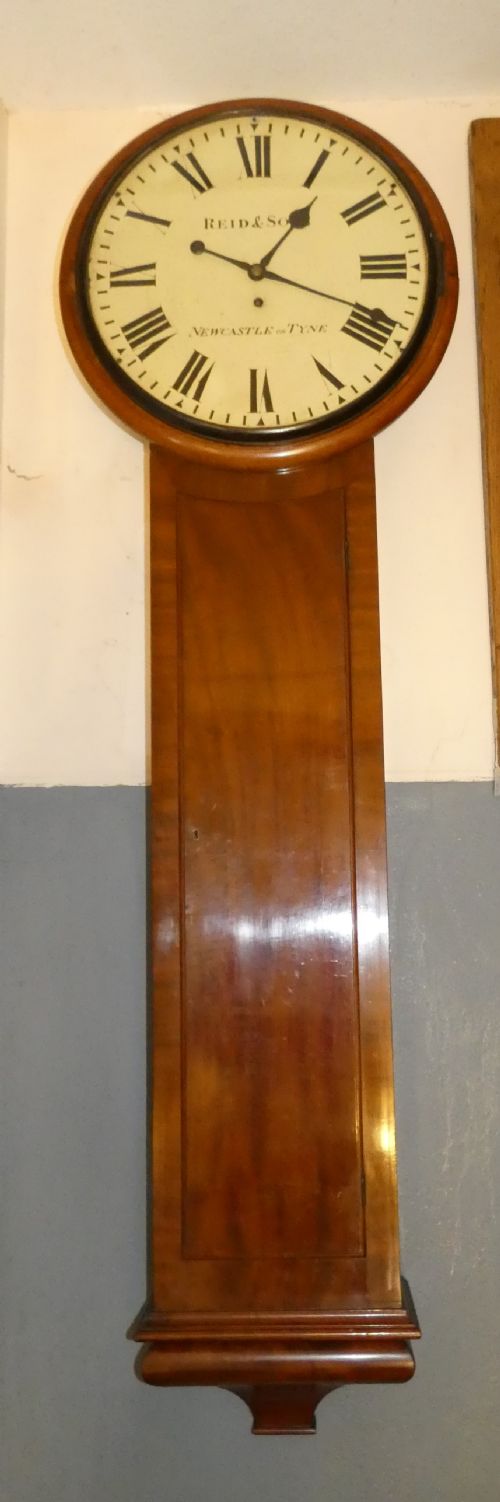


Edwardian Mahogany Wall Clock
These pieces bring the reliable accuracy and solid timber of an edwardian mahogany wall clock into your room, offering both practical timekeeping and historic character.
Edwardian Mahogany Wall Clock
When you search for an edwardian mahogany wall clock, you encounter circular dial timepieces originally made for railway stations, schools, offices, and domestic interiors. The examples met on this page span several decades and styles, including pieces from the Victorian era through to the interwar period.
Most pieces take the form of round dial wall clocks or drop-dial variants housed in mahogany cases. They range from small eight-inch dials up to large regulator clocks designed to command attention in a public space or a large room.
How they were made
Cases are constructed from mahogany, sometimes with carved details or inlaid sections framing the dial. The wood is selected for grain and durability, protecting the precision movement housed within.
Dials are protected by glass held in brass or metal bezels, while the interior mechanisms utilise fusee movements, iron, steel, and painted metal dials designed for steady, reliable timekeeping over many decades.
Edwardian Mahogany Wall Clock Retail Price Guide 2026
Typical asking prices for edwardian mahogany wall clock among the pieces listed under this phrase on Sellingantiques today, from the lower quarter to the upper quarter. They describe what is for sale here now, not the wider market.
Listings span the Victorian era, the Edwardian period, and the 1930s, constructed in mahogany, brass, glass, and painted steel.
What varies in quality
The distinction between ordinary production and superior quality rests in the crispness of the case carving, the execution of the mahogany housing, and the refinement of the dial lettering. Signed dials from known makers or specific railway and institutional commissioners elevate a piece above standard utility clocks.
Mechanical integrity and originality also divide the range, with clean, untouched fusee movements and well-preserved timber cases representing the higher standard of survival.
D J Wellby·John Walker·Balbiani Brookley·Camerer Cuss And Co·Edward Hannam
The Edwardian Mahogany Wall Clock Glossary
- Fusee
- A conical pulley used in clock movements to maintain even driving power as the mainspring unwinds. This mechanism is standard in better quality British dial clocks.
- Drop dial
- A clock case featuring a round dial at the top and a short wooden trunk below, often used to enclose a pendulum or weights.
- Convex dial
- A dial face that curves outward toward the glass, designed to catch the light and reduce glare in public rooms.
- Timepiece
- A clock that tells the time without incorporating a striking or chiming mechanism.
- Regulator
- A precision pendulum clock built to maintain a high degree of accuracy, often featuring a long case for the pendulum swing.
Edwardian Mahogany Wall Clock: Frequently Asked Questions
Where were these clocks originally used?
Many of these clocks served in railway stations, post offices, schools, and municipal buildings, where clear visibility and exact timekeeping were essential for public coordination.
Others hung in private offices and domestic hallways, built to meet the daily demands of Victorian and Edwardian life.
How do fusee movements work?
A fusee movement uses a conical pulley connected to the mainspring by a chain or cord. As the spring loses tension, the chain moves to a wider part of the cone, balancing the force delivered to the gears.
This clever mechanical arrangement ensures the clock maintains consistent timekeeping throughout its running cycle.
How do I tell an Edwardian clock from a Victorian one?
Edwardian clocks, made from roughly the start of the twentieth century up to the First World War, often share the clean proportions and dark mahogany tones of late Victorian pieces but reflect slightly simpler trade lettering and case mouldings.
Examining the back box, movement serial numbers, and dial signatures helps narrow down the period of manufacture.