
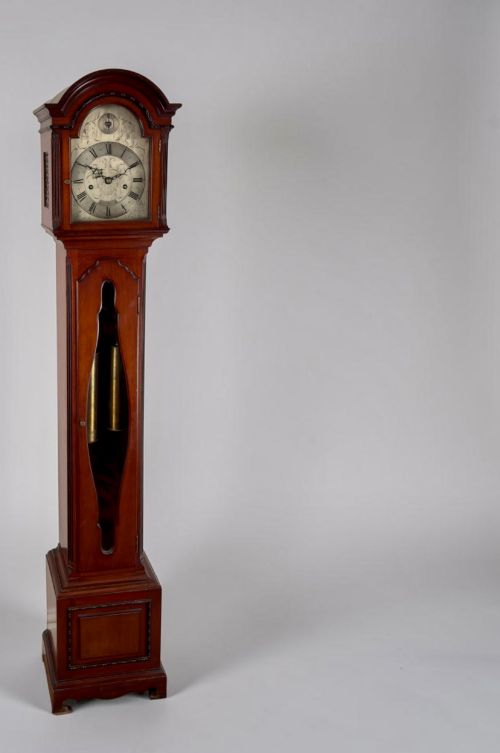
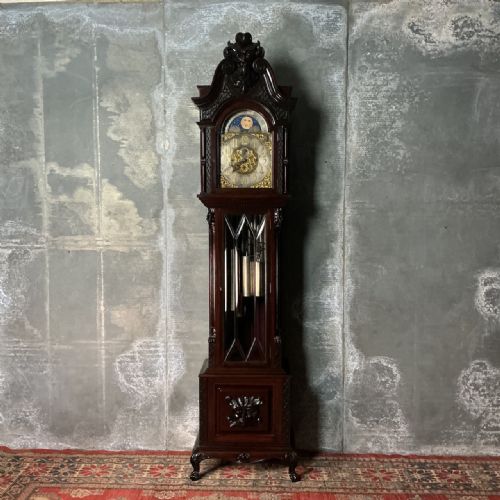
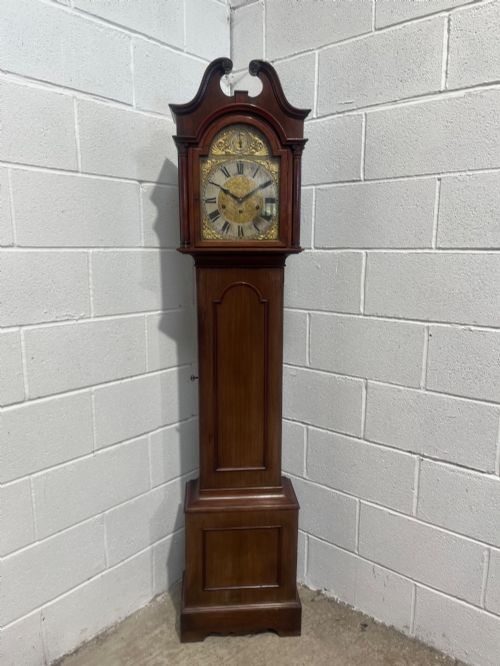
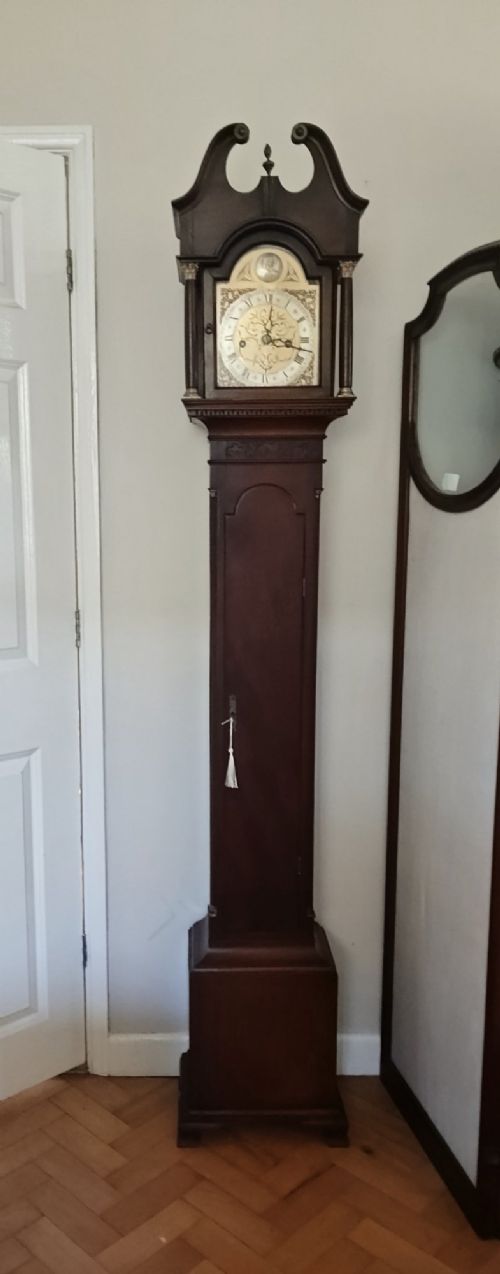
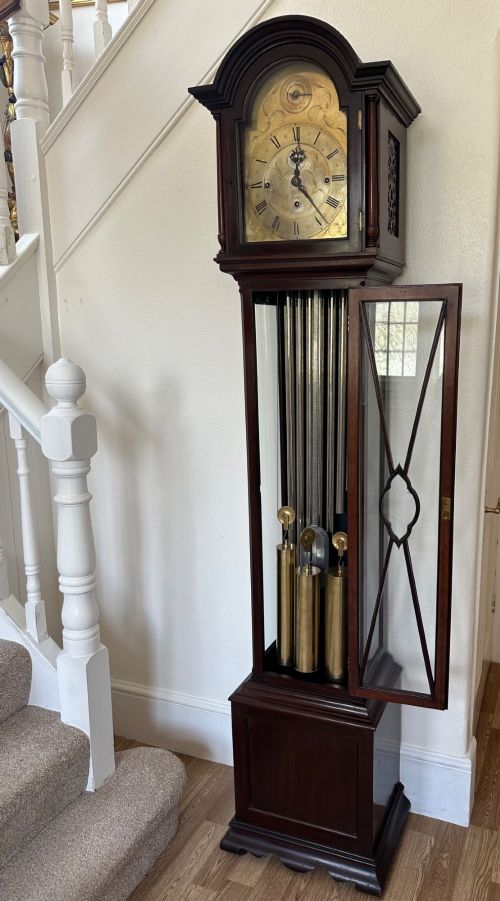

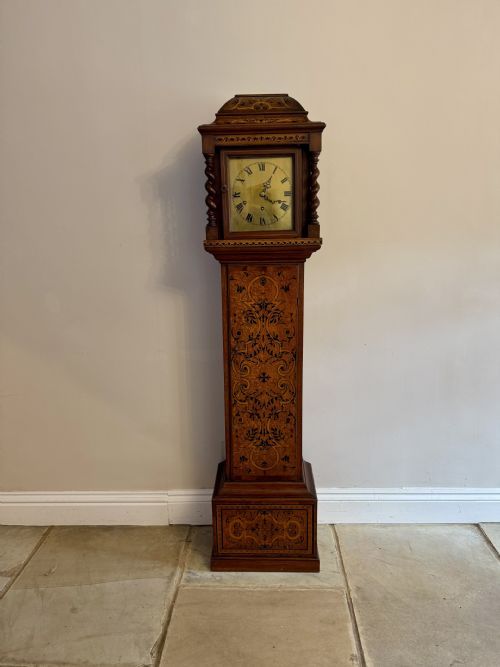


Edwardian Mahogany Floor Clock
An edwardian mahogany floor clock brings architectural presence and mechanical rhythm into a room, combining rich timber with precise horology.
Edwardian Mahogany Floor Clock
When you search for an edwardian mahogany floor clock, you encounter tall domestic timepieces that anchor a hallway or reception room. These upright instruments measure hours and chime melodies using weights, springs, or tubular bells housed in timber cases.
The selections span grand proportions down to smaller grandmother clocks and slim longcase formats. Makers of the period drew on Georgian and Victorian design idioms, adapting earlier proportions for twentieth-century domestic spaces.
Mahogany predominates, often enriched with satinwood inlay, marquetry, or brass dials. While Edwardian examples form the core of the selection, related nineteenth-century pieces also appear.
Materials and construction
Internal movements rely on brass, steel, and iron components. Advanced examples incorporate musical mechanisms, striking trains, and sets of tubular bells or gongs to mark the quarters and hours.
Some slender grandmother clocks were built specifically to fit into lower-ceilinged Edwardian stairwells without ducking.
Determinants of quality
The sophistication of the movement distinguishes standard timekeepers from complex musical and chiming mechanisms. Pieces featuring multiple tube bells or quarter-chiming trains represent advanced horological skill.
Cabinet work varies from simple rectilinear housings to finely proportioned cases with elaborate marquetry inlay, carved details, and well-figured timber grains. Signed dials by established retail firms or makers add notable distinction.
Gillett & Johnston of Croydon·Edward Shepley of Manchester·LISTER & SONS·Camerer Cuss & Co·DENT OF LONDON·Maple & Co of London
The Edwardian Mahogany Floor Clock Glossary
- Longcase clock
- A tall pendulum clock enclosed in a vertical wooden case, historically known as a grandfather clock.
- Grandmother clock
- A smaller, scaled-down version of the traditional longcase clock, typically produced during the twentieth century.
- Marquetry inlay
- Decorative woodwork where pieces of contrasting timber, shell, or metal are fitted into a veneer to form geometric or floral patterns.
- Tubular bell
- A set of metal tubes suspended within the clock case and struck by hammers to produce chime melodies.
- Moon dial
- A secondary dial on the clock face that tracks the phases of the lunar cycle alongside standard time.
Edwardian Mahogany Floor Clock: Frequently Asked Questions
Where should I place a floor clock?
These tall timepieces require a stable, level floor and a solid wall for secure anchoring to prevent tipping. Hallways, landings, and reception rooms provide suitable environments away from direct heat sources and dampness.
Because the movement relies on gravity and a plumb pendulum, the case must stand vertically straight. Ensuring a firm foundation allows the escapement to beat evenly and keeps the clock running accurately.
How do I wind a chiming clock?
Winding involves using a specialised key to raise the internal weights or tension the spring barrels. Each train - time, strike, and chime - requires individual attention according to the specific mechanism.
Care must be taken not to overwind the movement, and hands should only be adjusted in the correct direction as instructed by the mechanism design. Regular winding maintains the tension needed for consistent timekeeping.
What is the difference between a grandfather and grandmother clock?
A grandfather clock is a full-sized floor clock, generally standing well over six feet tall with substantial proportions. A grandmother clock is a miniature version, scaled down in height and width to fit more modest rooms.
Despite the difference in scale, grandmother clocks often house complex mechanical movements, including chiming trains and brass dials, mirroring the engineering of their larger counterparts.
How do I identify an Edwardian case?
Edwardian cases typically exhibit lighter mahogany tones, refined satinwood inlay, and sometimes marquetry decoration inspired by earlier Georgian and Sheraton styles. Construction methods from this era often combine machine precision with skilled hand finishing.
Examining the interior timber, hinges, and dial construction helps separate Edwardian productions from nineteenth-century precursors and later revival pieces.
Do these clocks require professional setup?
Transporting and installing a tall clock involves handling delicate pendulums, weights, and intricate gear trains. Many owners prefer professional assistance to ensure the movement is correctly pinned, leveled, and lubricated upon arrival.
A horologist can calibrate the beat and ensure the striking mechanism synchronizes properly with the hands, establishing reliable operation from the start.