
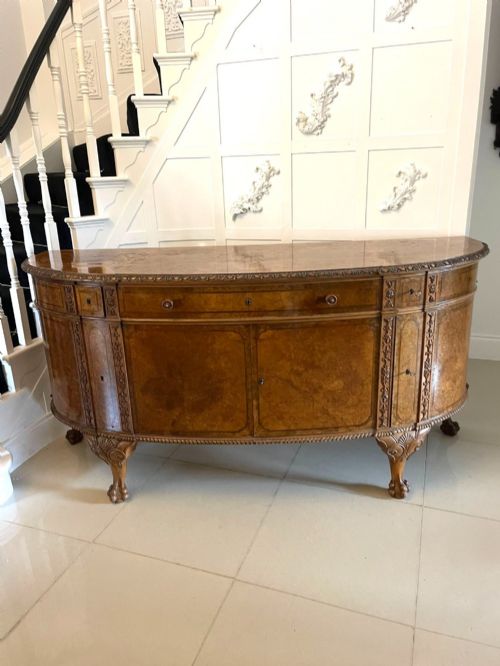
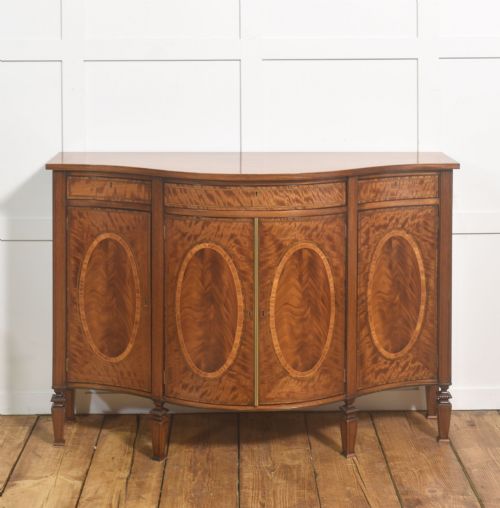
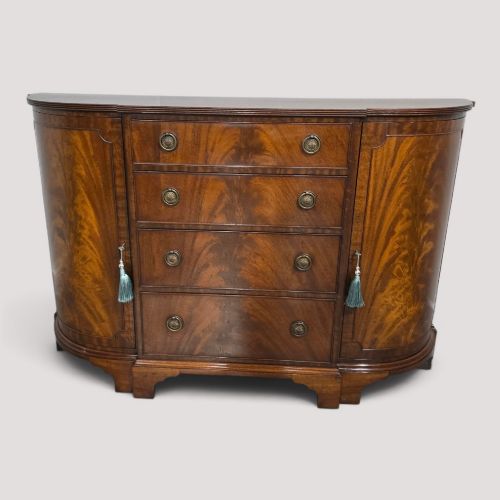
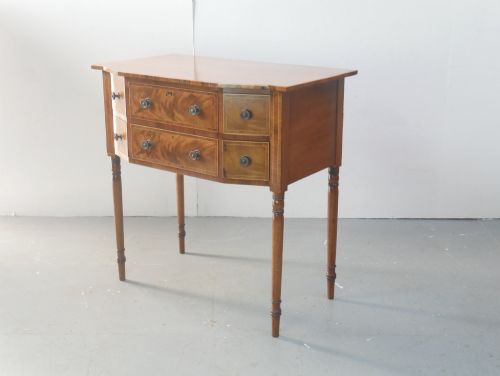





Edwardian Bowfront Server
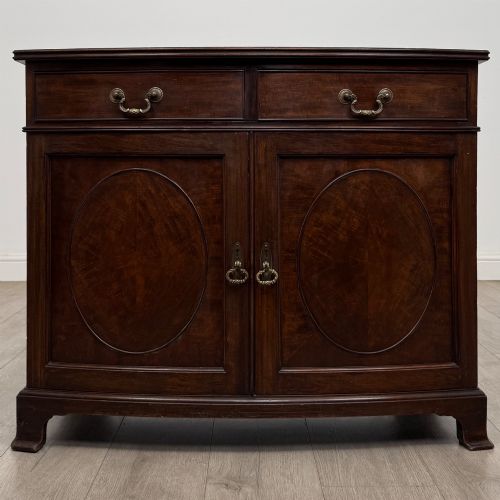
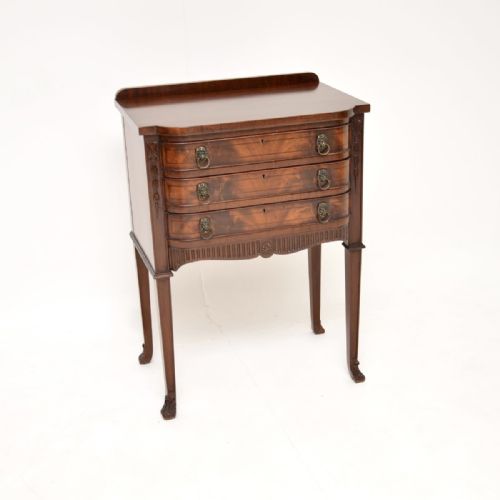
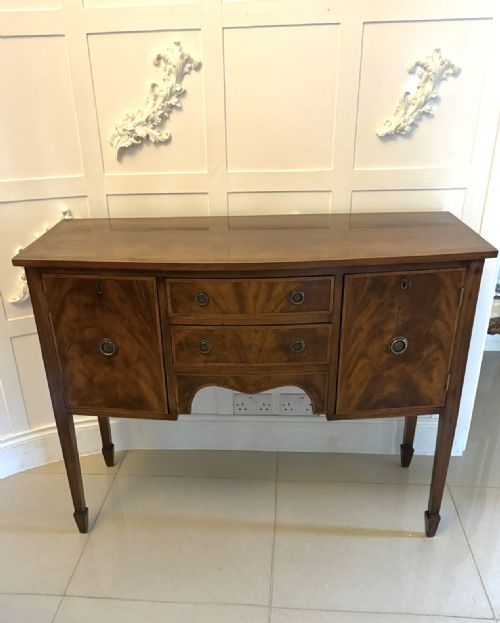
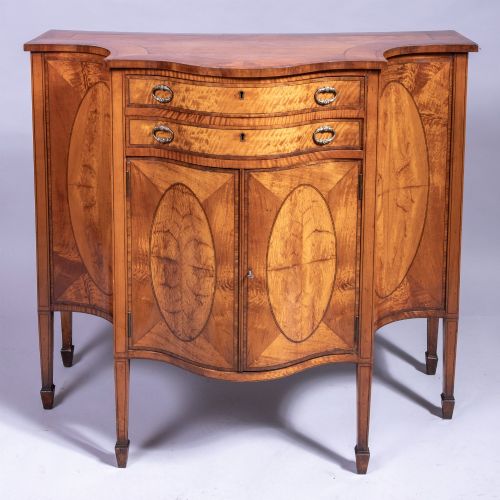
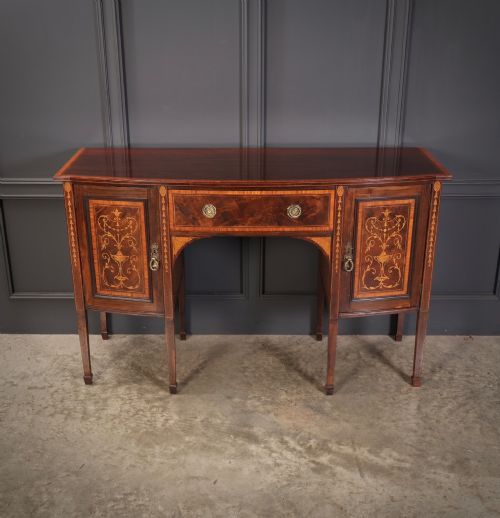
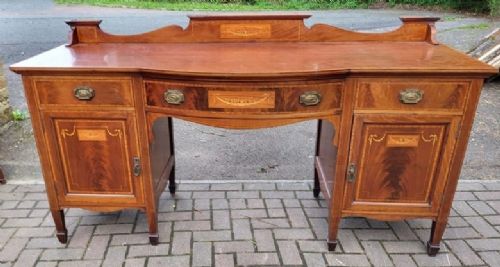
An Edwardian bowfront server brings together curving mahogany timber and delicate stringing to anchor a dining room with proportion and storage.
Edwardian Bowfront Server
When you search for an edwardian bowfront server, you encounter low profile dining room storage pieces built with curved fronts that project forward in the centre. These items originate predominantly from the Edwardian era and the Sheraton Revival period, alongside occasional Georgian and Regency pieces that influenced later cabinet makers.
The version you are most likely to meet on this page is constructed from mahogany, frequently enhanced with flame mahogany veneer or contrasting crossbanding. Such items often incorporate satinwood, boxwood inlay, and marquetry to define the borders and panels of the doors and drawers.
Forms span from small sideboards and serving tables to side cabinets and larger breakfront sideboards. Dimensions range from small proportions suited to compact rooms up to substantial serving pieces designed for larger dining spaces.
Materials and Construction
Cabinet makers utilised solid mahogany and applied flame mahogany veneers to curved carcases, shaping timber to achieve the characteristic bow front profile. Satinwood and boxwood inlay provided sharp tonal contrast against the deeper brown of the primary wood.
Brass fittings, including handles and key escutcheons, punctuate the drawer fronts and cupboard doors. Detailed marquetry work adorns panels and tabletops, executed through precise hand-cut veneer marquetry techniques.
Materials across the selection include mahogany, satinwood, burr walnut, and brass.
Assessing Quality and Execution
The grade of an edwardian bowfront server rests on the selection of timber and the precision of its veneer work. Flame mahogany with rich figuring commands attention, whilst finely cut boxwood inlay and crisp marquetry demonstrate superior workshop execution.
Structural harmony also dictates standing. Pieces that retain balanced proportions across their curved drawers and doors, coupled with refined brass hardware, represent the upper tier of period production.
George Hepplewhite
The Edwardian Bowfront Server Glossary
- Bowfront
- A furniture front that curves outward in the centre, softening the linear angles of a traditional cabinet. This shape requires skilled carpentry to bend wood or shape veneers to the curved carcase.
- Crossbanding
- A narrow strip of veneer applied around the border of a drawer front or tabletop with the grain running perpendicular to the main panel. It creates a neat framing effect common in Sheraton Revival pieces.
- Satinwood
- A lustrous, pale yellow timber native to India and Ceylon, prized for its golden sheen. It appears frequently in inlaid panels and stringing lines on Edwardian furniture.
- Marquetry
- The art of forming decorative patterns by fitting together thin slices of various woods and other materials onto a structural surface. It allows for complex floral and geometric motifs across doors and server tops.
- Breakfront
- A piece of furniture whose central section projects forward from the flanking outer sections. This architectural form adds depth and shadow play to larger sideboards and cabinets.
Edwardian Bowfront Server: Frequently Asked Questions
What is an edwardian bowfront server?
An edwardian bowfront server is a dining room storage piece featuring a curved front facade, typically constructed from mahogany and decorated with inlaid satinwood or boxwood. These items served as serving surfaces and storage for dining silver and linens.
They combine practical capacity with decorative elegance, drawing heavily design inspiration from earlier Georgian and Sheraton styles.
How do I tell an Edwardian piece from a Georgian original?
Edwardian interpretations often display lighter satinwood stringing, crossbanding, and marquetry reflecting the Sheraton Revival taste of the early twentieth century. Georgian originals rely on heavier structural timber framing and simpler mahogany surfaces.
Examining the interior secondary woods and backboards also helps reveal the true period of manufacture.
Where should I place a bowfront server?
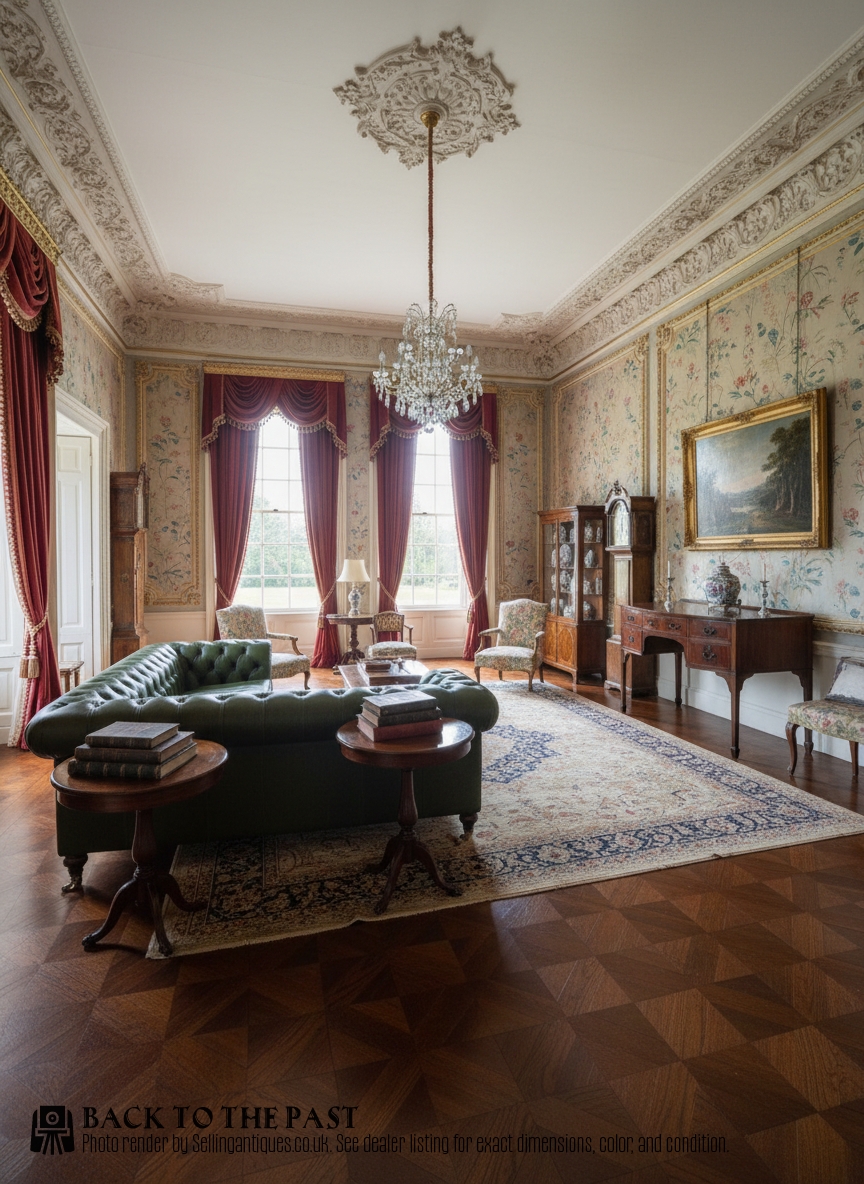
These servers fit well against the main wall of a dining room or hallway where their curved profile can be appreciated without blocking narrow walkways. Their surface provides a functional staging area for serving dishes during meals.
In living spaces, smaller proportions serve as side cabinets or display surfaces for lamps and decorative objects.
What woods are typical for these servers?
Mahogany forms the primary structural and visible timber, often selected for its rich grain and dark reddish-brown tone. Flame mahogany veneer adds dramatic figuring to drawer fronts and cabinet doors.
Satinwood and boxwood provide contrasting lighter details for stringing lines and inlaid motifs.