




Ebonised Mantle Clock
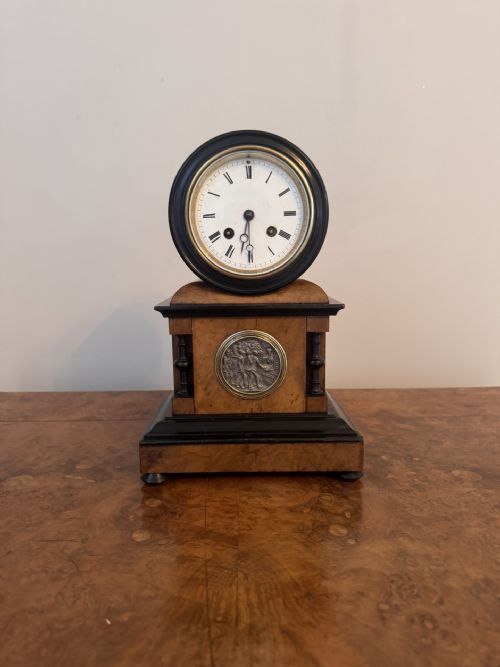
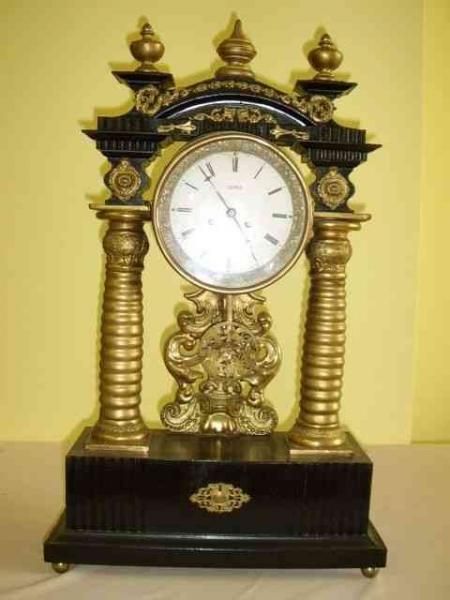
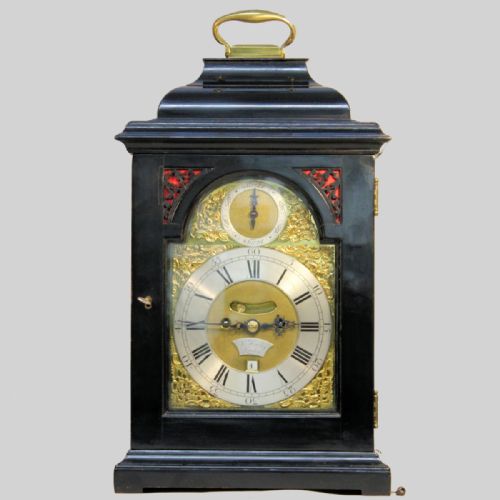
These ebonised mantle clock examples combine dark polished cases with brass and ormolu mounts, offering striking focal points for a mantelpiece.
Ebonised Mantle Clock
An ebonised mantle clock brings a dark, formal presence to a room, frequently encountered in Victorian and Georgian designs across these listings. These timepieces range from architectural bracket clocks to portico forms and smaller desk pieces designed for domestic interiors.
Makers utilised dark wood finishes alongside contrasting gilt brass, bronze, and enamel dials to create visual depth. Surviving examples reflect centuries of horological craft, spanning the eighteenth century through the late Victorian period.
The selection here includes regional English makers alongside French and American firms, showing diverse regional approaches to the dark wood case. Buyers find bracket clocks with fusee movements alongside chiming mantel clocks driven by eight-day mechanisms.
Materials and construction
Cases are formed from wood treated with an ebonised finish to mimic ebony, often combined with burr walnut or mahogany beneath the dark surface. Ormolu and gilt brass mounts provide structural highlights and decorative framing around the dial aperture.
Dials frequently feature enamel cartouches or painted chapter rings protected beneath bevelled glass panels. Movements rely on mechanical brass gears, including fusee and verge escapements, driven by weights or springs.
Gilt bronze and porcelain elements appear on continental pieces, adding colour contrast to the heavy black timber cases. Marquetry inlay occasionally breaks the dark surface on Georgian and nineteenth-century examples.
Some nineteenth-century models insisted on chiming the hours while visitors tried to converse quietly in the parlour.
Judging quality
Quality rests in the crispness of the case carving, the execution of the brass mounts, and the complexity of the internal movement. Finer pieces demonstrate precise marquetry work and heavy cast ormolu rather than pressed metal components.
The reputation of the maker dictates desirability, with signed dials by known London or provincial watchmakers elevating a piece. Original components, uncompromised ebonising, and intact chiming mechanisms distinguish superior examples from standard production.
Thomas A Paris·Charles Frodsham·Somersall London·John Leroux London·John Fletcher London·James Evans·Isaac Hurley London·D Robertson of Perth·Baldwin of Loughborough·Wm Gilbert USA·John Scandrett of Worcester
The Ebonised Mantle Clock Glossary
- Ebonised wood
- Timber stained or painted to resemble genuine ebony wood. This finish was popular across Victorian and Georgian periods for formal mantelpieces.
- Fusee
- A conical pulley used in clock movements to equalize the pull of the mainspring as it unwinds. It ensures even timekeeping throughout the running period.
- Verge escapement
- An early type of clock escapement mechanism that controls the release of the gear train. It produces a distinctive ticking sound and is common in eighteenth-century bracket clocks.
- Ormolu
- Gilt bronze mounts applied to furniture and clock cases for decoration. The technique involves coating bronze in a finely ground gold-mercury amalgam.
- Bracket clock
- A portable clock designed to sit on a bracket or shelf, typically featuring a handle on top. Many early examples incorporate ebonised wooden cases and striking mechanisms.
Ebonised Mantle Clock: Frequently Asked Questions
How do I wind an ebonised mantle clock?
Most mechanical clocks require a key inserted into the dial holes to tighten the springs or lift the weights. Care must be taken not to overwind the movement, stopping as soon as resistance is felt.
Chiming and striking models may require synchronising the hands after a full wind to ensure the audio matches the visual time.
Where should I place a bracket clock?
Bracket clocks need a stable, level surface such as a mantelpiece, heavy sideboard, or dedicated wall bracket. A level foundation ensures the escapement ticks evenly and the pendulum or balance wheel operates correctly.
Keep wooden cases away from direct sunlight and sudden temperature changes to protect the ebonised finish and internal wood.
How do I tell an 18th-century clock from a Victorian one?
Eighteenth-century pieces often feature verge escapements, bell-top wooden cases, and engraved backplates signed by the maker. The woodwork tends to show traditional joinery and hand-finished brass fittings.
Victorian examples frequently incorporate heavier ebonised cases influenced by aesthetic movement or classical revival styles, sometimes utilising gong strikes alongside bell chimes.
What is a fusee movement?
A fusee is a conical drum connected to the mainspring by a cord or chain. As the spring loses tension, the chain moves to a wider part of the cone, maintaining constant power to the gear train.
This mechanism is a sign of better horological quality in antique bracket and mantel clocks.