

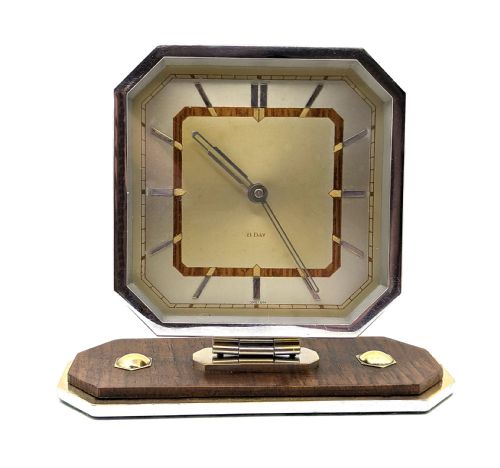
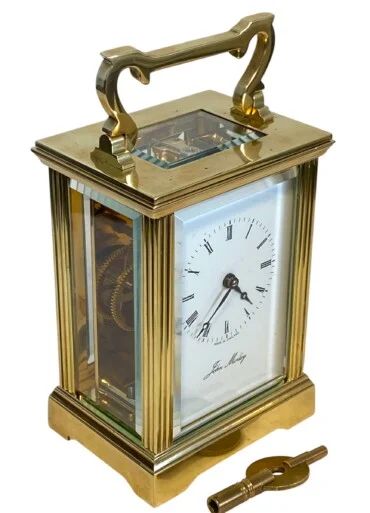


8 Day Mantle Clock
An 8 day mantle clock keeps time for a week between winds, combining practical utility with the decorative weight of wood, marble or metal.
8 Day Mantle Clock
An 8 day mantle clock is designed to sit on a fireplace shelf or sideboard, running for just over a week before needing a fresh turn of the key. The pieces seen here span the Regency and Victorian eras through to the Art Deco period, offering a wide range of domestic timepieces.
Victorian examples frequently employ heavy black or coloured marble, alongside ornate brass and gilt bronze details. Regency and Georgian iterations lean towards fine mahogany bracket clocks with traditional dial faces.
Twentieth-century variants introduce walnut, chrome, glass and bakelite alongside streamline modernist silhouettes. The selections range from substantial French architectural clock sets to compact travel and desk pieces.
How they were made
Clockmakers housed mechanical movements inside cases built from dense hardwoods like mahogany and walnut, or carved from solid marble and slate. Ormolu, gilt bronze and brass mounts decorated the exterior, while silvered or enamelled dials tracked the hours.
Movements relied on spring-driven or weight-driven mechanisms, often utilising fusee chains or balance wheels to regulate the release of energy. Skilled artisans combined precision metalwork with cabinetmaking and stone carving to produce reliable household timekeepers.
Listings feature movements housed in marble, mahogany, chrome, walnut, and ormolu spanning the nineteenth and twentieth centuries.
What varies in quality
The standard of an 8 day mantle clock depends on the precision of its movement and the integrity of its case materials. Finer examples display crisp casting on ormolu mounts, careful marquetry inlay on wood surfaces, and complex striking or chiming gear trains.
Pieces signed by notable makers or fitted with specialised escapements command greater attention from collectors. The weight of the marble, the clarity of the enamel dial, and the crispness of the timber carving separate standard production items from exceptional workshop creations.
Mappin & Webb·John Morley·Philippes Paris·Thomas Moss·Winterhalder & Hofmeier·Samuel Marti·Smiths Clocks Ltd·Japy Freres·Junghans·Asprey·Harrods of London·Jaeger LeCoultre
The 8 Day Mantle Clock Glossary
- Bracket clock
- A portable timekeeper originally designed to sit on a wall bracket rather than a floor. These spring-driven pieces often feature carrying handles on top.
- Fusee
- A conical pulley connected to the mainspring by a chain or cord. This clever device equalises the diminishing pull of the spring as it unwinds, ensuring steady timekeeping.
- Ormolu
- Finely ground high-carat gold mercury-gilded onto a bronze object. This rich surface treatment protects the metal underneath and creates a warm, shimmering finish.
- Escapement
- The mechanical linkage that controls the movement of the gear train by allowing the wheels to release in measured increments. It gives mechanical clocks their characteristic ticking sound.
- Boulle
- A form of marquetry utilising tortoiseshell and brass inlay developed in France. It creates a striking contrast of dark tortoiseshell and gleaming metallic patterns.
8 Day Mantle Clock: Frequently Asked Questions
How often should I wind an 8 day mantle clock?
These movements require winding approximately once a week to maintain continuous operation. Using the correct key on the winding arbors ensures the mainsprings tension evenly without over-tightening.
Allowing the clock to run down fully before resetting prevents strain on the gear train. Regular winding keeps the escapement rhythm steady.
Where is the best place to put a heavy marble clock?
Marble and slate pieces need a sturdy, level surface capable of supporting substantial weight without sagging. Mantle shelves and heavy sideboards provide adequate stability for dense stone cases.
Keeping the clock away from direct sunlight and damp walls preserves the internal metalwork and exterior finish. A stable foundation also helps the pendulum swing truly.
How do I tell a Victorian marble clock from an Art Deco one?
Victorian examples rely on classical revival motifs, heavy black marble, and ornate bronze mounts influenced by French styles. They often feature prominent architectural pediments and visible gilt dials.
Art Deco pieces embrace geometric symmetry, streamlined chrome, green onyx, and contrasting bakelite or walnut. Their forms favour clean silhouettes over elaborate historical ornamentation.
What is the difference between a timepiece and a striking clock?
A timepiece simply records the hours and minutes without sounding an audible alert. These mechanisms focus purely on accurate timekeeping functions.
A striking clock includes an additional gear train and hammer system to chime on bells, gongs or wires at the hour or half-hour. This extra complication requires a separate winding port on the dial face.