
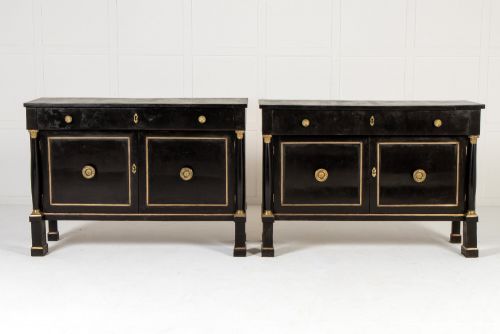
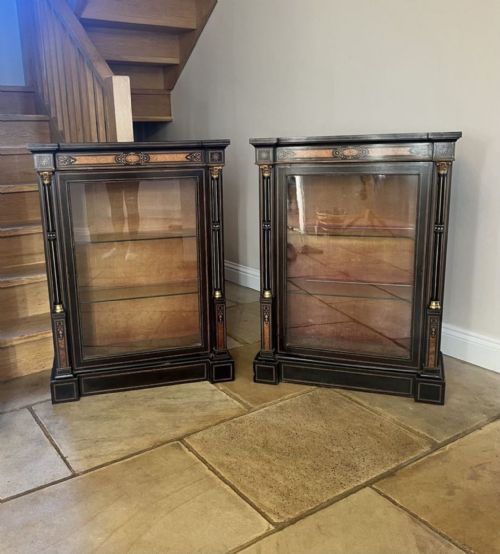


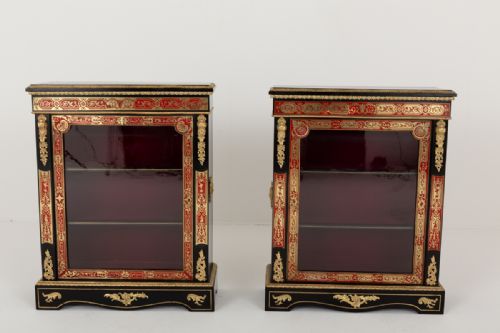


Ebonised Credenza Pair
An ebonised credenza pair offers striking symmetry and dark finishes, bringing dramatic nineteenth-century French and Victorian presence into a modern room.
Ebonised Credenza Pair
When searching for an ebonised credenza pair, buyers encounter matched sets of dark-finished display furniture spanning the eighteenth and nineteenth centuries. These pieces encompass side cabinets, pier cabinets, and credenzas originating from British, French, and Italian workshops.
The versions most frequently met on this page date from the Victorian era and the French Napoleon III period. They combine ebonised wood structures with elaborate decorative techniques like Boulle marquetry and brass inlay.
How they were made
Craftsmen utilised dense timbers finished with ebonising agents to imitate costly ebony, providing a deep black ground for ornamentation. This dark surface was then carefully prepared for metal and shell inlays.
Makers applied intricate brass and tortoiseshell marquetry, often alongside hand-chased ormolu mounts and gilt bronze details. Selected pieces incorporate contrasting amboyna wood panels or inset porcelain plaques to break the dark expanse.
Listings feature Victorian, Napoleon III, and eighteenth-century items utilising ebonised wood, amboyna, brass, and tortoiseshell.
What varies in quality
The standard of execution in the brass inlay and tortoiseshell work dictates the refinement of the piece. Superior examples display precise, tight fitting of metal marquetry without excessive filler.
The weight and crispness of the ormolu mounts also separate standard production from exceptional pieces. Heavier, finely chased bronze mounts indicate a more ambitious commission from the outset.
The Ebonised Credenza Pair Glossary
- Ebonised wood
- Timber treated with a dark stain or finish to simulate the appearance of solid ebony. This technique gained immense popularity during the nineteenth century for formal reception rooms.
- Boulle work
- An elaborate form of marquetry consisting of tortoiseshell and brass inlaid in contrasting patterns. It is named after the renowned cabinetmaker André-Charles Boulle.
- Ormolu
- Gilt bronze mounts applied to furniture for decorative enrichment and corner protection. The technique involves coating bronze in a mixture of mercury and gold.
- Pier cabinet
- A tall, narrow display cabinet designed specifically to fit the wall space between windows. These cabinets typically feature glass doors enclosing velvet-lined shelving.
- Amboyna
- A highly figured, exotic burl wood yielding rich amber tones and intricate grain patterns. It is frequently used as a contrasting veneer on dark cabinet frames.
Ebonised Credenza Pair: Frequently Asked Questions
Where were these cabinets placed originally?
These matched cabinets typically stood against drawing room walls or between tall windows to reflect light and display precious porcelain.
Their dual format provided balanced symmetry which nineteenth-century interior designers favoured for formal entertaining spaces.
How do I care for ebonised wood?
Dust regularly with a soft, dry cloth and keep the timber away from direct sunlight and radiators to prevent shrinking.
Apply a microcrystalline wax occasionally to nourish the dark finish without attracting dust to the delicate metal inlays.
Are these true pairs?
A true pair was constructed together in the same workshop to match precisely in dimensions, timber selection, and decorative layout.
Near pairs share identical periods and styles but originated as individual items subsequently gathered together by dealers.
What is the difference between a credenza and a pier cabinet?
A credenza is traditionally a low, wide cabinet featuring central doors flanked by curved glass panels for prominent display.
A pier cabinet is noticeably taller and narrower, built to occupy specific vertical wall piers between architectural openings.