


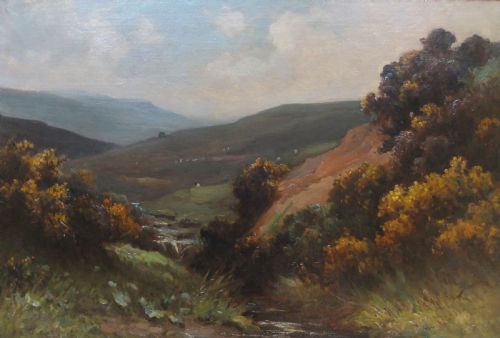

Earthy Green Landscape Painting
An earthy green landscape painting brings the quiet depth of woodland, pasture and moor directly onto the wall.
Earthy Green Landscape Painting
An earthy green landscape painting captures the verdant tones of British and European countryside, often depicting farmyards, rivers, and livestock from the nineteenth and early twentieth centuries. These works reflect the enduring appeal of pastoral scenes created during the Victorian, Edwardian, and interwar periods.
The most common examples on this page are oil paintings on canvas or wood panel, alongside watercolours on paper, originating from British, Scottish, and French regional schools. They span styles from British Impressionism and the Barbizon School to traditional Victorian pastoral views.
Buyers seek these pieces to introduce organic colour palettes and historical depth into domestic interiors, connecting living spaces with traditional rural topographies. Each canvas or board preserves a specific regional viewpoint, from Yorkshire dales to Devon rivers.
How they were made
Artists painted primarily with oil paint on stretched canvas, wooden panels, or prepared boards, building up rich green and earthy pigments to depict foliage and terrain. Watercolours on paper provide a lighter, more translucent alternative utilised for topographical studies and regional views.
Pigments were applied using traditional brushwork ranging from tight academic precision to the looser, expressive marks characteristic of British Impressionism and the Barbizon School. Canals, stretchers, and wood panels bear the physical marks of studio preparation and plein air excursion.
Several canvases bear handwritten inscriptions on their wooden stretchers, recording forgotten riversides and long-gone farmers.
What varies in quality
Quality rests in the handling of light and the subtlety of the green and brown pigment mixes, where skilled brushwork distinguishes a flat depiction from a truly atmospheric scene. Works by established regional artists or those exhibiting academic affiliation often display superior composition and tonal balance.
The preservation of the original paint surface, canvas tension, and support stability significantly influences the integrity of each piece. Surviving inscriptions, original stretchers, and documented artist provenance add historical weight to the physical execution.
Tom Campbell·Reginald Grange Brundrit·James Orrock·Herbert Royle·Alfred Grey·Thomas Creswick·Owen Bowen·William Traies·Ernest Higgins Rigg·Tom Dudley·Alfred Banner·Frederick William Jackson·Kershaw Schofield·Alois Arnegger·George F Wetherbee·William Greaves·Charles Branwhite·Fred Lawson·Benjamin Williams Leader·George Graham
The Earthy Green Landscape Painting Glossary
- Canvas
- A heavy woven fabric stretched across a wooden frame to serve as a support for oil painting. It provides a flexible yet durable textured surface for pigment application.
- Wood Panel
- A rigid wooden board utilised as a primary support for paintings, particularly common in nineteenth-century works. Panels offer a smooth, stable ground that resists the sagging associated with aged canvas.
- Watercolour
- A paint consisting of pigment suspended in a water-soluble binder, traditionally applied to paper. It yields transparent washes that capture delicate light and atmosphere.
- Barbizon School
- A nineteenth-century French art movement focused on tonal realism, plein air observation, and naturalistic landscape depiction. Its ethos deeply influenced pastoral painting across Europe.
- Provenance
- The documented history of ownership and exhibition tracing a painting from its creation to the present day. Verified provenance confirms authenticity and historical context.
Earthy Green Landscape Painting: Frequently Asked Questions
What periods do these paintings date from?
The selection spans from the nineteenth century through the Edwardian era and into the 1930s and 1940s. This includes Victorian pastoral scenes alongside early twentieth-century British and French school works.
Each period brings distinct stylistic conventions, reflecting shifts in how artists observed and recorded the natural world.
How should I hang an oil painting?
Secure a sturdy picture hook into a wall stud or use appropriate wall fixings rated for the weight of the framed canvas. Hang the piece at eye level away from direct sunlight and excessive heat sources.
Stable indoor humidity prevents the wooden stretcher and canvas from warping or cracking over time.
What is the difference between oil and watercolour?
Oil paint utilises a drying oil binder on canvas or panel, producing rich, opaque colours with visible brush texture. Watercolour employs a water-soluble medium on paper, resulting in transparent, luminous washes.
Oils are traditionally framed behind glassless moulding, whereas watercolours require protective glazing.
Are these paintings signed by the artist?
Many of the works retain the artist's original signature, sometimes accompanied by dates, location inscriptions, or exhibition labels on the reverse. Unsigned works are attributed based on style, technique, and subject matter.
Inscriptions on stretchers often provide valuable clues regarding the specific geographic location depicted.