

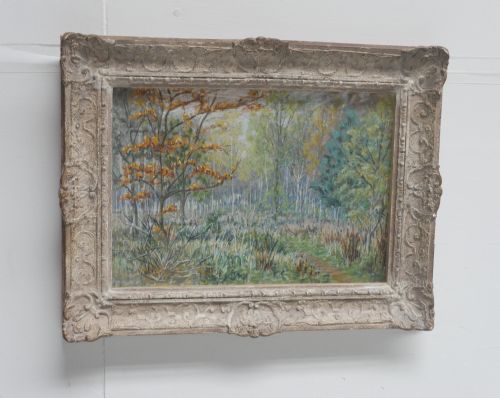


Framed Woodland Wall Art
Framed woodland wall art brings the depth of nineteenth-century forests and pastoral scenes into domestic rooms through original oil and watercolour paintings.
Framed Woodland Wall Art
When buyers search for framed woodland wall art, they encounter original paintings spanning from the seventeenth century to the mid-twentieth century. The selection relies heavily on oil paintings on canvas or board, alongside watercolours and pastels capturing British, Irish, and continental landscapes.
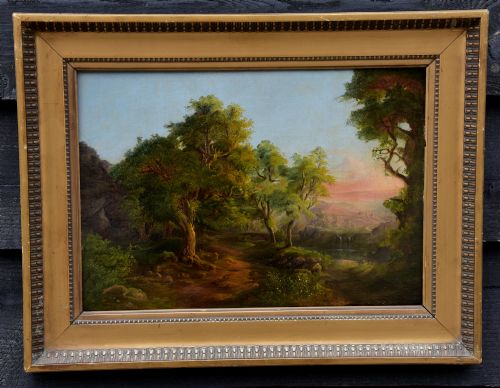
The dominant forms present pastoral scenes, tree-lined paths, and forest rivers populated by figures, cattle, or figures gathering firewood. These artworks reflect periods including the Victorian era, Edwardian years, and mid-century vintage movements.
Makers range from listed artists working within British Impressionism and Victorian Naturalism to regional schools. Each piece is housed within a frame that complements the painted canvas or paper surface.
How they were made
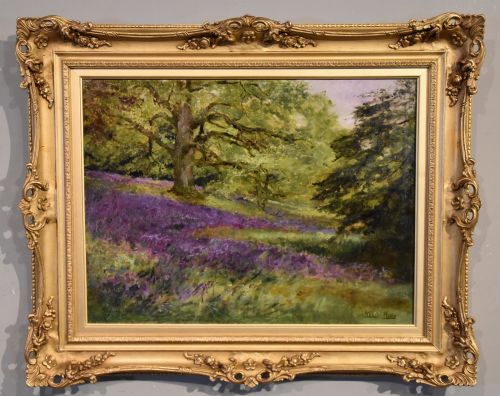
The primary technique relies on oil paint applied to canvas, board, or paper, building texture and depth through layered brushwork. Artists also utilise watercolour and pastel on paper to capture lighter atmospheric effects in forest settings.
Support materials consist of wood panels, stretched canvas, and heavy paper, often framed with wood mouldings sometimes accented by gold leaf or simple gilt liners. Glass is utilised to protect works executed on paper.
Pigments were mixed by hand or sourced commercially in tubes during later periods, capturing natural light through distinct tonal palettes characteristic of Victorian landscape traditions and subsequent twentieth-century movements.
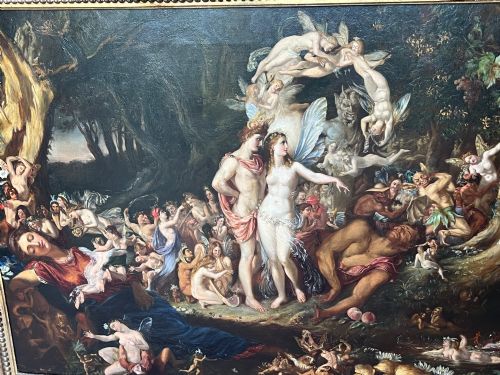
Fairies, angels, and Hansel and Gretel silhouettes occasionally inhabit the branches alongside cattle and sheep drovers.
What varies in quality
The handling of light and shadow distinguishes superior landscape compositions from ordinary decorative works. Master painters create palpable depth through nuanced layering of oil paint, whereas lesser examples rely on flat tones.
Brushwork reveals the hand of the artist, with confident, expressive application marking the work of established painters compared to stiff repetition in student or commercial pieces. The integration of figures or livestock into the woodland setting also dictates artistic merit.
Materials contribute significantly to overall standard, observed in the weight of the canvas, the stability of the wood support, and the integrity of the original framing relative to the period of the artwork.
Sir Joseph Noel Paton·Richard Sebastian Bond·William H Myers·Sir Peter Lely·Thomas W Lascelles·Henry Yeen King·Arthur Herbert Rigg·Thomas Bromley Blacklock·James Mallard Bromley·William Mellor·Alfred Grey·John Wright Oakes·Rowland Henry Hill·Abraham Hulk Jnr·Charles James Adams·J McIntyre·John Falconar Slater·Hans Kappel Øvre·Frederick Bartman·Charles Edmond Rene His·Donald Watson
The Framed Woodland Wall Art Glossary
- Oil on canvas
- A painting medium where pigment is suspended in drying oil, typically linseed, applied to a woven fabric stretched across a wooden frame. This technique allows for rich colour saturation and textured impasto work.
- Watercolour
- A painting method where water-soluble pigments are applied to paper, producing luminous, transparent washes. It is frequently employed for delicate landscape studies and botanical details.
- Oil on board
- A composition executed directly onto a rigid wooden panel or stiff pasteboard rather than fabric. This surface provides a firm foundation favoured by plein-air painters.
- Pastel
- A dry drawing medium consisting of powdered pigment and a binder, shaped into sticks. It creates soft, velvety colour transitions well suited to atmospheric forest scenes.
- Gold leaf
- Extremely thin sheets of beaten gold applied to wooden picture frames to provide a decorative metallic finish. It reflects ambient light to frame the artwork effectively.
- Impressionism
- An art movement characterised by relatively small, thin yet visible brush strokes and an emphasis on accurate depiction of light. British interpretations often focus on rural landscape and woodland motifs.
Framed Woodland Wall Art: Frequently Asked Questions
What periods do these paintings date from?
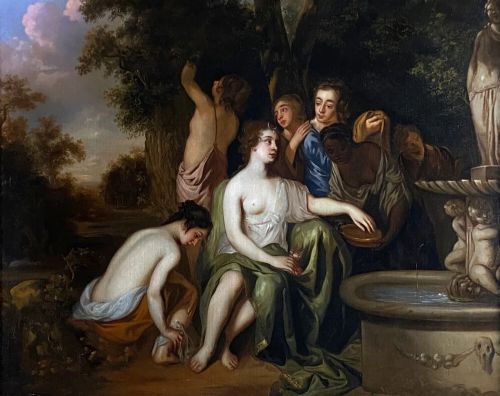
The available artworks span several centuries, beginning with seventeenth-century Dutch school and Baroque examples, continuing through nineteenth-century Victorian naturalism, and extending into mid-century twentieth-century pieces.
Most items originate from the Victorian and Edwardian eras, reflecting traditional landscape painting movements across Britain, Ireland, and continental Europe.
How should I hang framed woodland art?
These pieces require sturdy picture hooks suited to the weight of the wooden frames and canvas supports. Ensure they hang away from direct sunlight to protect oil pigments and watercolours from fading over time.
Matching the frame style to your interior decor helps integrate the landscape subject into domestic spaces comfortably.
What subjects appear besides trees?
Woodland scenes frequently incorporate pastoral elements such as rivers, lakes, country lanes, and mountainous terrain. Figures, cattle watering, sheep droving, and children gathering firewood often populate the foreground.
Wildlife and birds, including jays perched in branches, also feature across various watercolours and oil paintings.
Are these works original or prints?
Every listed item consists of an original painting, drawing, or oil on canvas executed by hand. Artists utilised mediums including oil paint, watercolour, pastel, and ink on paper, board, or canvas supports.
Signatures from listed painters frequently appear on the canvas or board, denoting unique historical artworks.