

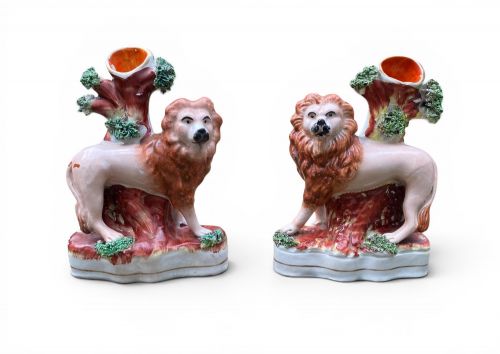


Earthenware Lion Figurine
These earthenware lion figurine pieces bring fierce presence to a mantelpiece, offering the robust charm of traditional ceramic modelling.
Earthenware Lion Figurine
An earthenware lion figurine represents a distinct branch of British and European ceramic folk art, capturing the majestic beast in various seated and standing postures. When searching for an earthenware lion figurine, buyers encounter robust mantel ornaments ranging from simple spill vases to dramatic pairs flanking a hearth.
The selections span centuries of production, featuring Georgian and Victorian interpretations alongside earlier continental examples. Most pieces appearing on this page belong to the nineteenth century, including Staffordshire pottery models and treacle glazed figures.
Forms vary from heraldic Medici lions with their paws resting upon spheres to narrative scenes such as the death of the lion queen. Makers utilised traditional earthenware bodies to create these domestic sculptures, which often served as decorative focal points in nineteenth-century parlours.
How they were made
Potters shaped these earthenware lion figurine pieces using local clay bodies, frequently employing slip-casting or press-moulding techniques to form the hollow animal bodies. Artisans then applied various surface treatments before firing, including lead glaze, tin glaze, and rich treacle glaze.
Listings feature earthenware lion figurine pieces spanning the eighteenth, nineteenth, and twentieth centuries, utilising lead glaze, tin glaze, and treacle glaze.
What varies in quality
Glazing quality creates a clear hierarchy among these ceramic animals, where deep and even lead or treacle glazes impart a rich lustre. The presence of matching pairs and well-preserved gilding or enamel detailing elevates the decorative impact of individual pieces.
Rockingham Pottery·Lancaster and Sons of Hanley
The Earthenware Lion Figurine Glossary
- Earthenware
- Porous pottery fired at relatively low temperatures, forming the primary body for these traditional ceramic figures. It requires a vitreous glaze to ensure the surface remains sealed against moisture.
- Pearlware
- A refined earthenware developed in the late eighteenth century featuring a subtle bluish glaze that pooled pleasingly in crevices. It sits chronologically between salt-glazed stoneware and later creamware.
- Treacle Glaze
- A dark, manganese-rich brown glaze that produced a glossy, treacle-like finish popular on nineteenth-century Staffordshire pottery. This heavy coating gives the lions a deep, reflective surface.
- Tin Glaze
- An opaque white glaze made by adding tin oxide to lead glaze, providing a smooth ground for painted decoration on continental pieces. It characterises much European faience production.
- Spill Vase
- A hollow ceramic cylinder incorporated into a figurine design to hold wooden spills used for lighting pipes and fires. These dual-purpose objects combine domestic utility with sculptural display.
Earthenware Lion Figurine: Frequently Asked Questions
What is an earthenware lion figurine?
An earthenware lion figurine is a decorative ceramic sculpture modelled in the likeness of a lion, commonly produced by British potteries during the nineteenth century. These ornaments typically sat upon mantelpieces in pairs.
They reflect popular Victorian tastes for domestic animal figures and heraldic motifs, drawing inspiration from classical sculpture and contemporary menagerie displays.
How were these lion figures used?
These ceramic lions served primarily as ornamental display pieces in Victorian homes, bringing a sense of majesty and exoticism to the parlour. Some variations incorporated integral spill vases to hold wooden tapers.
Positioned on either side of a fireplace or atop a sideboard, they acted as symmetrical focal points for room decoration.
How do I date an antique ceramic lion?
Dating relies on stylistic clues, glaze types, and the specific clay body used in the construction of the figure. Pearlware bodies and tin glazes generally point toward earlier eighteenth-century production, while rich treacle glazes and marked pieces suggest mid to late Victorian origins.
Examining the underside and manufacturing marks helps narrow down the period of creation and identify the specific pottery workshop.
Are Staffordshire lions always found in pairs?
Many Staffordshire lions were produced as symmetrical pairs designed to flank a central ornament on a mantelpiece. However, individual figures also survive independently due to separation over the decades.
Collectors often search specifically for matched pairs, though single figures remain popular decorative items in their own right.