

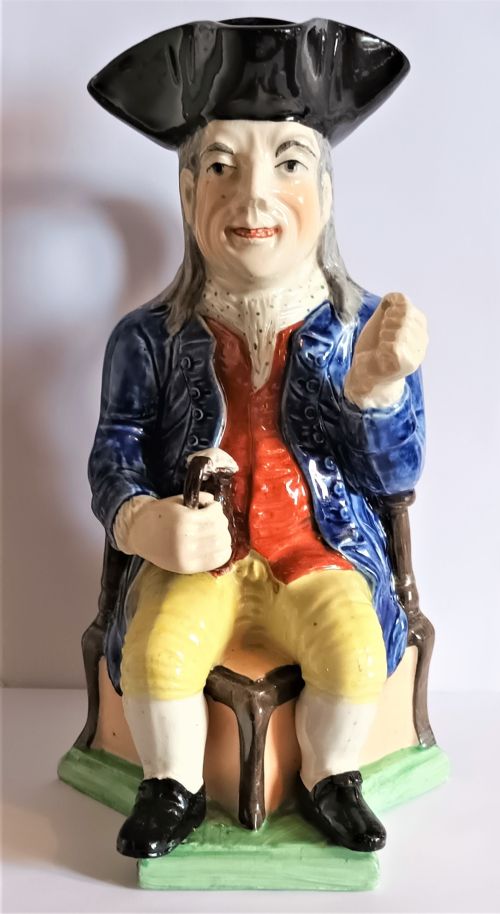


Multicoloured Pottery Figure
A multicoloured pottery figure brings character and story to a shelf, capturing historical subjects, literary favourites and animals in vibrant earthenware.
Multicoloured Pottery Figure
When you search for a multicoloured pottery figure, you encounter a diverse gathering of decorative ceramics that span the Georgian and Victorian eras up to the early twentieth century. These pieces take the form of Staffordshire flatbacks, Toby jugs, tobacco jars, and spill vases depicting historical leaders, literary characters, and rustic subjects.
The pieces you are most likely to meet on this page originate from English kilns, particularly Staffordshire, alongside examples from Scottish Portobello potteries, Italian majolica workshops, Dutch makers, and Edwardian factories. They range from primitive folk art figures to detailed royal portrait pairs and Italian Renaissance Revival statuettes.
Subjects vary widely from biblical scenes and military generals to figures like Robin Hood, Little Red Riding Hood, and traditional street sellers. Whether styled as flatbacks meant to stand before a mantelpiece or functional tobacco jars, each multicoloured pottery figure reflects the popular tastes and domestic ornamentation of its period.
Materials and methods of construction
Makers shaped these earthenware and pearlware ceramic bodies by hand or in moulds before applying lead glazes and enamel paints to create the characteristic multicolour palette. Potters utilised low-firing techniques suited to porous earthenware, sealing the clay body beneath glossy or translucent lead glaze.
Listings feature earthenware, pearlware, and ceramic bodies finished with lead glaze and enamel paint across the Georgian and Victorian eras.
Distinctions in quality
The preservation of the original enamel paint and lead glaze heavily influences the standing of a piece, as bright and undisturbed surface decoration retains the intended visual impact. Pairs and matched sets also command distinct interest compared to single survivors.
Wedgwood & Co. Ltd·Lakin & Poole·Rozenburg
The Multicoloured Pottery Figure Glossary
- Flatback
- A figure moulded with a finished front and a plain, unglazed or partially glazed flat reverse designed to sit flush against a wall or mantelpiece. These pieces appeared frequently in Victorian parlours.
- Pearlware
- A refined earthenware developed in the late eighteenth century featuring a subtle bluish tint in the glaze, precursor to many nineteenth-century figures. It provided a whiter surface for enamel decoration.
- Lead glaze
- A glossy coating containing lead oxide applied to earthenware and fired to create a waterproof and lustrous finish. This technique enhanced the brightness of underlying ceramic colours.
- Toby jug
- A pottery jug modelled in the form of a stout, jovial man, usually seated and holding a mug of beer or a pipe. They serve both a decorative and a functional purpose.
- Spill vase
- A hollow figural vase designed to hold taper candles or wooden spills used for lighting pipes and fires. These typically stand beside animals or human figures.
Multicoloured Pottery Figure: Frequently Asked Questions
What periods do these figures come from?
The pieces span from the late eighteenth century through the Georgian and Victorian periods up to Edwardian times. Most examples date from the nineteenth century.
Production methods and subjects shifted across these decades, moving from early primitive folk art and pearlware to mass Victorian flatbacks and later majolica or factory pieces.
Were these figures meant for display?
Most pieces served as decorative ornaments intended for display on mantelpieces, shelves, and side tables in domestic interiors. Flatback designs specifically suited placement against walls.
Certain forms, such as Toby jugs and tobacco jars, combined decorative figural modelling with practical utility in the home.
What are spill vases used for?
Spill vases incorporate a small cylindrical holder alongside the main figural subject to store wooden tapers or spills. Households used these tapers to transfer fire from the hearth to candles and pipes.
They frequently depict animals, such as dogs, positioned beside the central tube.