

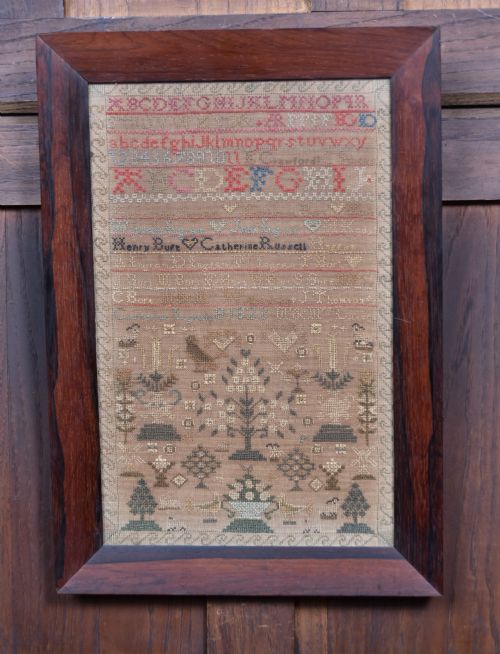


Early 19th Century Needlepoint
Early 19th century needlepoint brings together intricate textile art and period frames, offering tactile history for the collector.
Early 19th Century Needlepoint
Early 19th century needlepoint encompasses framed pictures, sampler panels, and upholstered seating such as armchairs and side chairs retaining wool work seats. These pieces originate from the Georgian, Regency, and nineteenth-century periods, often manifesting as silkwork pictures, crewel work embroidery, or felt and wool work pictures.
The buyer looking at early 19th century needlepoint most frequently encounters framed textile art alongside mahogany seating featuring period needlework inserts. Scottish and English examples appear across the listings, showing narrative scenes and traditional sampler layouts from around 1800 to 1840.
Materials and construction
Maker construction combines textile craft with cabinetmaking, utilising linen grounds worked in wool, silk, and felt. Framed pictures employ glass for protection alongside wood and giltwood framing.
Seating forms employ mahogany and wood frames, sometimes inlaid, fitted with brass elements and wool work seats. Embroidery techniques range from crewel work to detailed silkwork embroidery.
An early needlework picture preserves a stitched scene from the story of Jack and the Beanstalk.
Assessing quality in early pieces
Quality rests upon the fineness of the stitchwork and the preservation of the textile medium. Silkwork and wool work retain greater appeal when the colour and thread tension remain intact across the pictorial surface.
The structural integrity of the accompanying mahogany frames, side chairs, and armchairs influences overall merit. Original framing and undisturbed needlework panels distinguish superior examples from heavily restored counterparts.
The Early 19th Century Needlepoint Glossary
- Samplers
- Textile panels worked by individuals to demonstrate proficiency in various stitches and alphabets. They frequently include names and dates.
- Crewel work
- Embroidery executed in wool yarn onto a linen twill ground, producing textured surface designs. It appears commonly in early pictorial pieces.
- Silkwork
- Needlework created using fine silk threads, often combined with painted backgrounds to depict figures or landscapes. These pictures typically sit beneath glass.
- Giltwood
- Wood carved and coated with a thin layer of gold leaf, utilised for picture frames. This finish reflects period interior aesthetics.
Early 19th Century Needlepoint: Frequently Asked Questions
What is early 19th century needlepoint?
It includes framed embroidered pictures, samplers, and upholstered seats created during the Georgian and Regency eras.
These works utilise wool, silk, and felt on linen grounds, framed in wood or giltwood.
How were samplers used?
Samplers served as educational exercises for young makers to practice lettering, numbers, and decorative stitches.
They often recorded the maker's name, age, and school, preserving personal social history.
How do I care for needlework?
Keep textile art away from direct sunlight to prevent the silk and wool threads from fading.
Ensure framed pieces remain sealed behind glass to protect the delicate fibres from dust and moisture.
What distinguishes Regency needlework seats?
Regency seating incorporates wool work inserts directly into mahogany armchairs and side chairs.
This combines functional furniture with decorative textile arts characteristic of the early nineteenth century.