
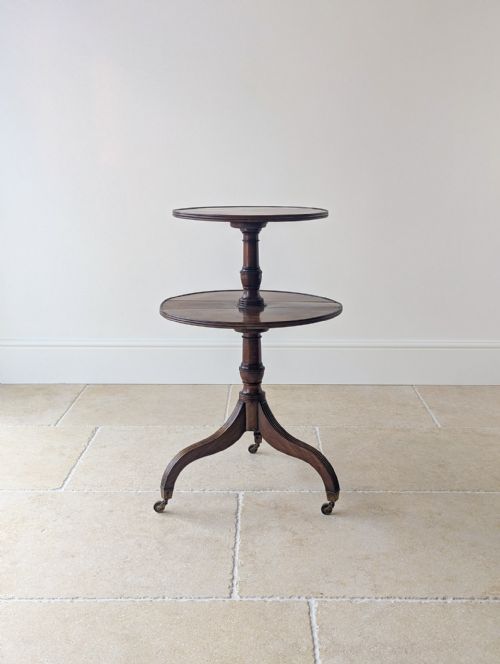


Drop Leaf Dumb Waiter
These drop leaf dumb waiter pieces are ingenious tiered serving servers with folding shelves, designed to hold dishes near the dining table without crowding it.
Drop Leaf Dumb Waiter
When you search for drop leaf dumb waiter, you find multi-tiered serving furniture built with hinged flaps that drop down or fold away when not in use. These pieces belong primarily to the Georgian, George III, and Regency periods, spanning the late eighteenth century into the early nineteenth century.
The versions you meet most often on this page take circular or octagonal forms arranged in two or three tiers connected by central columns and brass fittings. Their folding leaves allow them to stand compactly against a wall before opening out to hold dishes and serving items during a meal.
How they were made
Cabinet makers constructed these serving stands from solid mahogany, utilising the dense grain to build sturdy upright columns and shaped tabletops. The wood was finished to bring out a deep, warm tone that suited formal dining rooms.
Working brass hardware provides the mechanism for the folding leaves and drop shelves, allowing sections to raise and lower securely. These metal components ensure the tiered leaves remain stable when loaded with heavy ceramics or silver.
Dining companions appreciated these quiet tiered stands because they allowed dinner table conversations to continue without servants overhearing local gossip.
What varies in quality
Quality also shows in the integration of the folding mechanism and the proportion of the vertical tiers. Better examples balance three folding shelves gracefully on a sturdy column without appearing clumsy when fully extended.
The Drop Leaf Dumb Waiter Glossary
- Dumb waiter
- A tiered serving stand designed to hold food and tableware independently of servants during a meal. These pieces often feature revolving or folding shelves.
- Drop-leaf
- A table or tier with hinged flaps that can be folded down to save space or raised to increase surface area. This mechanism defines the primary utility of these serving pieces.
- Tiered table
- Furniture built with multiple horizontal surfaces arranged vertically on a single central column. They maximise surface area within a compact floor footprint.
- Regency
- An English design period spanning the early nineteenth century, characterised by classical restraint and refined proportions. Pieces from this era often display clean lines and dark mahogany.
Drop Leaf Dumb Waiter: Frequently Asked Questions
What is a drop leaf dumb waiter?
A drop leaf dumb waiter is a multi-tiered piece of dining room furniture featuring folding shelves attached by hinges. It was designed to hold food, wine, and plates near the dining table.
Most surviving examples date from the Georgian and Regency periods, constructed in mahogany with brass fittings and circular or octagonal tiers.
How were dumb waiters used?
These pieces served as silent assistants during formal meals, holding extra dishes and serving items so diners could help themselves without requiring constant attendance from staff.
The folding leaves allowed the stand to remain compact during storage or smaller gatherings, opening up fully when extra surface space was required.
How do I tell George III from Regency pieces?
George III pieces typically date from the late eighteenth century, displaying traditional cabinet making with circular or octagonal tiered shelves and folding flaps. They rely on solid mahogany and sturdy central columns.
Regency examples generally lean towards the early nineteenth century, featuring refined classical proportions and crisp turning on the central pillar while maintaining the practical folding shelf design.
Where should I place a dumb waiter at home?
A dumb waiter sits comfortably in a dining room, serving room, or drawing room as a practical surface for displaying ceramics or holding drinks. With the leaves dropped, it occupies minimal floor space against a wall.
Opening the folding leaves transforms the piece into a wide tiered display stand suitable for entertaining guests or holding books.