

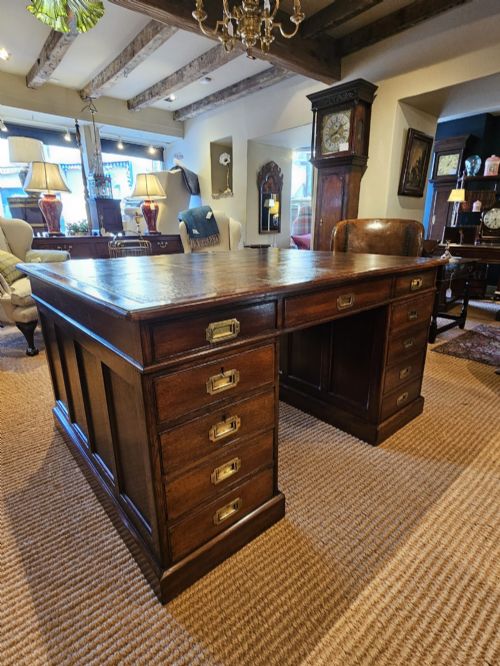
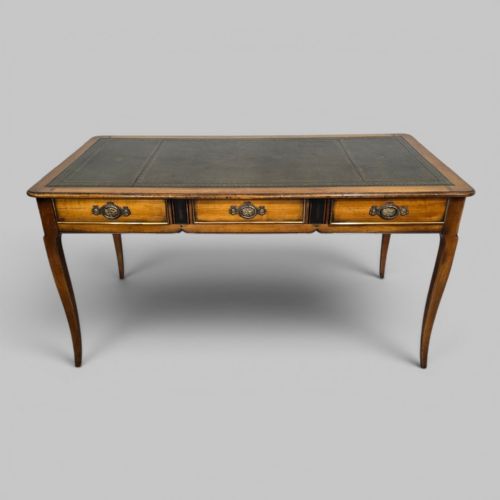


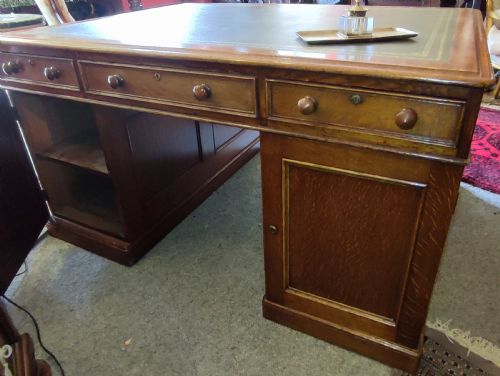


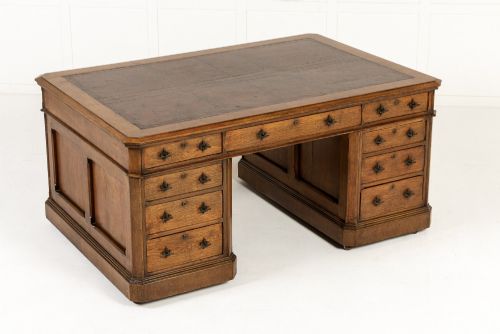

Double Sided Oak Desk
A double sided oak desk gives you a working surface on both faces, built for two people to sit opposite each other.
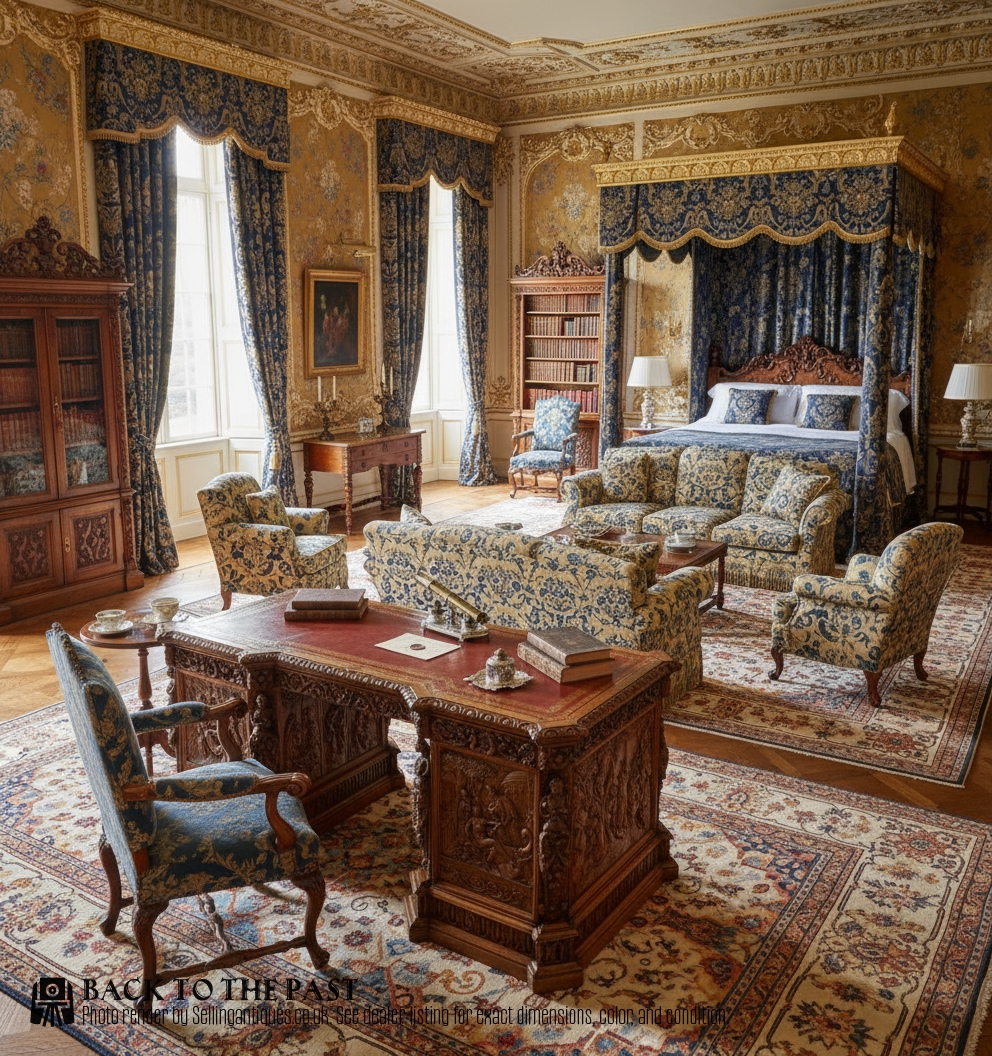
Double Sided Oak Desk
When you search for a double sided oak desk, you are looking at substantial pieces designed with drawers and cupboards accessible from both sides, often called partners desks. These workspace furniture pieces appear in periods ranging from the early nineteenth century through the Victorian era up to nineteen-ten, drawing on styles such as Regency, Arts and Crafts, and French Provincial.
The version you are most likely to meet on this page is the large pedestal desk formed of two drawer pedestals supporting a wide top. They emerge in various oak finishes, including burr oak, blond oak, limed oak, and ebonised wood.
Makers and workshops constructed these desks for libraries, studies, and grand offices where two people needed to work facing one another. The evidence shows pedestal desks, kneehole desks, and writing tables spanning diverse aesthetic movements from Gothic Revival to Edwardian designs.
How they were made
Cabinet makers utilised solid oak and burr oak timbers to build the structural frames and panelled sides of these large desks. They incorporated hand-carved religious panels or simpler moulded detailing depending on the decorative style of the period.
Working surfaces typically feature inset leather writing pads bordered by timber surrounds. Drawers and cupboards utilise brass hardware, such as original brasses and handles, fitted securely to the solid wood construction.
Double Sided Oak Desk Retail Price Guide 2026
Typical asking prices for double sided oak desk among the pieces listed under this phrase on Sellingantiques today, from the lower quarter to the upper quarter. They describe what is for sale here now, not the wider market.
Listings feature oak partners desks spanning the nineteenth century, Victorian era, Regency period, and early twentieth century.
What varies in quality
The distinction between standard examples and the finest pieces lies in the selection of timber figure, such as richly patterned burr oak, and the precision of the joinery. Superior desks exhibit harmonious proportions and well-figured grain across all visible double-sided panels.
Execution of decorative elements, from hand-carved panels to original brass furniture, separates ordinary workshop production from museum-quality examples. The integrity of the secondary timbers and the original leather writing surface also define the standing of a desk.
T Wilson·Heals
The Double Sided Oak Desk Glossary
- Partners desk
- A large double-sided desk designed for two people to work opposite one another, featuring drawers and cupboards on both faces. These pieces were traditionally utilised in libraries and private studies.
- Pedestal desk
- A freestanding desk comprising a top supported by two pedestals containing banks of drawers. The pedestals rest directly on the floor.
- Burr oak
- Timber taken from a growth on an oak tree, showing a distorted and highly figured grain pattern. Cabinet makers used burr oak veneer on high-status furniture fronts and tops.
- Kneehole desk
- A desk with a central recess for the legs, flanked by pedestals of drawers on either side. This form provides a comfortable seating position for a single user.
- Ebonised wood
- Timber treated with chemical stains or dark finishes to imitate ebony. This technique was popular during the Victorian period for accentuating architectural details.
Double Sided Oak Desk: Frequently Asked Questions
What is a double sided oak desk?
A double sided oak desk is a large workspace piece fitted with drawers and cupboards on both faces, allowing two people to sit opposite each other. These items are frequently referred to as partners desks in the trade.
They appear in various historic styles, from Victorian and Regency to Arts and Crafts, utilising solid oak, burr oak, and ebonised timber.
How do I date an oak partners desk?
Dating relies on examining the construction methods, timber selection, and stylistic details characteristic of periods like the nineteenth century or Edwardian era. Hardware such as original brasses also helps confirm the age of the piece.
Cabinet makers of different decades applied distinct decorative vocabularies, ranging from Gothic Revival carvings to plain limed oak finishes.
Where were these desks used?
These desks were designed for grand domestic libraries, solicitors offices, and administrative headquarters where colleagues needed to work face-to-face. Their double-sided configuration provided independent storage and workspace for two individuals.
Because they are finished on all sides, they typically stood in the centre of a room rather than against a wall.
Are all partners desks made of solid oak?
While oak is the primary structural material, makers frequently incorporated oak veneers, such as burr oak, to create decorative patterns on large surfaces. Secondary timbers appear in drawer linings and internal framing.
Some examples also combine oak with leather writing inserts and brass hardware.