


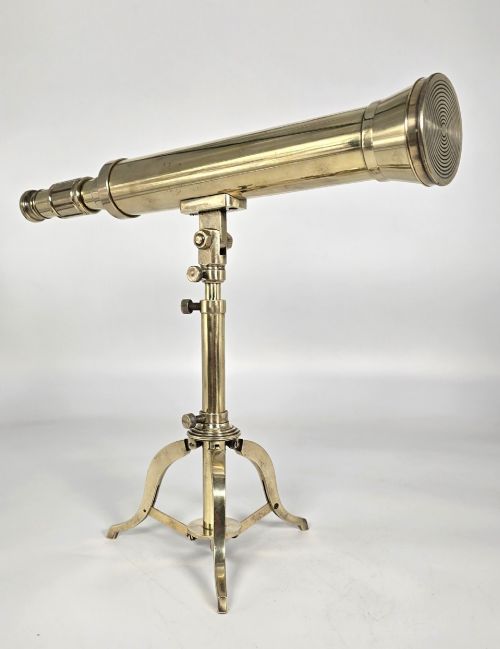


Desktop Brass Telescope
A desktop brass telescope brings both historical precision and polished optical craft to a study or library table.
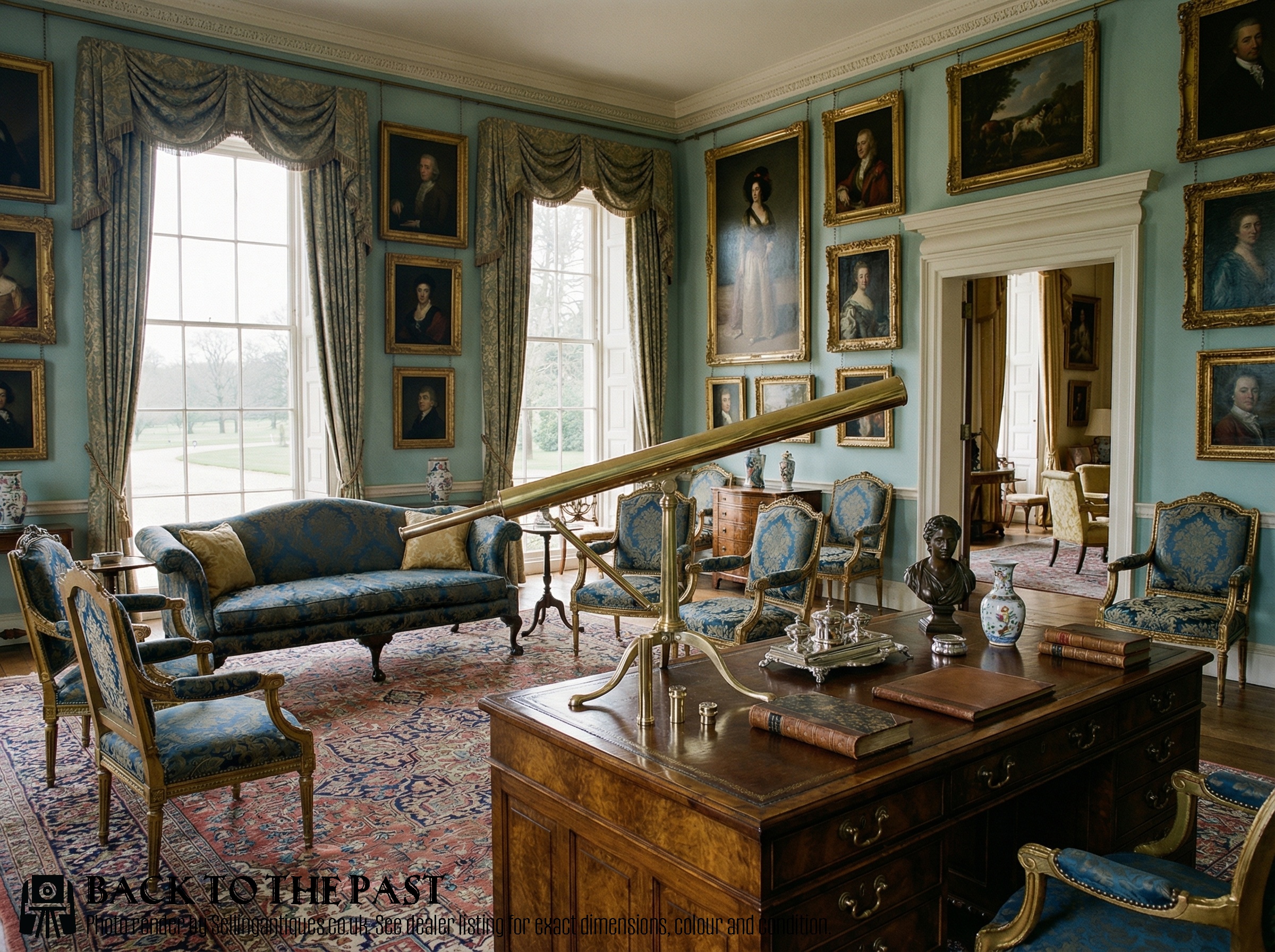
Desktop Brass Telescope
When you search for a desktop brass telescope, you are looking at scientific and navigational instruments designed for tabletop use rather than full deck deployment. These pieces span from the eighteenth century through the Victorian era and into the early twentieth century, showing a clear evolution in domestic scientific display.
You are most likely to meet two-draw or three-draw library telescopes mounted on folding stands or heavy bases, often housed in fitted wooden cases. The forms range from compact Gregorian and library models to larger astronomical instruments intended for serious study.
The origins stretch from Georgian London workshops to Victorian English makers, reflecting a period when optical instruments were both working tools and status objects for the home.
Materials and construction methods
These instruments rely heavily on polished brass for the main barrel assemblies and draw tubes, paired with clear glass lenses to achieve magnification. Many examples integrate mahogany or other hardwoods for bases, fitted presentation cases, and carrying handles.
Leather is frequently used to wrap the brass body tubes of Victorian multi-draw models, providing a secure grip and a tactile contrast to the metal fittings. Nickel plating and gilt brass finishes appear in later nineteenth and early twentieth century pieces to alter the surface appearance and durability.
Makers utilised cast iron for stable folding tripod stands on heavier tabletop variants, ensuring the instrument remained balanced during observation.
The listings show instruments spanning the eighteenth century, the Georgian period, the Victorian era, and the nineteen-twenties.
The markers of finer quality
Quality in these instruments rests on the precision of the draw action and the clarity of the optical glass. Finer pieces demonstrate smooth movement between brass tubes without slack or binding, indicating careful lathe work by the original maker.
The presence of an original fitted case or a matching folding tripod stand elevates a piece, as these accessories are frequently separated or lost over decades of use. Engraved signatures on the barrel or eyepiece draw from recognised London makers signal higher workshop standards than unsigned commercial output.
Nairne & Blunt of London·S & B Solomons·Matthew Berge London·G.adams of london·Broadhurst & Co
The Desktop Brass Telescope Glossary
- Draw
- A sliding tubular section of a telescope that pulls out to focus the instrument. Multi-draw examples allow the telescope to collapse into a compact length for storage.
- Gregorian
- A type of reflecting telescope using a concave primary mirror and a secondary mirror to redirect light back through an aperture in the main mirror. This design provides an upright image suitable for terrestrial viewing.
- Library telescope
- A larger optical instrument designed for stationary use on a table or desk rather than handheld navigation. These typically require a dedicated stand or pillar mount.
- Objective lens
- The primary glass lens at the front of the telescope that gathers light from the object being viewed. Its diameter determines the light-gathering power of the instrument.
Desktop Brass Telescope: Frequently Asked Questions
What is a desktop brass telescope used for?
These instruments were originally employed for terrestrial viewing, astronomy, and navigation from a stable tabletop position in a home library or study.
Today, they serve primarily as decorative objects that showcase period optical engineering and craftsmanship.
How do I identify a Georgian telescope?
Georgian instruments often feature hand-engraved maker signatures on the brass draw tubes and simple, robust wooden or brass mountings typical of eighteenth-century workshop practices.
They tend to focus on library and Gregorian configurations without the later leather wrapping common in Victorian designs.
Are these telescopes still functional?
Many of these pieces retain their original glass lenses and adjustable draws, allowing them to magnify distant objects when properly focused.
Their primary appeal, however, lies in their historical status and decorative presence rather than modern optical performance.
How should I care for a brass telescope?
Keep the instrument in a stable environment away from excessive moisture to protect the glass optics and prevent tarnishing on the metal surfaces.
Avoid aggressive metal polishes on signed brass barrels, as harsh chemicals can wear away historical engravings and maker marks.