


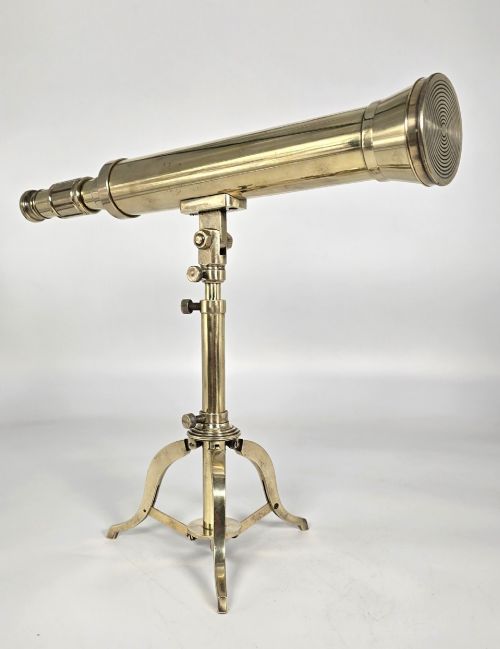


Antique Brass Refractor
An antique brass refractor is a precision optical instrument built to bring distant horizons or stars into sharp, clear view.
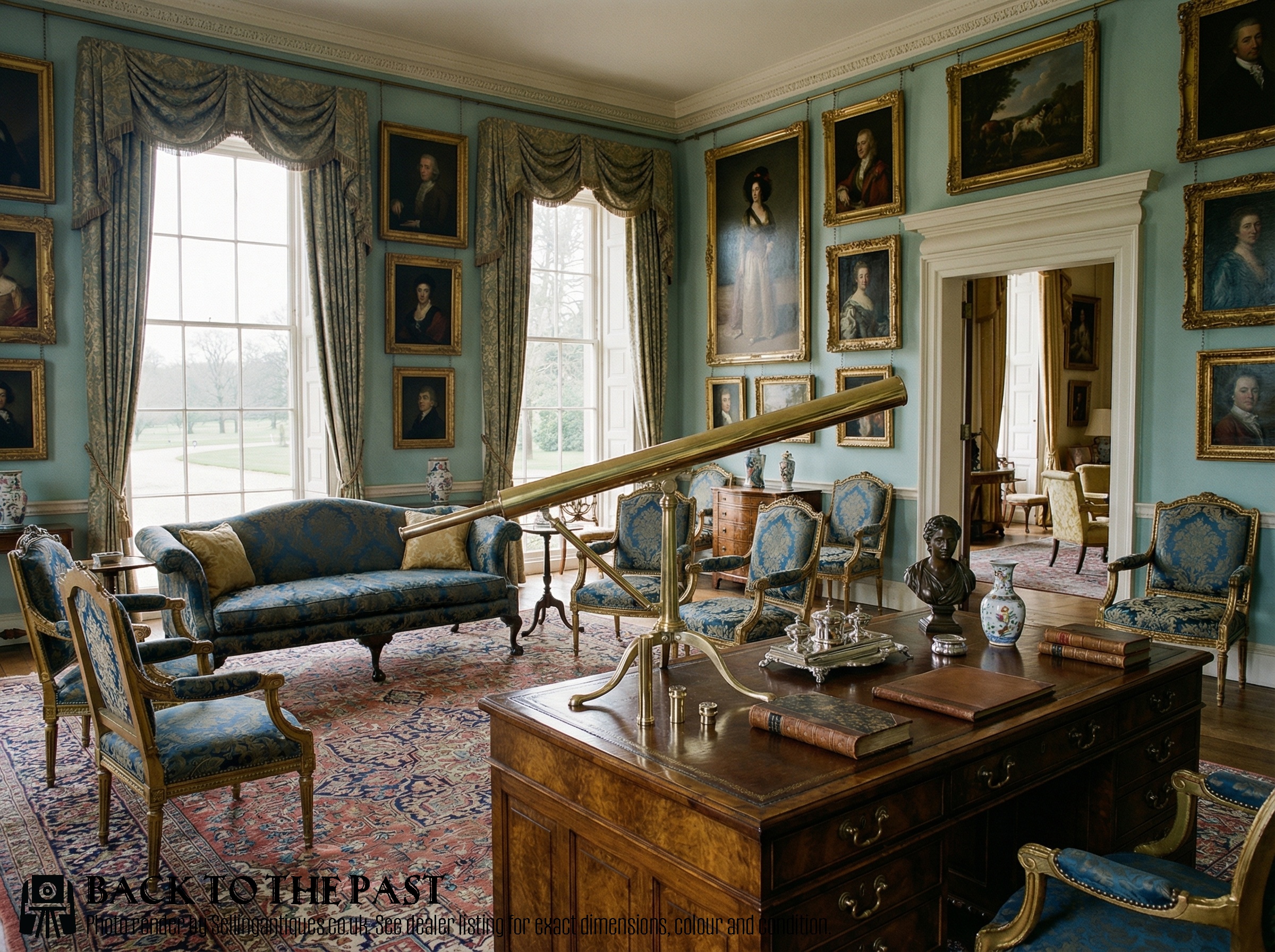
Antique Brass Refractor
When you search for an antique brass refractor, you encounter historic optical instruments designed primarily as library, table top, pocket, or maritime telescopes. These pieces date from the eighteenth century through the early twentieth century, spanning Georgian, Regency, and Victorian periods.
The version most commonly met on this page is the English brass telescope, often featuring multiple draw tubes constructed from polished brass and frequently paired with fitted mahogany boxes, leather grips, or folding brass tripods.
How they were made
Maker workshops constructed these instruments using heavy brass for the main barrels and draw tubes, often combining the metal with glass lenses, turned mahogany bodies, and stitched leather coverings. Cast iron and steel also appear in support structures like folding tripods.
Opticians housed multiple lens elements inside sliding draw tubes to allow manual focusing for terrestrial and astronomical viewing. Metal components received polished finishes, while specialised makers engraved signature details directly onto the brass barrels.
Listings demonstrate instruments constructed from brass, glass, mahogany, steel, and cast iron across eighteenth, nineteenth, and early twentieth century periods.
What varies in quality
Quality rests upon the optical clarity of the glass lenses and the precision engineering of the sliding brass draw tubes, which should extend smoothly without excessive play. Heavier gauge brass and crisp maker signatures engraved on the metal elevate a piece above standard utility models.
The presence of original fitted mahogany cases, leather wrappings, and stable folding tripod stands indicates a higher tier of historic scientific instrument production.
Nairne and Blunt of London·W and T Gilbert London·Steward of London·S and B Solomons·G Adams of London·Broadhurst and Co
The Antique Brass Refractor Glossary
- Refractor
- An optical telescope that uses lenses to form an image. This design bends light through glass objectives to magnify distant objects.
- Draw tube
- A sliding section of tubing that extends to adjust the focal length. Telescopes often utilise multiple draws to achieve compactness when closed.
- Terrestrial refractor
- A telescope configured to show upright images of land-based subjects. These instruments often include internal erecting lenses for correct orientation.
- Library telescope
- A large optical instrument designed for stationary indoor use on a table or tripod. Such pieces feature substantial brass barrels and high magnification.
- Achieved focal length
- The distance between the optical centre of the lens and the point where rays converge. This measurement determines the overall magnifying power.
Antique Brass Refractor: Frequently Asked Questions
What is a refractor telescope?
A refractor telescope is an optical instrument that gathers light through a primary glass lens at the front to magnify distant views.
Historic examples use brass tubes and multiple sliding draws to achieve correct focus for terrestrial or astronomical observation.
How were library telescopes used?
Library telescopes were large optical instruments positioned on sturdy table top tripods or pillars within domestic studies and libraries.
Owners utilised them to examine distant landscape vistas or observe celestial bodies through tall windows.
How do I date an antique brass telescope?
Dating relies on mechanical construction details, material combinations such as mahogany and brass, and engraved signatures from known London opticians.
Stylistic shifts from Georgian simplicity to Victorian manufacturing methods help narrow the period of production.
How should I clean antique brass?
Historic scientific instruments retain character through the natural oxidation and mellow patina built up on the brass over centuries.
Aggressive polishing removes this aged surface, so dusting with a soft dry cloth is the preferred method of care.