




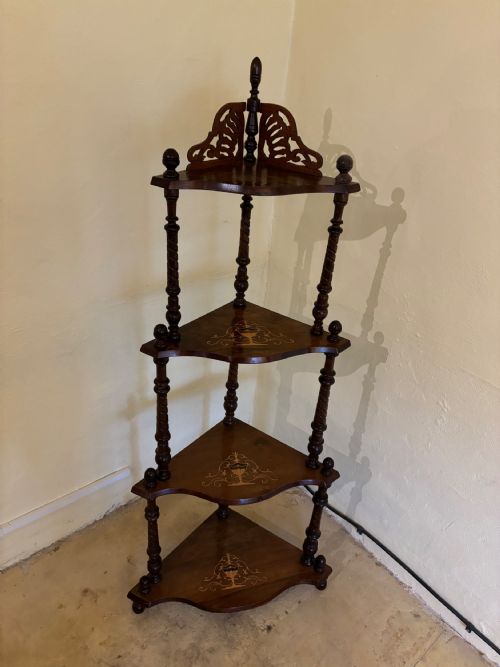
Dark Walnut Etagere
These dark walnut etagere pieces are multi-tiered display stands built for drawing rooms, offering both open shelving and enclosed cabinets to showcase treasured ornaments.
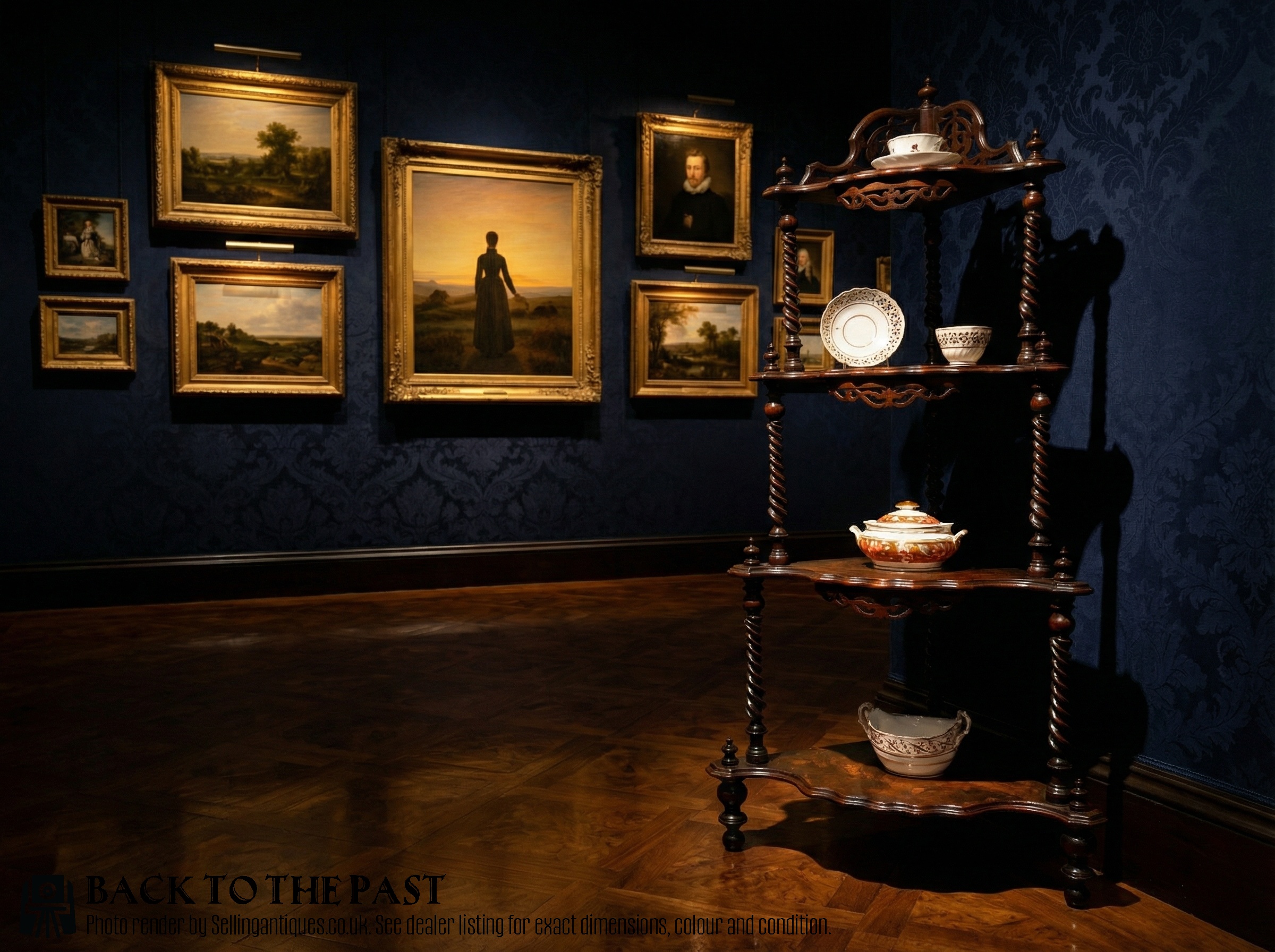
Dark Walnut Etagere
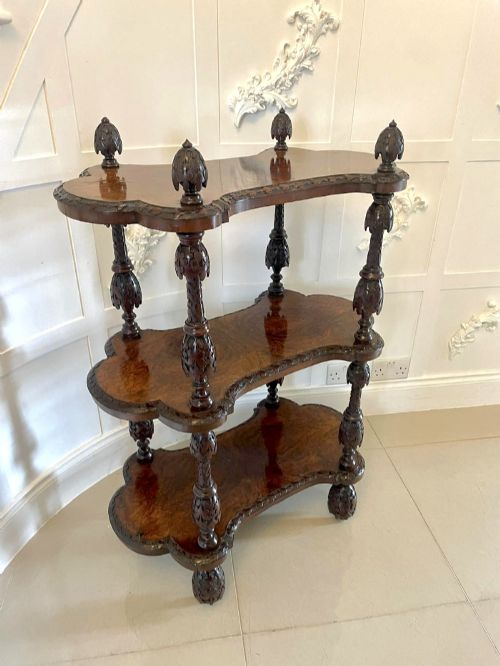
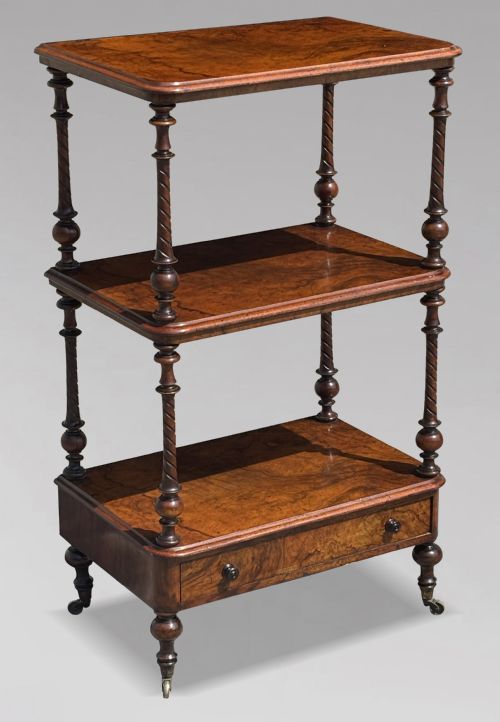
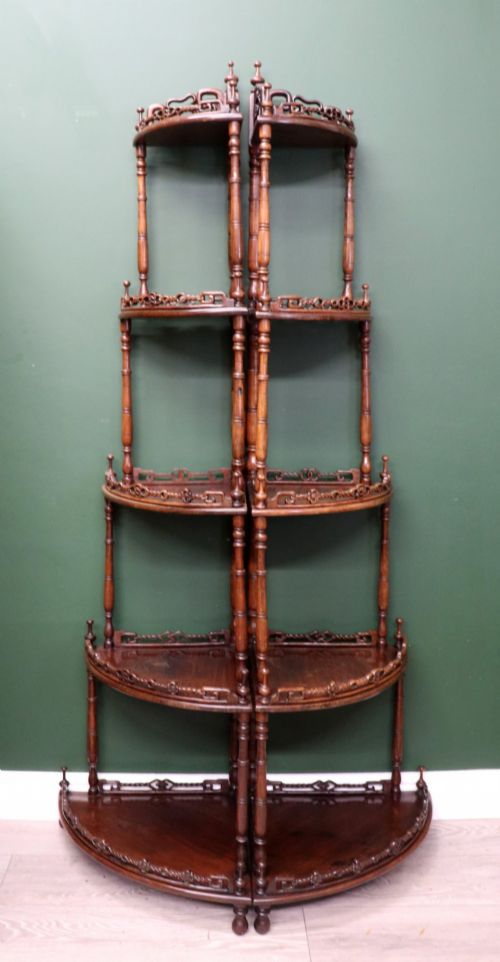
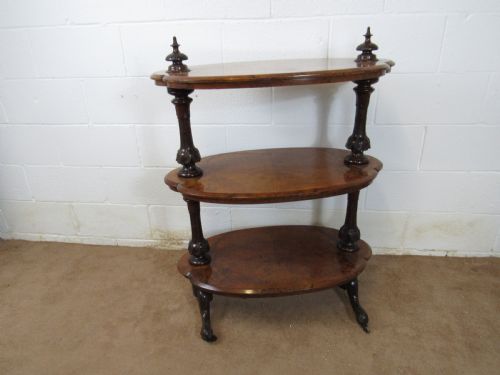
A dark walnut etagere is typically encountered in nineteenth century Victorian forms, ranging from freestanding three-tier whatnots to corner shelves and wall-mounted cabinets. These tiered display units were designed to hold books, ceramics and decorative objects in domestic interiors.
The selection includes related forms such as music cabinets, console tables and corner whatnots sharing the same timber and tiered arrangement. Pieces span several decades from the mid-nineteenth century onwards, reflecting diverse stylistic influences including French provincial and Japonisme.
Freestanding examples often feature turned supports or carved pillars separating the open shelves, whilst wall-mounted versions maximise smaller spaces. Each piece demonstrates the versatility of Victorian storage furniture adapted for display rather than hidden utility.
Materials and construction
Construction relies primarily on walnut and burr walnut, valued for deep colour and rich grain patterns, sometimes enhanced by wood inlay or brass details. Glass panels and gilt bronze mounts appear on specific decorative items, adding textural contrast to the timber frames.
Master cabinetmakers utilised traditional joinery alongside hand carving to shape the tiered shelves, structural uprights and occasional leather writing surfaces. The application of French polish deepened the dark tone of the walnut, protecting the timber whilst accentuating natural figuring.
Dark Walnut Etagere Retail Price Guide 2026
Typical asking prices for dark walnut etagere among the pieces listed under this phrase on Sellingantiques today, from the lower quarter to the upper quarter. They describe what is for sale here now, not the wider market.
Listings feature walnut and burr walnut predominantly, complemented by occasional brass, glass and gilt bronze elements across Victorian periods.
Judging quality and craftsmanship
Quality rests upon the selection of timber, where figured burr walnut veneer or finely matched solid walnut indicates a superior piece. The crispness of hand-carved ornamentation and the integration of delicate inlays distinguish standard production from exhibition pieces.
Structural integrity depends on the stability of the tiered shelves and the precision of the joints connecting uprights to platforms. Finer examples exhibit thoughtful proportions and harmonious details that elevate a functional display stand into a masterwork of the cabinetmaker's art.
Gabriel Viardot
The Dark Walnut Etagere Glossary
- Etagere
- A piece of furniture consisting of a set of open shelves for displaying small objects or ornaments. These tiers are typically supported by slender columns or pillars.
- Whatnot
- A nineteenth century term for an etagere or multi-shelved stand used for storage and display. They frequently appear in corner or freestanding formats.
- Burr walnut
- A prized timber harvested from walnut tree growths, displaying swirling and intricate grain patterns. It is typically used as a veneer on prominent surfaces.
- Japonisme
- A late nineteenth century artistic style influenced by Japanese art and design. It manifests in furniture through asymmetrical layouts and orientalised decorative motifs.
- Gilt bronze
- Copper alloy treated with a gold coating to provide decorative metallic mounts. It is frequently employed to accent handles, feet and structural terminals.
Dark Walnut Etagere: Frequently Asked Questions
What is the difference between an etagere and a whatnot?
An etagere and a whatnot are fundamentally the same type of tiered display furniture, though the term whatnot is more commonly found in nineteenth century British records. Both serve to exhibit ornaments and books across multiple open levels.
Usage depended on the room, with etageres often standing freely as centrepieces and whatnots frequently tucking into corners or against walls to save space.
How do I date a Victorian walnut etagere?
Dating relies on examining the timber selection, construction methods and decorative styles present in the piece. Mid-nineteenth century items often feature robust turned supports and rich burr walnut veneers.
Later Victorian examples from the eighteen-eighties and nineties may incorporate stylistic shifts like Japonisme or more intricate hand-carved detailing.
Where should I place a corner whatnot at home?
A corner whatnot is specifically designed to fit snugly into ninety-degree room angles, making use of otherwise neglected floor space. They work well in living rooms, hallways or studies to display small collections.
Ensure the unit is positioned away from direct sunlight and strong heat sources to protect the walnut timber and polished finish.
Can these shelves hold heavy books?
These tiered units were primarily built for decorative display rather than heavy library storage. The open shelves are well-suited for lighter volumes, ceramics, glassware and small sculptures.
Freestanding nineteenth century examples provide sturdy support for standard ornaments, but wall-mounted versions require secure fixing if holding heavier items.