
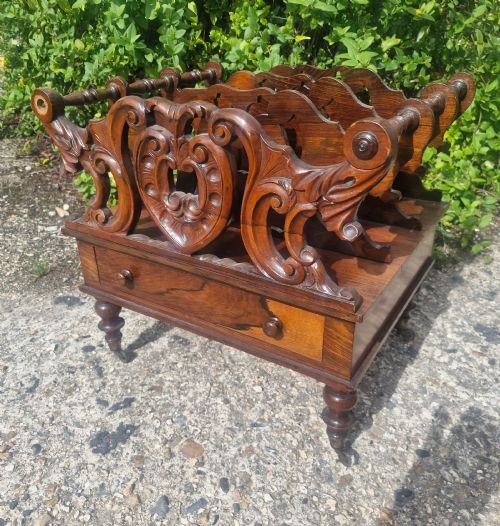
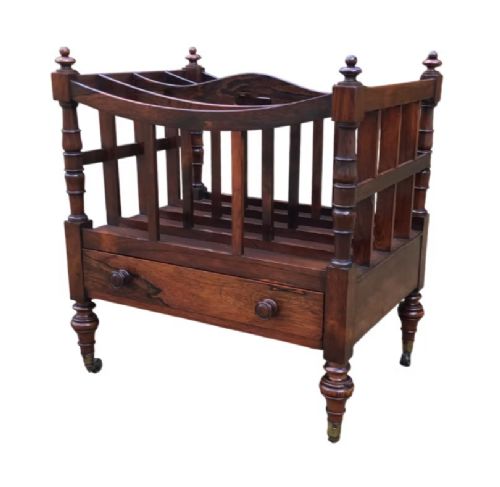
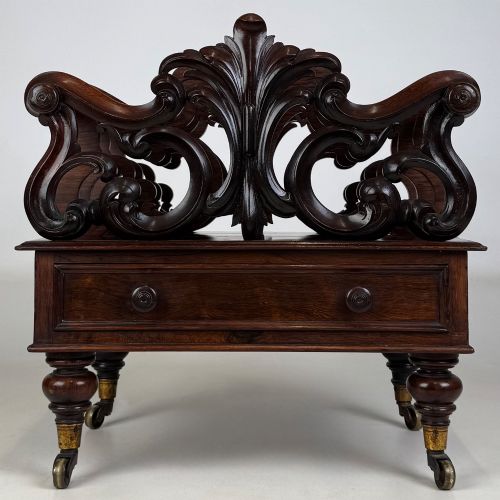


Dark Rosewood Magazine Rack
A dark rosewood magazine rack brings deep timber tones and structured compartments for periodicals into a traditional interior.
Dark Rosewood Magazine Rack
A dark rosewood magazine rack, frequently encountered under the traditional name canterbury, serves as a compartmentalised stand for newspapers, journals, and sheet music. These pieces date predominantly from the nineteenth century, spanning the Regency, William IV, and Victorian periods.
The form typically comprises vertical slatted divisions raised above castors or small feet, sometimes incorporating a lower drawer for smaller items. English examples dominate the selection, alongside occasional French and American pieces reflecting similar functional demands.
Variations include music stands, folio stands, and combined whatnot designs that integrate shelving above the main storage partitions. Buyers seeking a dark rosewood magazine rack will most commonly find nineteenth-century canterburys adapted to hold modern periodicals.
How they were made
Constructed primarily from rich rosewood timber, these items utilise the dense grain and deep natural colour of the wood to create strong structural frames. Brass details, including carrying handles, casters, and inset fittings, provide functional contrast to the dark timber surfaces.
Joinery techniques involve precise framing for the vertical divisions and turned supports, whilst decorative elements often incorporate carved foliage, Prince of Wales feathers, or Gothic Revival motifs. Ceramic components and occasional glass or metal elements appear in specific hardware or structural fittings.
The listings show pieces spanning the Regency, William IV, and Victorian periods, constructed primarily in rosewood with brass and ceramic details.
What varies in quality
The distinction between standard and superior pieces rests upon the crispness of the timber carving and the architectural balance of the partitions. Elaborate detailing, such as finely turned spindle legs or well-executed foliate carving, elevates a piece above simpler utility versions.
Proportion and scale also define the standing of a piece, with larger country house formats or documented design influences demonstrating greater ambition in cabinet-making. The integrity of the rosewood grain and the integration of original brass castors further determine the overall distinction of the object.
Gillows
The Dark Rosewood Magazine Rack Glossary
- Canterbury
- A low, multi-compartment stand designed for holding sheet music, newspapers, or periodicals. This term is frequently used interchangeably with magazine rack in nineteenth-century furniture.
- Regency
- A British design period spanning the early nineteenth century, characterised by classical restraint and refined architectural lines. Pieces from this era often display clean geometric forms or subtle classical motifs.
- William IV
- A transitional stylistic phase falling within the 1830s, bridging Regency elegance and heavier Victorian proportions. Furniture from this period frequently showcases bolder scrolling woodwork and substantial rosewood veneers.
- Whatnot
- A piece of open shelving furniture designed for displaying or holding small objects, sometimes combined with a canterbury base. These items provide multiple tiers alongside traditional compartment storage.
- Folio stand
- An oversized variant of the canterbury designed to hold large sheets of paper, prints, or folios. These items typically feature substantial proportions suited to grand drawing rooms.
Dark Rosewood Magazine Rack: Frequently Asked Questions
What is a canterbury?
A canterbury is a low compartmentalised stand originally built to hold sheets of music, newspapers, and unbound literature. The form emerged in the eighteenth century and remained popular through the Victorian era.
In modern settings, these pieces function effectively as magazine racks placed beside seating areas. Their vertical divisions keep periodicals upright and organised.
How do I date a rosewood rack?
Dating relies upon stylistic markers such as Regency classical lines, William IV scrollwork, or heavier Victorian carving. The presence of specific design influences or documented cabinet-maker styles also helps narrow the period.
Hardware details, including brass castors and fastening types, provide additional clues to the manufacturing decade. Construction methods observed inside the base drawers further indicate the era of production.
Where should I place it?
These racks suit living rooms, studies, or libraries where periodicals and reading materials accumulate near armchairs or sofas. Their freestanding nature allows them to sit comfortably beside desks or tables.
Because rosewood reacts to strong direct sunlight, positioning the piece away from south-facing windows preserves the deep tone of the timber. Regular placement in stable indoor environments protects the polished wood finish.
How do I care for rosewood?
Maintenance requires dusting with a soft, dry cloth to prevent surface grit from scratching the polished rosewood finish. Avoiding moisture and excessive heat protects the timber from warping or drying out over time.
Periodic application of appropriate furniture wax helps nourish the grain without building up heavy residues. Careful handling of brass castors and carrying handles prevents strain on the original joints.