
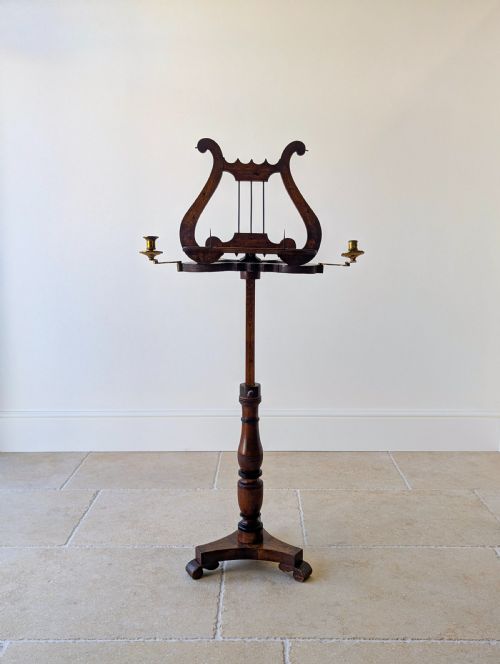


William IV Music Stand
A william iv music stand brings architectural timber and adjustable brass engineering together to hold scores in grand nineteenth-century libraries.
William IV Music Stand
When you examine a william iv music stand, you encounter pieces designed for the performance and reading of sheet music during the early nineteenth century. The examples on this page span the periods from Georgian through Victorian, with the William IV style and Regency influences dominating the selection.
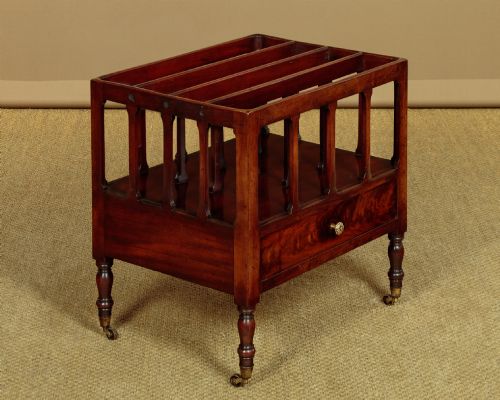
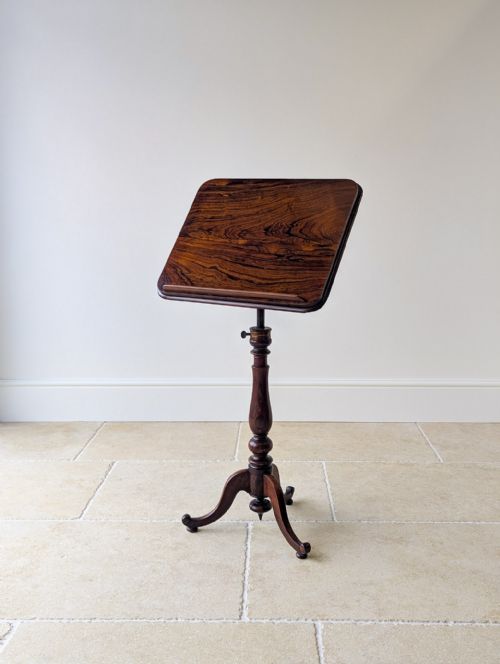
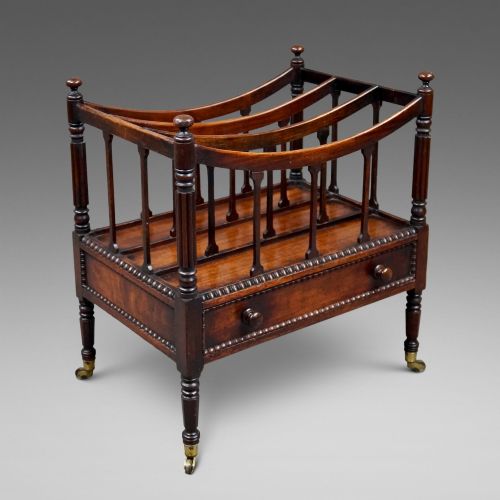
The forms extend beyond dedicated stands to include canterburys, reading stands, whatnots, and writing tables fitted with folio racks. Mahogany and rosewood form the majority of the wooden structures, often incorporating brass adjustments and lyre motifs.
How they were made
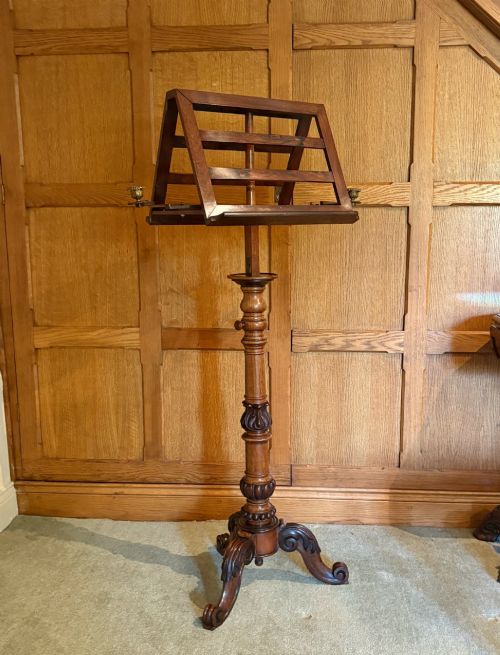
Cabinet makers utilised dense imported hardwoods like mahogany and rosewood, frequently incorporating goncalo alves or intricate inlay work to accentuate the grain. These timbers were turned, carved, and joined to form sturdy tripod bases, X-frames, and compartmentalised framework.
Metalworking played an essential functional role, with brass ratchets, screws, and pivots enabling the adjustable reading desks and music racks to alter height and angle securely. Steel components occasionally appear within the internal mechanisms and fittings of the stands.
William IV Music Stand Retail Price Guide 2026
Typical asking prices for william iv music stand among the pieces listed under this phrase on Sellingantiques today, from the lower quarter to the upper quarter. They describe what is for sale here now, not the wider market.
Listings feature 19th Century, Regency, Georgian, and Victorian periods alongside William IV styles.
What varies in quality
The sophistication of the timber selection and the crispness of the carving determine the standing of a piece, with figured rosewood and richly patinated mahogany sitting at the upper end. Attribution to known workshops or the presence of complex mechanical adjustments for reading heights elevates the execution.
Construction methods such as finely dovetailed joints, substantial brass hardware rather than plated iron, and harmonious proportions separate standard utility pieces from masterworks designed for prominent country house interiors.
Gillow·J.C.Loudon
The William IV Music Stand Glossary
- Canterbury
- A low piece of furniture with vertical partitions designed to hold sheet music, magazines, or books. This form frequently incorporates a small drawer beneath the divisions.
- Lyre-form
- A decorative motif shaped like an ancient stringed instrument, commonly used for the central support or music rest of stands. Carved timber or brass creates the open framework.
- Gonçalo Alves
- A dense exotic hardwood with striking contrasting dark brown and golden-brown figuring, utilised for select high-status pieces. It is often referred to as tiger wood.
- Whatnot
- An open set of tiered shelves supported by slender columns or pillars, used for displaying books or ornaments. These occasionally integrate reading stands or music storage.
William IV Music Stand: Frequently Asked Questions
What is a william iv music stand used for?
These stands were built to hold bound volumes or loose sheets of music at a comfortable height for musicians playing instruments or singing. They allowed performers to adjust the desk angle for optimal readability in parlours and music rooms.
Over time, many of these pieces adapted to serve general reading or display functions in domestic interiors, holding newspapers, folios, or books beside seating areas.
How do I identify a william iv music stand?
Look for architectural elements typical of the 1830s, such as heavy turned columns, carved lyre motifs, and robust tripod bases. Rosewood and mahogany are the predominant timbers found across these examples.
Check for adjustable brass ratchets and screw mechanisms, which were characteristic of the period's engineering. The integration of canterbury compartments for score storage is also a frequent design feature.
Are these stands adjustable for height?
Many examples feature original brass screw mechanisms or ratchet supports designed to alter the height and tilt of the reading desk. These functional parts allowed seated or standing musicians to position their scores precisely.
Care should be taken when operating antique metal adjustments to preserve the threaded brass components and wooden housing. Not every variant includes height adjustment, as static table-top models and compartmented racks also exist.
How do I care for rosewood and mahogany?
Maintain these dense tropical hardwoods by keeping them away from direct heat sources and strong sunlight, which can fade the finish. Regular dusting with a dry, soft cloth preserves the polished surface.
Apply occasional appropriate wax feeds sparingly if the timber appears dry, buffing gently to maintain the natural sheen. Avoid silicone-based sprays that can penetrate the historic grain and finish.