


Dark Rosewood Desk Box
A dark rosewood desk box combines rich timber with brass mounts, offering a practical compartment for correspondence and writing materials.
Dark Rosewood Desk Box
A dark rosewood desk box is primarily represented by writing slopes, document boxes, and campaign stationery containers originating from the Georgian, Regency, and Victorian periods. These pieces range from compact tabletop trinket containers to substantial brass-bound military slopes designed for travel.
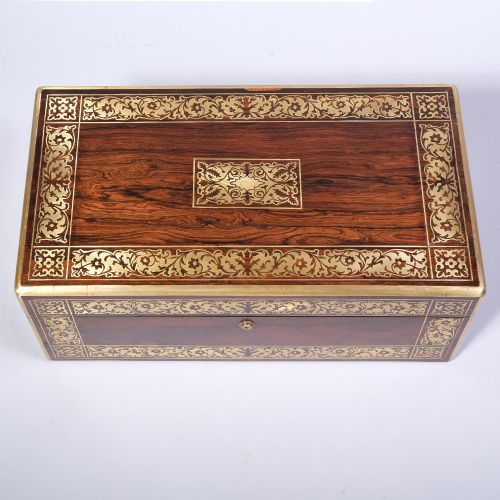
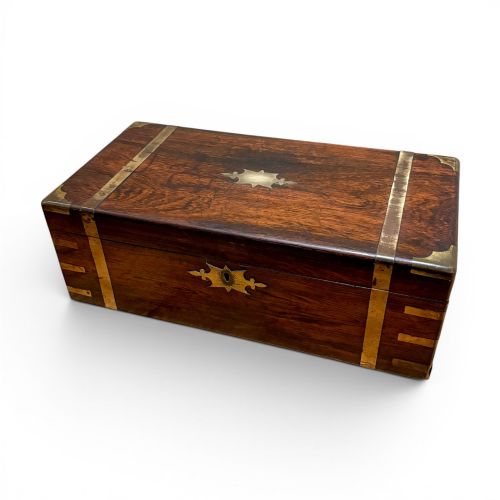
The version most commonly encountered on this page is the 19th-century writing slope or correspondence box, frequently detailed with brass inlay, corner mounts, and fitted internal compartments for inkwells and paper.
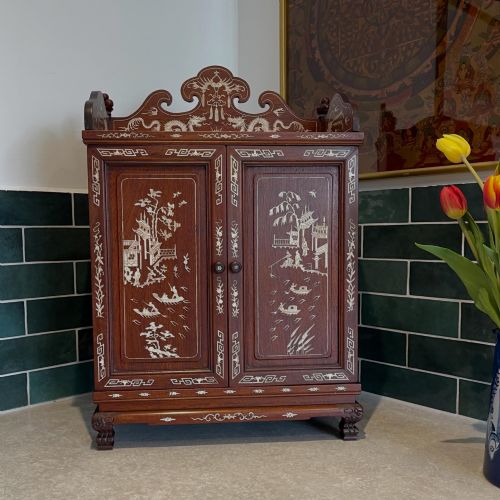
Styles extend beyond standard British cabinet-making to include William IV, Grand Regency, Napoleon III, and Anglo-Indian variants, alongside occasional items like sewing tables and table cabinets constructed in the same dense timber.
Materials and construction methods
Cabinet-makers utilised dense, dark rosewood veneers over firmer secondary timbers, often cutting the grain to highlight deep natural figuring across the lid and sides. Solid rosewood also appears in smaller document boxes and campaign pieces.
Metalwork played a structural and decorative role, with heavy brass bound edges, flush carrying handles, and intricate cut brass inlay secured into precision-cut channels in the timber.
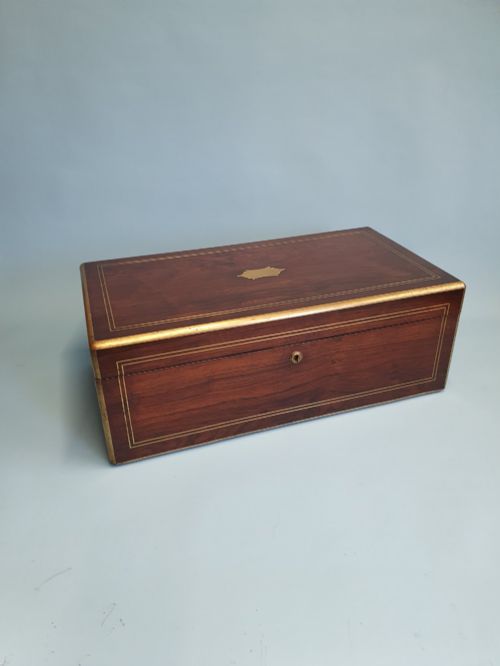
Internal components incorporate secondary woods like boxwood for stringing and inlay, alongside fitted fabric writing surfaces, secret drawers, and compartments designed to hold ink and quills securely.
Listings span the Georgian, Regency, William IV, and Victorian periods, alongside 19th-century manufacturing dates and specific years like 1800, 1820, 1850, 1860, and 1920.
Factors separating the finest examples
The standard of a dark rosewood desk box rests upon the precision of its brass inlay and the integrity of its timber joints. Finer workshops invested greater time in flush-fitting corner mounts and ensuring the grain pattern matched seamlessly across the folding flaps of writing slopes.
Internal complexity also distinguishes higher-grade pieces, separating simple unlined storage boxes from elaborate writing slopes featuring secret compartments, spring-loaded mechanisms, original working keys, and meticulously fitted stationery dividers.
Gillows of Lancaster
The Dark Rosewood Desk Box Glossary
- Writing slope
- A portable desk featuring a hinged lid that opens to reveal an angled writing surface and internal compartments for stationery. These boxes fold flat when closed for travel.
- Campaign box
- A sturdy portable desk or stationery container built for travel, typically fitted with recessed brass handles and corner mounts to withstand frequent movement.
- Brass bound
- A method of reinforcing box edges and corners with inset brass strips and brackets to protect the timber during transit.
- Secret drawers
- Concealed compartments hidden behind false panels or accessed through internal release mechanisms within the writing slope interior.
- Boxwood inlay
- Lighter contrasting timber strips inserted into the darker rosewood surface to create geometric borders and decorative motifs.
Dark Rosewood Desk Box: Frequently Asked Questions
How do I use a antique writing slope?
A writing slope opens by releasing internal catches and folding down the hinged lid to create an inclined writing surface lined with leather or fabric.
Interior compartments hold inkwells, pens, and paper, while lifting panels often reveal deeper storage wells and secret drawers underneath.
Were these boxes made for travel?
Many examples on this page are designated as campaign boxes or military slopes, specifically constructed for officers and travellers on the move.
They feature robust brass banding, flush lifting handles, and secure locks to protect correspondence during long journeys.
How can I date a rosewood desk box?
Dating relies on stylistic markers, brasswork techniques, and construction details associated with Georgian, Regency, and Victorian cabinet-making.
Early 19th-century pieces often display fine cut brass inlay and military mounts, while later Victorian boxes show different proportions and lining materials.