
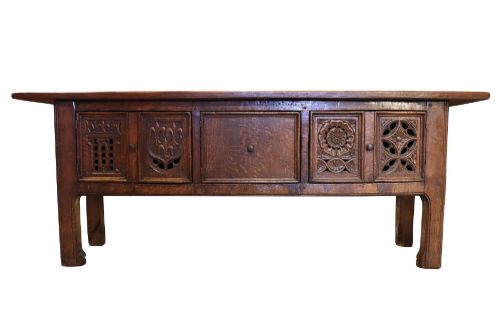
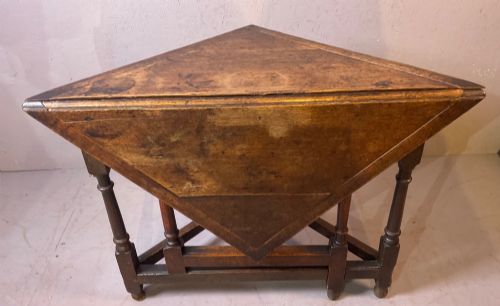

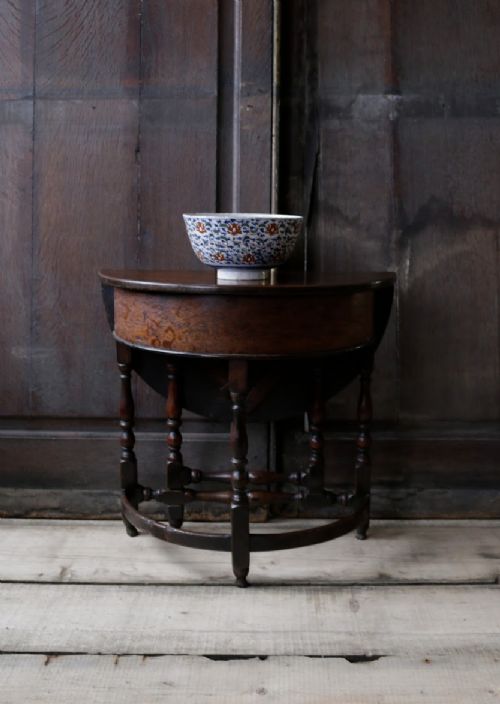


Dark Oak Credence Table
These dark oak credence table examples bring heavy timber grain and folding semicircular leaves straight into a room.
Dark Oak Credence Table
A dark oak credence table is a heavy timber furnishing defined by its folding top leaf and sturdy turned supports, appearing in seventeenth-century originals and later revivals. Buyers seeking this form encounter seventeenth-century pieces alongside Gothic Revival and Jacobean Revival interpretations from the late nineteenth and early twentieth centuries.
The primary form involves a semicircular top that folds out to reveal a flat surface, often supported by swinging gate legs or a framed base. Side tables, side cabinets, and dresser bases share similar heavy timber construction and dark patination across the listings.
How they were made
Makers utilised solid oak boards joined with traditional pegged mortise and tenon joints to build the foundational structure of these tables. Iron hinges and brackets occasionally reinforced the folding leaves and moving leg assemblies.
Carving was applied directly to the timber surfaces using chisels and gouges to create geometric panels, foliate motifs, and strapwork patterns. Hand-planed boards and turned uprights completed the construction before dark wax or polish was applied.
Listings feature oak and iron materials spanning the seventeenth century through the early twentieth century, including Jacobean and Gothic Revival styles.
What varies in quality
Quality rests in the crispness of the timber carving and the structural integrity of the folding mechanism. Finer examples display deep, hand-cut relief work and timber selection with rich medullary rays, whilst lesser pieces show mechanical stiffness or heavy restoration.
The proportion of the turned legs and the tightness of the joinery distinguish seventeenth-century originals and careful revivals from later utility copies. Original patination developed through centuries of handling holds greater visual depth than modern chemical darkening.
The Dark Oak Credence Table Glossary
- Credence table
- A folding table with a semicircular top supported by a swinging leg, historically used for holding sacramental elements or as a serving surface. The hinged flap opens to double the display area.
- Jacobean Revival
- A nineteenth or twentieth-century style copying the architecture and furniture design of the early seventeenth century. It utilises dark oak, heavy turned legs, and geometric panel carving.
- Gothic Revival
- An architectural and decorative style drawing on medieval forms, featuring pointed arches, tracery, and carved foliage. This aesthetic appears on late nineteenth-century oak furniture.
- Dresser base
- A long low table or cabinet fitted with drawers or cupboards beneath a flat top, sharing heavy timber construction with credence tables. These pieces provide substantial surface and storage space.
- Medullary rays
- Flakes or ribbon-like markings visible in quartersawn oak timber, prized by cabinetmakers for decorative effect. Their presence indicates quality cutting methods.
Dark Oak Credence Table: Frequently Asked Questions
What is a credence table?
A credence table is a folding timber stand featuring a semicircular top that swings open on a gate leg to reveal a flat surface.
These pieces served functional domestic and ecclesiastical roles historically, expanding from a wall-mounted shelf into a freestanding table with storage beneath the leaf.
How do I date an oak table?
Dating relies on examining the tool marks, construction joints, timber preparation, and wear patterns across the frame.
Seventeenth-century originals show hand-riven boards and pegged joints, whilst nineteenth-century revivals often display machine-cut elements and different patination.
Where should I place one?
These tables suit hallways, living rooms, or dining spaces where the dark timber contrasts against lighter walls.
The folding top allows the piece to sit flush against a wall as a console or swing open into the room.
What is Jacobean style?
Jacobean style refers to English design from the early seventeenth century, characterised by dark oak, heavy turned baluster legs, and geometric mouldings.
Revival pieces from the Victorian and Edwardian eras recreate these robust architectural forms.