


Dark Hardwood Nest Tables
Dark hardwood nest tables offer clever multi-tiered surface space, pairing traditional craftsmanship with practical living.
Dark Hardwood Nest Tables
Dark hardwood nest tables bring together sets of graduated tables designed to slide neatly beneath one another when floor space is at a premium. When searching for dark hardwood nest tables, buyers frequently encounter pieces originating from Chinese export workshops and the Victorian or Edwardian periods.
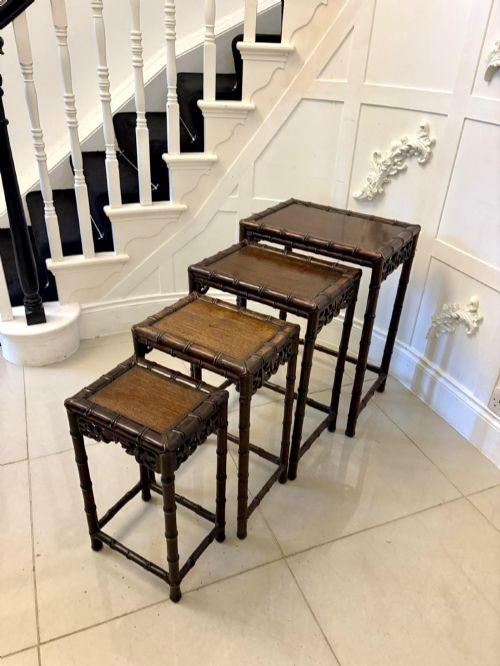
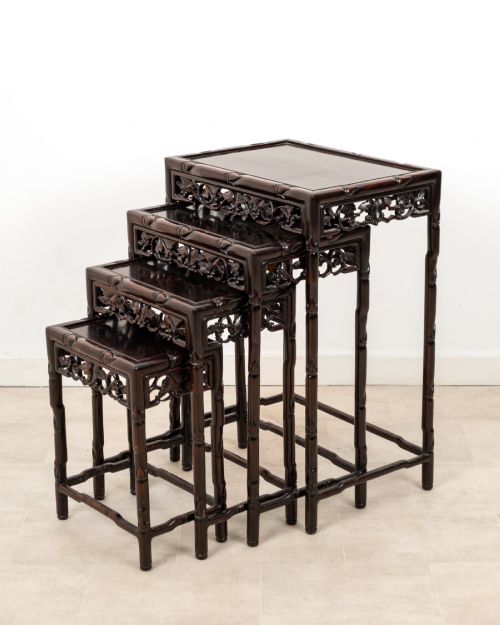
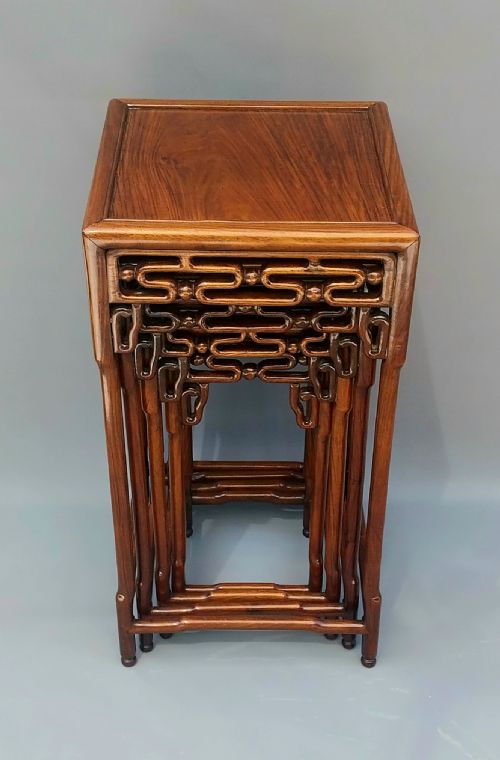
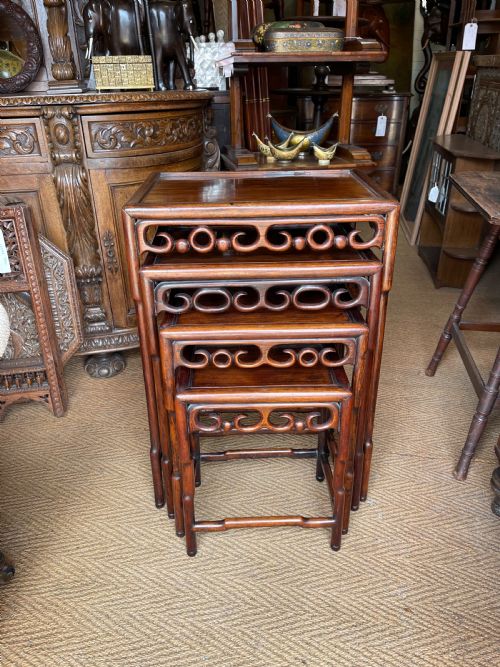
The configurations typically comprise sets of four tables that descend in height, allowing the smaller pieces to slot seamlessly into the largest frame. Formats range from plain occasional surfaces to heavily carved examples featuring traditional oriental motifs.
Origins span nineteenth-century workshops through to the early twentieth century, taking in Qing dynasty influences alongside Anglo-Indian production. These pieces serve both utilitarian purposes and decorative display roles within traditional and modern interiors alike.
Materials and Construction
Construction relies heavily upon dense tropical timbers such as hongmu, rosewood and teak, selected for their deep colour and robust durability. Artisans utilised traditional joinery methods to ensure the frames withstand repeated withdrawal and storage.
Surface decoration frequently involves intricate hand carving, depicting flora, fauna or geometric patterns along the friezes and legs. Certain examples incorporate glass inserts or faux bamboo turnings to alter the visual texture of the wood.
Listings incorporate pieces spanning the nineteenth and early twentieth centuries, constructed from rosewood, teak, and hongmu.
Evaluating Quality and Craftsmanship
Quality reveals itself in the crispness of the hand carving and the precision with which the smaller tables slide into the primary frame without binding. Superior examples employ dense, heavy hongmu or rosewood with consistent grain patterns throughout the set.
Lesser pieces show looser joinery tolerances and softer detail in the carved elements, sometimes utilising lighter secondary timbers beneath dark surface finishes. The integrity of the original joints and the stability of the graduated tiers dictate the overall merit of the set.
The Dark Hardwood Nest Tables Glossary
- Hongmu
- A dense, dark tropical hardwood traditionally utilised in fine Chinese furniture manufacture. It translates literally to red wood and develops a rich patina over time.
- Graduated
- Describing a set of tables where each piece decreases in dimensions to fit beneath the preceding one. This scaling allows the complete group to occupy the footprint of a single table.
- Quartetto
- An alternative historical term for a set of four matching tables designed to nest together. The designation appears frequently in nineteenth-century inventories and trade descriptions.
- Chinoiserie
- European artistic styles reflecting Chinese motifs and decorative techniques, popular during various historical periods. It often appears on pieces produced for export markets.
Dark Hardwood Nest Tables: Frequently Asked Questions
How do I care for dark hardwood tables?
Keep the wood away from direct heat sources and strong sunlight to prevent the timber from drying out or splitting.
Apply a microcrystalline wax occasionally to nourish the grain and maintain the natural lustre of the polished surface.
Were these tables made for export?
Many surviving sets originated in Chinese workshops specifically tailored to satisfy European demand for exotic oriental furnishings during the nineteenth century.
These pieces often blended traditional local construction methods with forms suited to Western drawing rooms.
What is a quartetto set?
A quartetto set consists of four distinct tables built to graduate in size so they slide into a single stack.
This format became particularly fashionable during the Victorian and Edwardian eras for serving tea or holding occasional items.
How can I date a nest of tables?
Dating relies upon examining the timber selection, joinery precision, and stylistic details such as carved motifs or turned faux bamboo legs.
Nineteenth-century examples often display heavier, denser woods and hand-cut joinery compared to later twentieth-century production.