


Carved Hardwood Stacking Tables
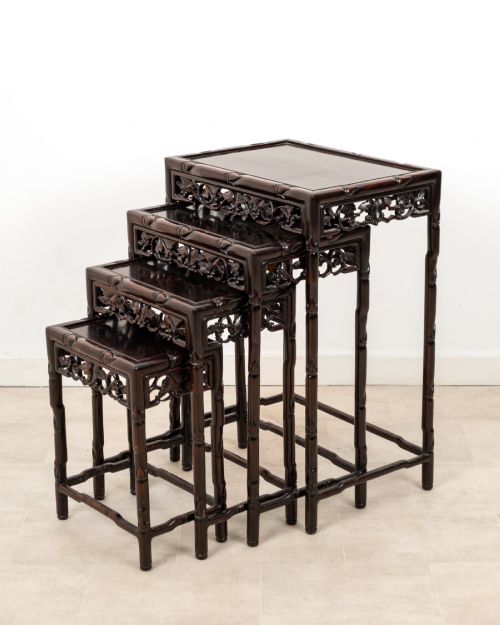
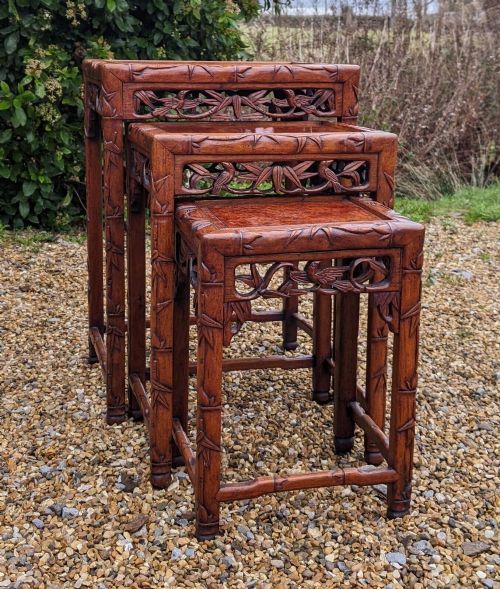
These carved hardwood stacking tables offer clever space-saving design combined with intricate regional carving.
Carved Hardwood Stacking Tables
Carved hardwood stacking tables typically arrive as nests of four graduated pieces designed to tuck neatly beneath one another when not in use. You will most frequently encounter Chinese examples alongside Anglo-Indian variations originating from the nineteenth and early twentieth centuries.
The forms range from occasional tables and side tables to low coffee tables, all sharing the practical ability to nest. Makers constructed these sets in graduating sizes so the smaller tables slide sequentially into the larger main frame.
Originating across Asian export workshops and domestic British colonial commissions, these nests served functional roles in drawing rooms and parlours. They provide versatile surface space without permanently crowding a room.
How they were made
Craftsmen utilised dense timbers such as rosewood, teak, hongmu, and huanghuali wood to build these durable nesting sets. The natural weight and tight grain of these hardwoods allowed for deep surface carving without compromising structural integrity.
Artisans applied traditional joinery techniques to construct the frames, ensuring each smaller table cleared the inner aprons of the next size up. Carved details were chiselled directly into the solid wood surfaces, often featuring floral motifs, traditional landscapes, or geometric borders.
Listings feature 19th-century, 1900, 1910, 1920, and Edwardian periods across hard woods like rosewood, teak, huanghuali wood, and hongmu.
What varies in quality
Quality rests primarily on the depth and crispness of the carving, as well as the choice of timber. Dense huanghuali or heavily figured rosewood commands attention through superior natural grain and colour contrast.
The precision of the graduated fit dictates daily practicality, separating fluidly engineered sets from those that bind during stacking. Finer examples maintain structural rigidity across all four tables while retaining delicate proportions in the legs and aprons.
The Carved Hardwood Stacking Tables Glossary
- Hongmu
- A translation meaning red wood, categorising a group of dense tropical hardwoods used in traditional Chinese furniture making. It develops a deep patina over time.
- Quartetto
- A traditional term describing a set of four pieces of furniture designed to be used together, such as a nest of four tables. Victorians frequently applied this label to nesting tables.
- Graduated
- Describing a set of tables where each successive piece diminishes in size to fit beneath the preceding one. This scaling ensures the entire nest occupies the floor space of only the largest table.
Carved Hardwood Stacking Tables: Frequently Asked Questions
How do I care for antique hardwood tables?
Keep these tables away from direct heat sources and sudden humidity changes to prevent the dense hardwood from splitting. Dust regularly with a soft, dry cloth and apply occasional natural wax to nourish the grain.
Avoid placing damp glasses directly on the polished surfaces without coasters. Lift the tables rather than dragging them across the floor to protect the joints of the smaller frames.
How many tables are in a standard nest?
Most antique nests consist of four graduated tables designed to slide sequentially beneath the largest top piece. Occasionally, you will encounter sets comprising three tables.
The fourth and smallest table sits at the very bottom of the stack, often featuring slightly reduced carving depth to fit within the strict clearance limits of the frame.
Were these tables made for export?
Many surviving sets were produced in Chinese export workshops specifically for the European market during the nineteenth and early twentieth centuries. These pieces blended traditional domestic forms with aesthetic tastes popular in Britain at the time.
Anglo-Indian examples similarly catered to colonial officers and British households seeking exotic hardwood furniture for domestic interiors.
How do I date a set of stacking tables?
Dating relies on examining the timber species, construction joinery, and the style of the carving. Nineteenth-century examples often display heavier timbers and hand-cut joints, while Edwardian pieces may show slight variations in proportion.
The presence of export stamps or specific regional carving motifs also helps narrow down the period of manufacture.