




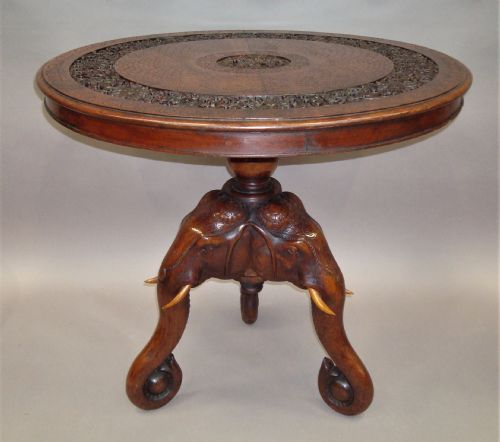


Dark Hardwood Centre Table
A dark hardwood centre table anchors a room with dense grain, rich tone, and intricate regional carving.
Dark Hardwood Centre Table
A dark hardwood centre table serves as a substantial freestanding piece designed to sit in the middle of a room rather than against a wall. The examples collected under this phrase span the nineteenth century and encompass Victorian, Qing Dynasty, Meiji Period, and Moorish Revival aesthetics.
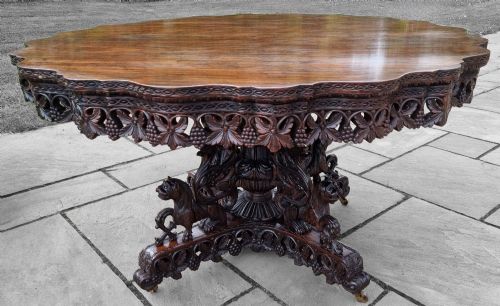
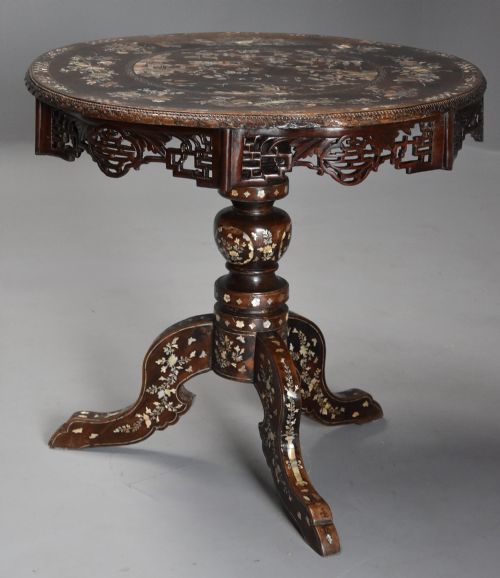
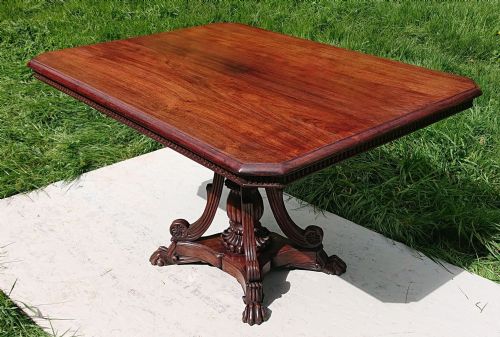
Most pieces meeting this search phrase emerge from colonial and East Asian workshops, displaying distinct regional forms such as circular tilt tops, drum tables, and rectangular frames with inset marble or cloisonné panels.
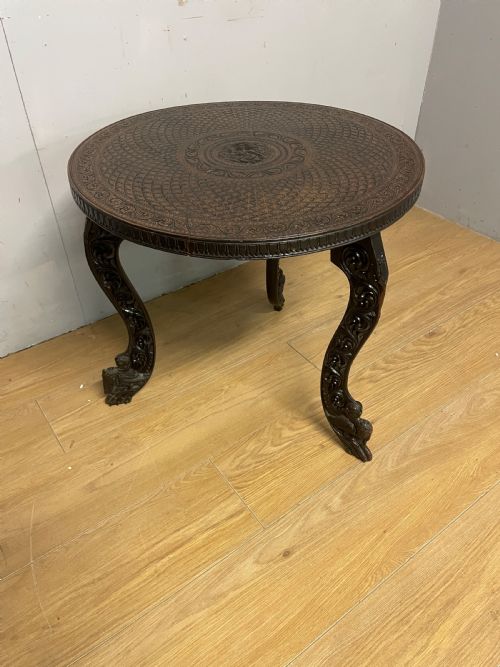
Makers utilised dense timbers like padauk, teak, and rosewood, applying deep relief carving that reflects Anglo-Indian, Burmese, Chinese, and Vietnamese traditions of the period.
How they were made
Cabinetmakers constructed these tables from heavy dark hardwoods including padauk, teak, and rosewood, selected for their stability and depth of natural colour. These dense timbers supported elaborate hand-carving without losing structural integrity across wide spans.
Surface ornamentation involved specialised regional techniques, ranging from deep figural and floral relief work to mother-of-pearl inlay and the integration of inset rouge marble or cloisonné enamel panels.
Listings for this phrase frequently feature nineteenth-century dates, spanning the Victorian era, Meiji period, and Qing dynasty.
What varies in quality
The depth and clarity of the hand-carving define the distinction between standard production and superior craftsmanship, with finer pieces exhibiting crisp undercut foliage, figures, and geometric borders. The integration of specialty panels, such as fitted rouge marble or cloisonné enamel, also signals higher workshop standards.
Structural execution, including the stability of tilt-top mechanisms, the precision of joinery in heavy timber, and the preservation of the dense hardwood grain, determines the overall calibre of the table.
The Dark Hardwood Centre Table Glossary
- Tilt top table
- A table featuring a hinged mechanism that allows the circular or oval tabletop to pivot into a vertical position when not in use. This design originated to save space in nineteenth-century drawing rooms.
- Padauk
- A heavy, durable tropical hardwood prized for its dense grain and rich reddish-brown colour. Makers utilised this timber extensively in Anglo-Indian colonial furniture.
- Cloisonné enamel
- A decorative metalwork technique where enamel paste is applied within compartments defined by soldered wire strips. This method appeared on select Japanese and Chinese table panels.
- Rouge marble
- A deep red, multi-toned decorative stone imported and cut for furniture inserts. Such stone panels provided a cool, flat surface contrasting with carved wooden frames.
- Anglo-Indian
- A descriptive term for furniture produced in India by local artisans following British form and utility requirements. These pieces frequently merge British Victorian proportions with traditional Indian carving motifs.
Dark Hardwood Centre Table: Frequently Asked Questions
Where should I place a centre table?
A centre table belongs in the middle of a principal room, allowing uninterrupted access from all four sides. It functions as a display surface for lamps, books, or decorative objects.
Ensure sufficient walking clearance around the perimeter of the furniture so the piece commands the space without obstructing movement.
How do I care for dark hardwood?
Maintain dense hardwoods like teak and padauk by dusting with a dry lint-free cloth and avoiding silicone-based polishes. Keep the timber away from direct heat sources and strong sunlight to prevent drying.
Apply natural beeswax occasionally to nourish the grain and preserve the deep natural tone of the wood.
How do I identify a tilt top mechanism?
A tilt top table utilises a wooden catch or brass latch beneath the surface that releases the circular top to pivot ninety degrees. This allowed nineteenth-century households to store tables flat against walls.
Examine the pivot block beneath the top to check for original hinges and locking pins.