
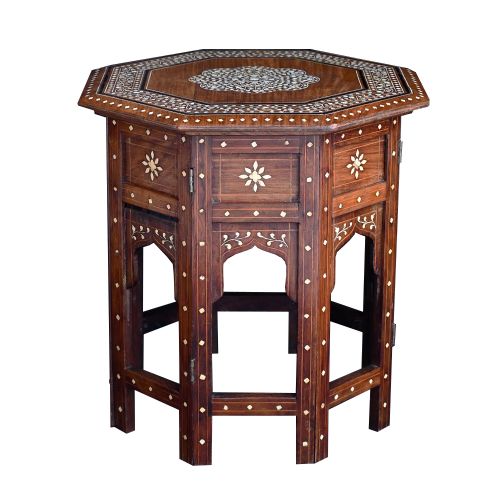
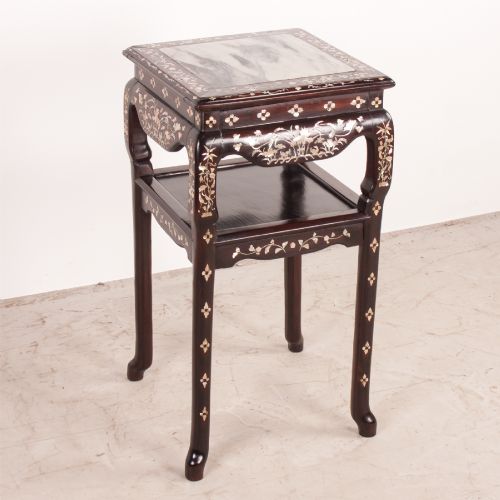
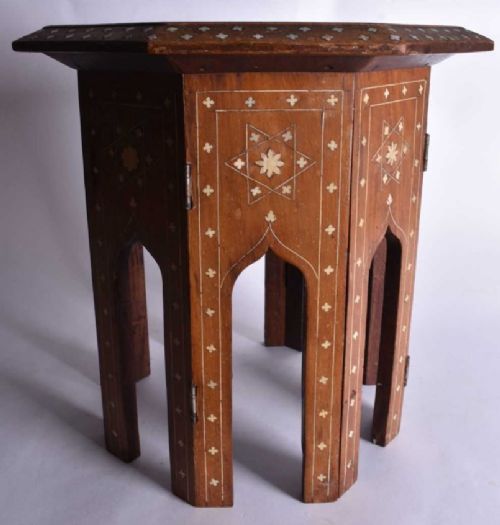


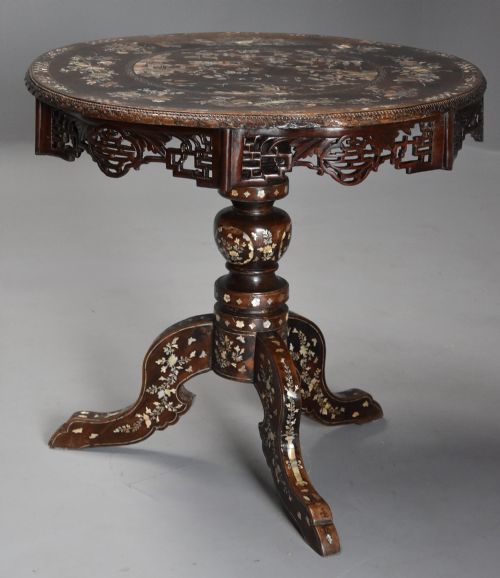


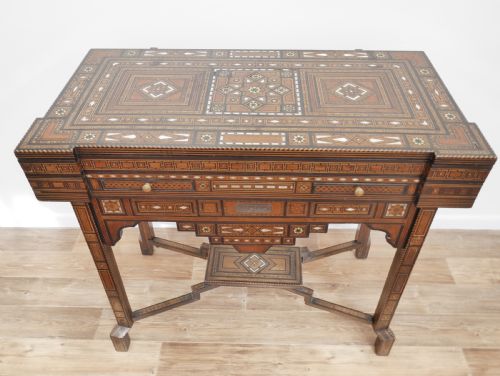


Vintage Pearl Inlay Table
A vintage pearl inlay table brings extraordinary pattern and rich timber to a room, offering a tactile surface built from shell and dense wood.
Vintage Pearl Inlay Table
The selection here encompasses pieces from the nineteenth and early twentieth centuries, alongside Victorian examples in rosewood, walnut and hardwood. These surfaces function primarily as occasional, side or centre tables within a room.
Makers and regional artisans utilised contrasting materials to frame the shell, resulting in distinct stylistic identities from Damascus, Hoshiarpur and beyond. The forms range from low folding tables to substantial pedestals designed to hold lamps or decorative objects.
Materials and construction
Craftsmen built these tables using dense timbers such as rosewood, walnut, coromandel and varied hardwoods, providing a stable dark ground for the decoration. Mother-of-pearl and bone were meticulously cut into geometric polygons, floral motifs or scrolling tendrils before being pressed into hand-chased channels.
Secondary materials such as brass wire and glass occasionally augmented the shell work, adding metallic sheen and contrasting colour to the timber tops. Many folding and occasional designs relied on precise joinery to allow complex octagonal bases to collapse without warping the inlaid panels.
Listings feature mother-of-pearl, bone, brass and glass combined with rosewood, walnut and exotic hardwoods across nineteenth and early twentieth-century pieces.
Evaluating craftsmanship and distinction
Quality rests on the density and precision of the mosaic work, where superior examples exhibit tight, seamless tessellation with minimal filler between the mother-of-pearl pieces. The complexity of the underlying timber carving and the symmetry of the overarching design elevate certain pieces above simpler production.
The choice of base wood significantly alters the character of the object, with dense tropical hardwoods and figured rosewood offering greater durability and depth than softer secondary timbers. Preserved alignment across folding joints and complete survival of intricate bone and shell elements distinguish the finest specimens.
Liberty & Co·Seller of Reading·Walker and Hall·Savory & Fils A Paris
The Vintage Pearl Inlay Table Glossary
- Mother-of-Pearl
- An iridescent internal layer of shells, particularly molluscs, used in thin sections for decorative inlay. It reflects light with shifting tones of silver, pink and green.
- Octagonal Top
- A geometric surface shape with eight sides frequently utilised in Damascus and Moorish occasional tables. This configuration allowed intricate edge borders to frame central star motifs.
- Moorish Revival
- A nineteenth-century architectural and decorative style incorporating Islamic design elements such as horseshoe arches and geometric strapwork. Tables in this taste rely heavily on dense mosaic patterns.
- Hoshiarpur
- A northern Indian city renowned for intricate wood inlay work using brass, bone and mother-of-pearl. Artisans there produced folding tables and occasional pieces on sheesham and hardwood bases.
- Damascus
- A Syrian centre of metal, wood and inlay craftsmanship producing tables and boxes decorated with intricate mother-of-pearl geometric schemes. These items often feature folding hexagonal or octagonal stands.
Vintage Pearl Inlay Table: Frequently Asked Questions
How do I clean a pearl inlay table?
Dust the surface regularly with a soft, dry cloth to prevent particles from lodging in the crevices between the shell and the wood.
Avoid liquid cleaners, chemical polishes and excessive moisture, which can loosen the natural glue holding the mother-of-pearl pieces in place.
Are these tables sturdy enough for daily use?
Most occasional and side tables function well for holding lamps, books or cups, provided they are placed on level flooring.
Folding models require careful handling when moving or opening to protect the wooden hinges and prevent stress on the inlaid panels.
How do I distinguish between regional styles?
Anglo-Indian and Hoshiarpur pieces often feature dense overall floral or geometric patterns set into shisham or hardwood with bone and shell.
Moorish and Damascus examples typically employ complex polygon and star tessellations framed by intricate strapwork on folding bases.
Can I place a table in direct sunlight?
Direct sunlight causes vulnerable timbers like rosewood and walnut to fade and can dry out the natural adhesives beneath the inlay.
Positioning the piece away from intense light sources and heat vents preserves both the colour of the wood and the iridescence of the shell.