




Dark Blue Area Rug
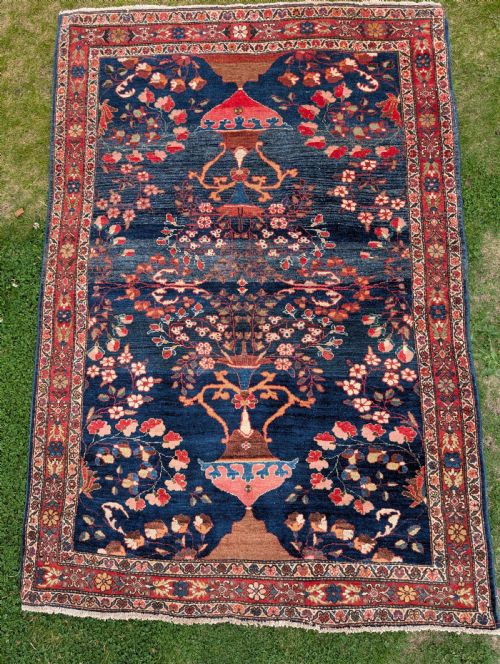
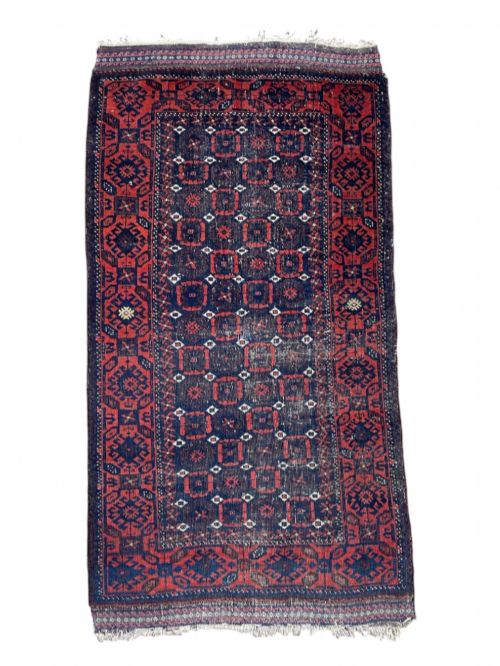
When you search for a dark blue area rug, you encounter hand-knotted tribal and village carpets dating from the nineteenth and early twentieth centuries.
Dark Blue Area Rug
A dark blue area rug on this page generally refers to antique Persian, Caucasian, and Afghan woven carpets originating from village and tribal workshops. These pieces span the nineteenth century through to the early decades of the twentieth century, displaying rich indigo fields and varied geometric or floral motifs.
Buyers will find distinct regional variations including Baluch prayer rugs, Qashqai tribal pieces, and larger Mahal or Ziegler carpets. Each type carries the specific design vocabulary of the weavers who knotted them by hand generations ago.
Materials and construction methods
These textiles rely predominantly on wool foundations and piles, occasionally incorporating cotton for structure or goat hair for durable outer binding edges. The yarn is hand-spun, giving the pile an irregular texture that absorbs dye in subtle variations.
Weavers utilised natural dyes to achieve deep indigo and dark blue shades, often sourced from plants combined with mineral mordants. Individual knots are tied tightly by hand onto vertical looms, creating dense structures designed to endure centuries of daily use.
Distinctions in craftsmanship
Quality rests in the fineness of the weave and the complexity of the design execution. Tighter knots and precise alignment of geometric or floral patterns indicate superior workshop discipline.
The depth and saturation of the natural dyes distinguish finer examples from standard pieces. Well-preserved wool pile retaining its original lanolin provides tactile resilience and lustre.
Qashqai·Khamseh·Baluch·Tabriz·Kashan
The Dark Blue Area Rug Glossary
- Pile
- The vertical tufts of wool or cotton that form the soft surface of the rug. This is created by knotting yarn onto the warp threads.
- Warp
- The stationary lengthwise threads stretched tightly on the loom. The entire foundation of the rug depends on these parallel strands.
- Weft
- The horizontal threads passed alternately over and under the warp strands. They lock the rows of knots firmly into place.
- Natural Dyes
- Colourants extracted from plants, insects, or minerals before synthetic alternatives became common. These substances age gracefully and develop a rich patina.
- Medallion
- A central ornamental design motif placed in the middle of the carpet field. It often mirrors the corner brackets or spandrels.
Dark Blue Area Rug: Frequently Asked Questions
How do I care for an antique wool rug?
Vacuum gently without using a rotating brush bar to protect the delicate antique wool pile from pulling or fraying. Professional cleaning by a specialist familiar with natural dyes and vegetable colours is essential every few years.
Keep the rug away from direct, harsh sunlight to prevent the deep indigo and dark blue shades from fading unevenly over time. Using a breathable underlay helps prevent slipping while allowing air circulation beneath the foundation.
Where were these dark blue rugs made?
The pieces originate across Persia, the Caucasus, and Afghanistan, reflecting the distinct artistic traditions of various nomadic tribes and village communities. Makers worked in regions such as Khorasan, Fars, and Shirvan using local materials.
Each weaving group developed specific motifs and knotting techniques that identify the geographical source of the textile. Tribal makers often worked from memory, passing design patterns down through generations.
How can I tell the age of a rug?
Age is determined by examining the structure, materials, dye types, and stylistic conventions used in the construction. Irregularities in the hand-spun wool and variations in natural indigo tones typically point to nineteenth-century production.
Nomadic pieces often display slight asymmetry in their borders and field geometry due to being woven on portable looms. Comparing the specific motif style against documented regional archives helps narrow down the decade.
Can I place these rugs in high traffic areas?
Many of these antique carpets were constructed by nomadic and village weavers specifically for rigorous everyday utility. The dense wool pile and sturdy goat hair or cotton foundations withstand normal walking traffic remarkably well.
Placing a proper cushioned underlay underneath helps absorb foot impact and reduces friction against the floorboards. Rotating the rug periodically ensures even wear across the surface over the years.