


Cut Glass Champagne Glasses
Cut glass champagne glasses bring weight and brilliance to a table, spanning Victorian bowls to Art Deco flutes.
Cut Glass Champagne Glasses
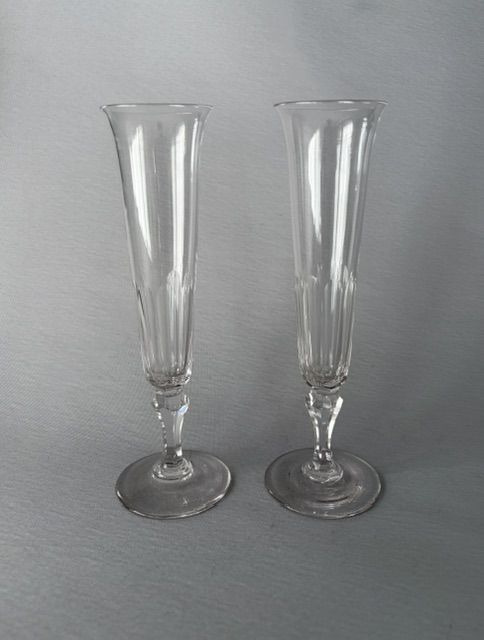
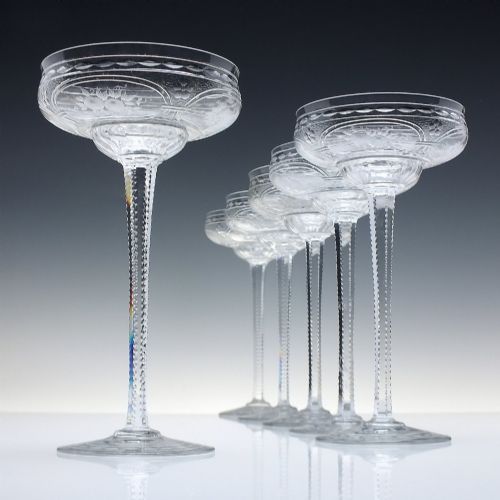
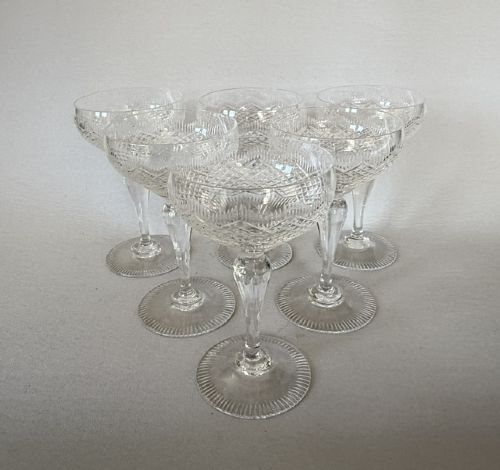
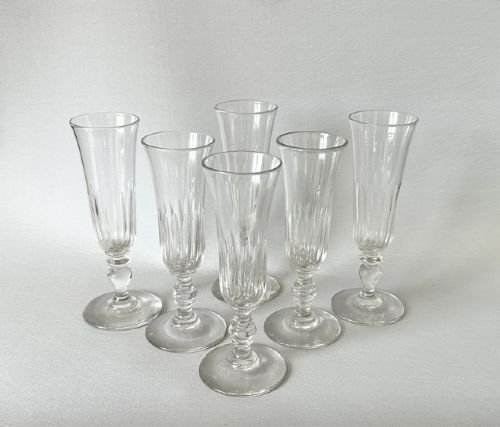
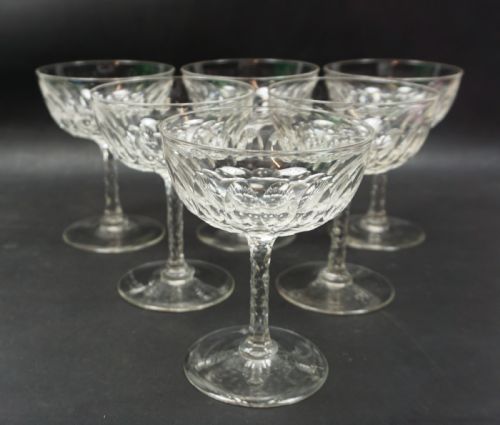
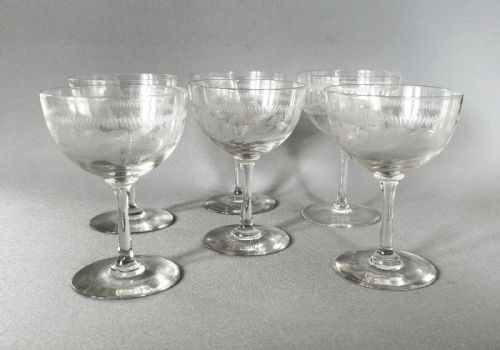
Cut glass champagne glasses appear across several distinct periods, most commonly taking the form of shallow coupes, broad bowls, and traditional flutes. Pieces span the Victorian era, the Edwardian period, and into the Art Deco years of the nineteen twenties, alongside earlier Regency examples.
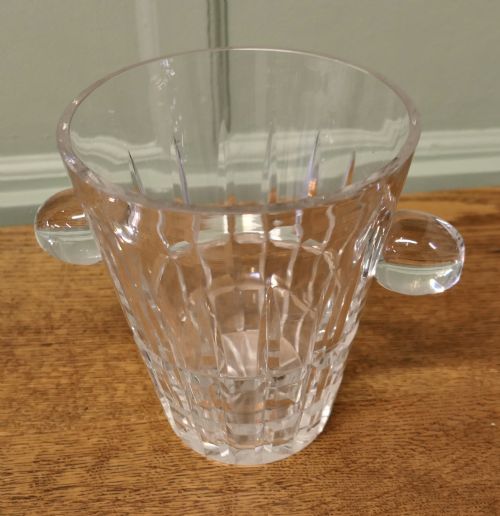
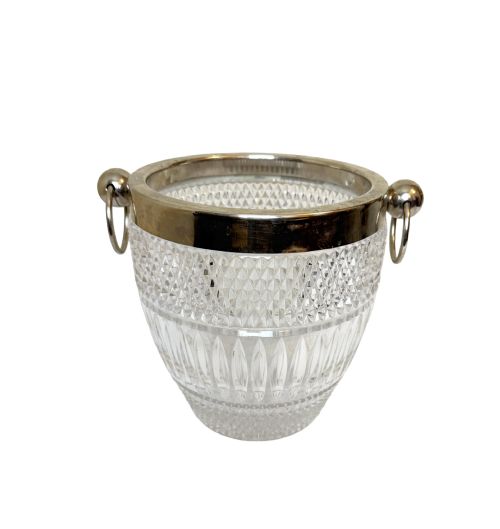
The selection on this page relies heavily on matching sets, whether small six-piece groupings or larger sets intended for formal dining. Alongside drinking vessels, the category broadens to include heavy lead crystal ice buckets, silver-plate coolers, and engraved champagne jugs.
Origins stretch from English workshops to French glasshouses, with distinct regional preferences appearing in the depth of the cutting and the weight of the metal. Buyers encounter everything from simple slice-cut stems to coloured over-crystal bowls and vessels engraved with dolphins, florals, or Greek key patterns.
Materials and methods
Makers utilised heavy lead crystal and standard glass, often employing hand-blown techniques before applying deep wheel cuts to the exterior surface. Coloured glass varieties achieve their tones through layered cased techniques, such as green or cranberry over clear crystal.
Finishing touches often involve fine hand-engraving of floral motifs like convolvulus, or geometric Greek key patterns, alongside silver-plate mounts, gilt bronze details, and pierced collars.
Some Victorian revellers enjoyed their champagne from novelty glass bottles shaped specifically to mimic the real vintage.
Assessing quality
Quality rests upon the crispness of the wheel cutting and the optical purity of the metal itself. Deeper, sharper facets refract light with greater intensity, whereas softer edges indicate hurried or later production.
Weight serves as a reliable indicator, with heavier lead crystal vessels offering a more solid balance in the hand. The consistency across a matched set, where bowls and stems maintain uniform thickness and ring true when struck gently, separates standard production from superior work.
Richardsons·Moser·Otto Prutscher·Wiener Werkstätte
The Cut Glass Champagne Glasses Glossary
- Cut Glass
- Glass decorated by holding the vessel against a rotating abrasive wheel to carve decorative patterns and facets into the surface. This technique produces sharp edges and brilliant light refraction.
- Coupe
- A broad, shallow-bowled glass originally designed for champagne before taller flutes gained favour. The wide rim allows bubbles to dissipate quickly.
- Lead Crystal
- Glass containing a significant proportion of lead oxide, which increases weight, clarity, and brilliance. It allows for deeper and sharper cutting without fracturing.
- Slice Cut
- A style of linear geometric decoration formed by wide, flat facets cut parallel around the body or stem of a glass. It provides a simple, tactile grip.
- Over Crystal
- A vessel formed of multiple fused layers of glass, typically a coloured exterior cased over clear crystal. When cut through, the pattern reveals a striking contrast between colours.
- Greek Key
- A continuous geometric band of interlocking right angles used as a border decoration on glass and silver. It appears frequently on Edwardian tableware.
Cut Glass Champagne Glasses: Frequently Asked Questions
What is the difference between a champagne coupe and a flute?
Coupes feature a wide, shallow bowl that first became popular in the nineteenth century, encouraging the wine to settle across a broader surface. Flutes are narrower and taller, designed to preserve the effervescence of the wine for longer periods.
While Victorian and Edwardian tables favoured the coupe, earlier Regency and later Art Deco periods introduced diverse forms, including specialised champagne bowls and engraved jugs.
How can I tell Victorian cut glass from later pieces?
Victorian examples often display heavier hand-cutting with softer wear marks on the foot rim from decades of handling. Edwardian and later pieces frequently employ crisper, lighter slice cutting or integrated geometric motifs like Greek keys.
Examining the pontil mark on the underside of older vessels reveals where the glassblower's rod was snapped and subsequently polished away.
Are these glasses suitable for modern use?
These antique and vintage pieces function well for serving champagne, provided they receive careful hand washing rather than exposure to high dishwasher temperatures. Their robust lead crystal construction makes them durable enough for occasional dining.
Care should be taken with heavy silver-plated mounts and delicate over-crystal vessels to preserve the finish.
Why do some coloured glasses have clear stems?
Coloured over-crystal vessels were often created by layering a vibrant hue over a clear glass base, then cutting through the outer layer to reveal the transparency beneath. This cased technique required high skill to balance weight and colour density.
Such pieces frequently date from the late nineteenth or early twentieth centuries.