

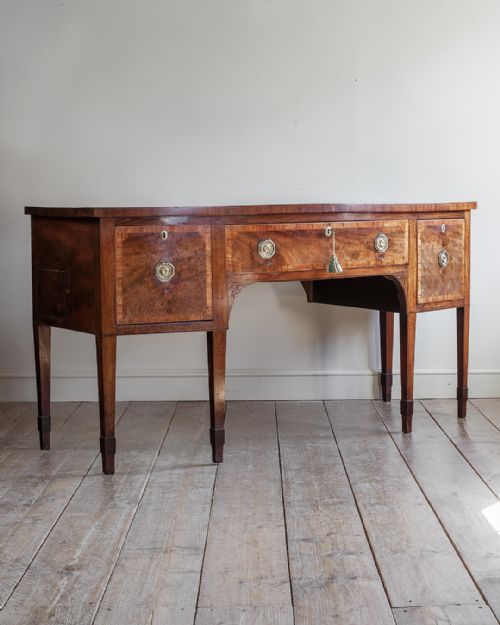
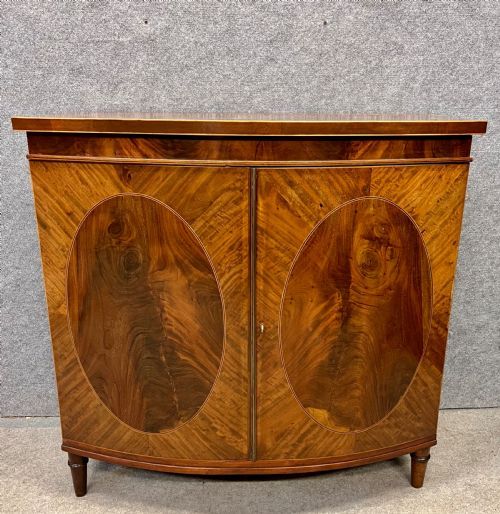
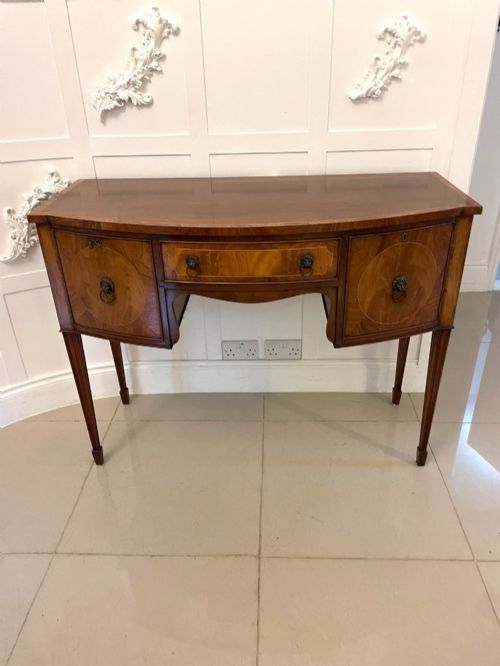
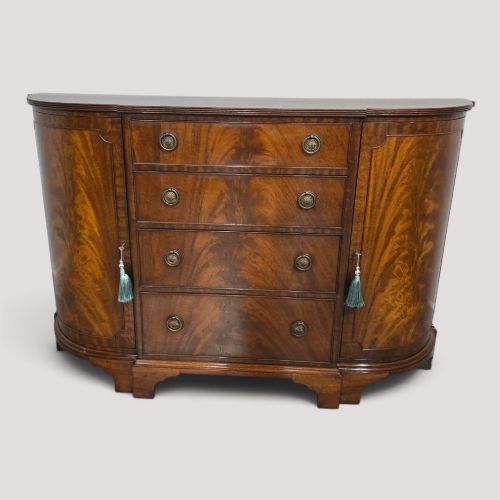
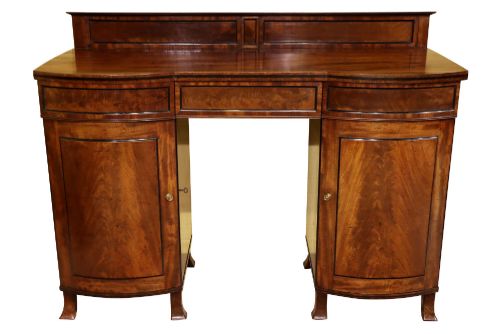
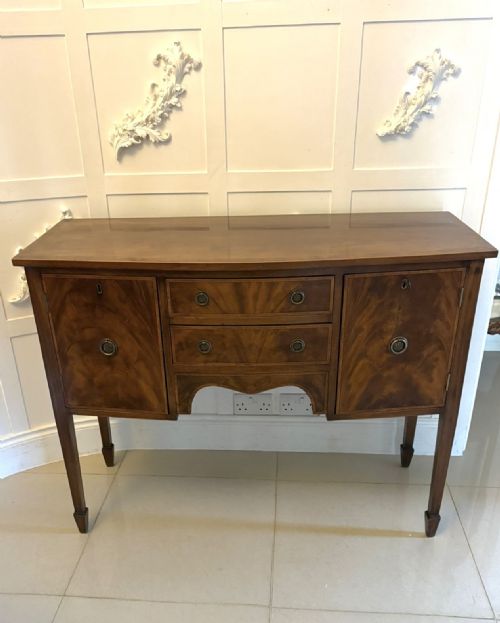

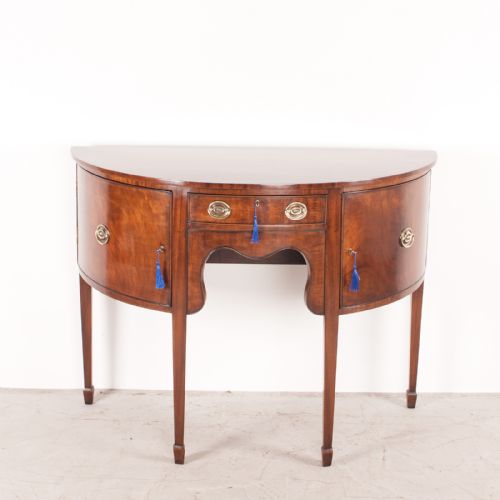


Curved Front Mahogany Sideboard
A curved front mahogany sideboard brings architectural grace to a dining room through sweeping lines and warm timber.
Curved Front Mahogany Sideboard
A curved front mahogany sideboard is a dining room storage piece designed with a bow, serpentine, or demi-lune contour. These forms emerge across the 18th century, Georgian, Regency, and Edwardian periods.
Makers utilised subtle curves to manage domestic space efficiently while displaying figured grain. Variations range from small Edwardian iterations to large George III serpentine examples.
Construction and materials
Cabinetmakers built these sideboards using solid mahogany and flame mahogany veneer applied to secondary timbers. Flame veneers created dramatic figuring across the curved drawer fronts.
Inlays of satinwood and boxwood define the edges and borders of many pieces, particularly on Georgian and Edwardian examples. Brass fittings, including handles and occasional feet, punctuate the dark timber.
Curved Front Mahogany Sideboard Retail Price Guide 2026
Typical asking prices for curved front mahogany sideboard among the pieces listed under this phrase on Sellingantiques today, from the lower quarter to the upper quarter. They describe what is for sale here now, not the wider market.
Listings feature mahogany, satinwood inlay, flame veneer, and brass across Georgian, Regency, and Edwardian periods.
Quality variations
The sophistication of the curved timber and veneer matching dictates the standard of a piece. Serpentine and demi-lune shapes demand precise carpentry to follow complex radii without distortion.
Delicate stringing, contrasting wood inlays, and original brass hardware elevate the status of a sideboard. Proportion and the integrity of the structural carcass separate everyday utility pieces from finer cabinet work.
The Curved Front Mahogany Sideboard Glossary
- Bowfront
- A convex curved front that projects outward in a smooth arc. This shape softens the corners of a room and maximises internal drawer space.
- Serpentine
- A front contour shaped with a convex centre flanked by concave curves. This intricate profile requires exceptional skill from the cabinetmaker.
- Demi-lune
- A half-moon shape used for sideboards, commodes, and console tables. It fits flush against a wall while presenting a rounded facade.
- Flame mahogany
- A veneer cut from timber where the branch meets the trunk, producing a flame-like pattern. It is prized for decorative impact on primary surfaces.
- Inlay
- Contrasting woods such as satinwood or boxwood set flush into the mahogany surface. This technique creates geometric borders and decorative panels.
Curved Front Mahogany Sideboard: Frequently Asked Questions
How do I date a sideboard?
Examine the secondary woods, construction methods, and handling of the drawer linings to establish an era. Stylistic markers such as stringing inlay or brass foot mounts also point toward Georgian or Edwardian origins.
Compare the carcass design with documented pieces from the 18th and 19th centuries. Timber shrinkage and hand-cut dovetailing provide further clues to age.
Where should I place one?
A curved front mahogany sideboard suits dining rooms, hallways, or spacious living areas where its profile can be appreciated. The sweeping front prevents sharp corners in high-traffic zones.
Ensure adequate wall space accommodates the specific arc, whether bowfront or demi-lune. Keep the piece away from direct heat sources to protect the mahogany veneer.
How do I clean mahogany?
Dust the surface regularly with a soft, dry cloth to prevent grit accumulation. Apply a quality beeswax periodically to nourish the timber and maintain the lustre of the polish.
Avoid silicone-based sprays and excessive moisture, which can damage antique polish and veneer. Gently buff the wood after waxing to preserve the depth of the grain.