




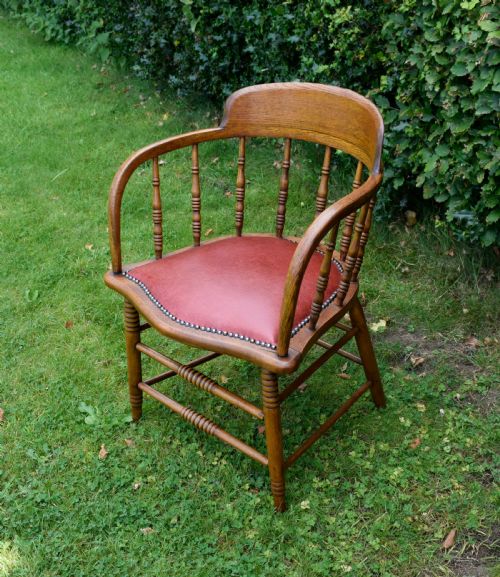

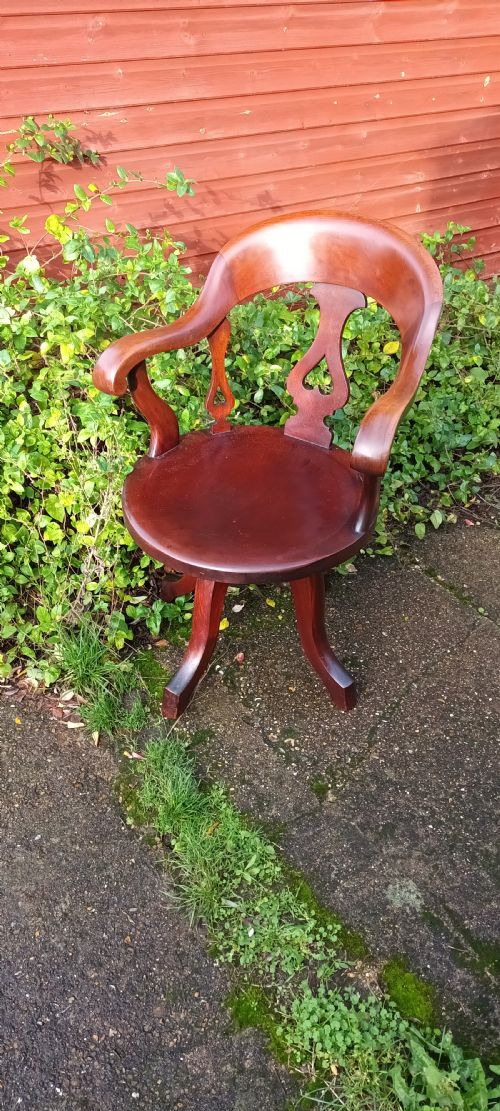
Curved Back Office Chair
These curved back office chair selections offer sturdy workspace seating crafted from timber and leather across multiple historic periods.

Curved Back Office Chair
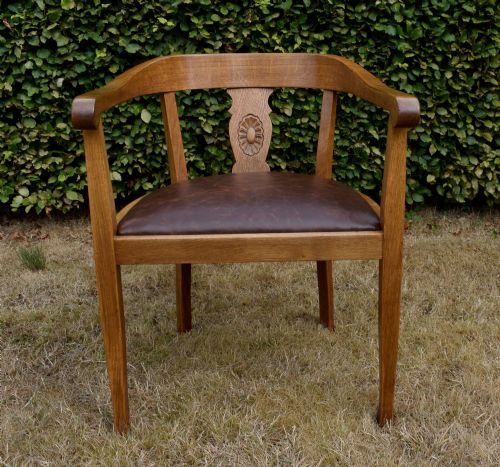
A curved back office chair provides supportive seating for a desk, combining historic forms with functional design. When you search for a curved back office chair, you encounter wooden frames built for steady daily use.
The versions most likely to appear on this page span the Victorian era, the Edwardian period, and the early twentieth century. These pieces take the form of desk chairs, office armchairs, tub armchairs, and captain's chairs.
Makers utilised resilient hardwoods to shape enclosing backrests that support the spine during long hours of work. Each example reflects the prevailing taste of its decade, from plain Victorian oak to inlaid mahogany.
How they were made
Carpenters constructed these seats using dense timbers such as mahogany, oak, walnut, beech, elm, and burr elm. Frames frequently incorporate bentwood techniques to achieve the smooth curve of the backrest.
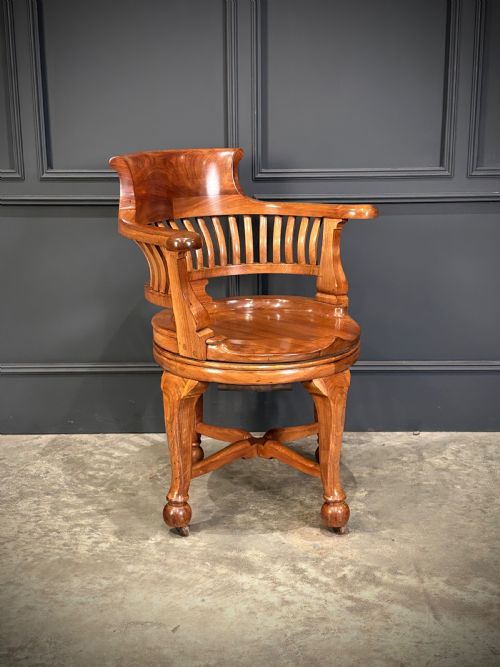
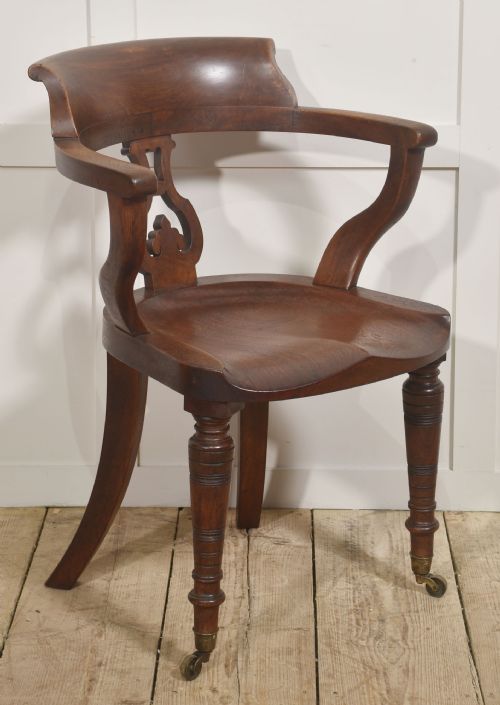
Many examples integrate metal swivel mechanisms and brass castors to allow movement around a desk. Upholstery consists of leather or oil cloth swab cushions secured to wooden bases.
Swivel office chairs on this page pair nineteenth century timber frames with rotating iron and brass mechanical hardware.
What varies in quality
The distinction between standard utility seating and superior examples lies in the selection of timber and the precision of the joinery. Solid walnut and burr elm frames demand greater skill from the cabinetmaker than simple beech or pine.
Revolving mechanisms and swivel hardware vary significantly in their engineering and durability. Smooth rotation and robust brass underpinnings separate better workshop output from basic commercial production.
Edward William Godwin·Thonet
The Curved Back Office Chair Glossary
- Captain's chair
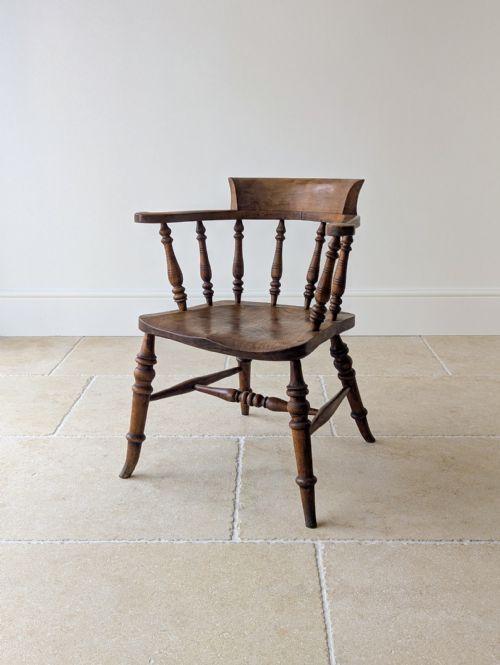
- A sturdy timber armchair with a rounded low back rail supported by spindles. This form provides comfortable support for administrative tasks.
- Swivel mechanism
- The mechanical apparatus beneath the seat allowing rotation. Better examples use iron and brass components.
- Bentwood
- Wood softened by steam and bent into curved shapes. This technique creates continuous circular backrests without visible joints.
- Tub armchair
- A fully enclosed curved upholstered or wooden backrest. The arms wrap forward to form a continuous barrier.
- Oil cloth
- A heavy canvas fabric treated with linseed oil to create a waterproof surface. It provides a durable seat covering on nineteenth century office chairs.
Curved Back Office Chair: Frequently Asked Questions
How do I identify a Victorian desk chair?
Victorian desk chairs often feature heavy mahogany or oak frames with turned spindles and leather upholstery. Look for dark timber patination and traditional hand-cut joinery.
Revolving versions from this period typically employ cast iron or brass mechanical spindles beneath the seat base.
Are these chairs suitable for daily desk use?
These historical chairs were built for administrative work and provide solid structural support. Many include ergonomic curved backrests designed for extended sitting.
Check that the swivel mechanism or wooden legs remain stable before committing to daily workspace use.
How do I care for antique leather upholstery?
Clean leather surfaces gently with a dry or slightly damp cloth to remove dust. Apply specialist leather balsam periodically to maintain suppleness and prevent cracking.
Keep wooden frames away from direct heat sources to prevent timber shrinkage and joint loosening.