
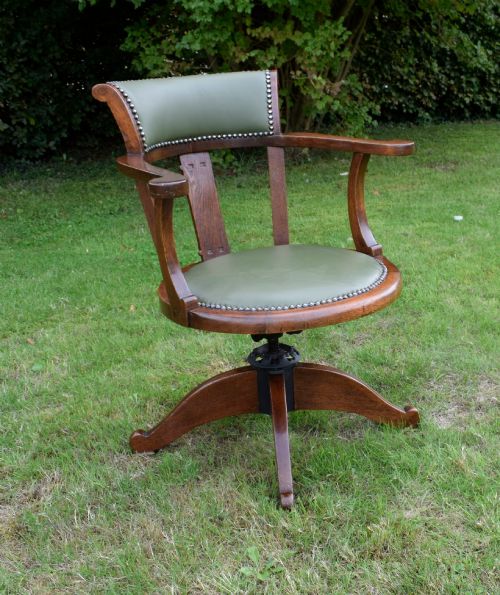
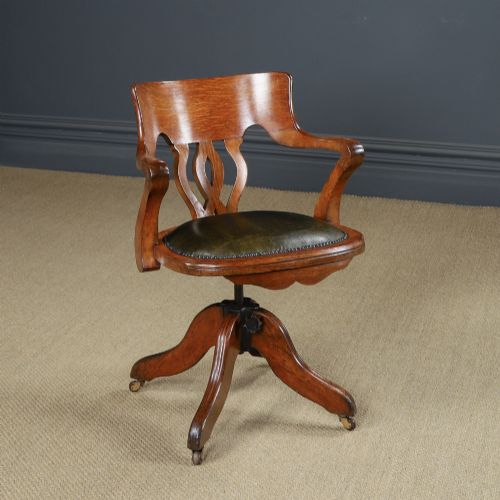
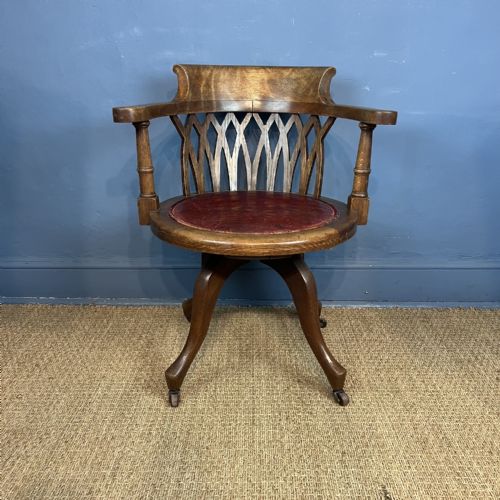
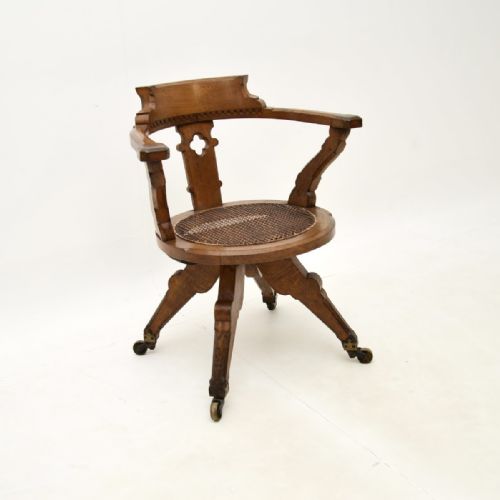


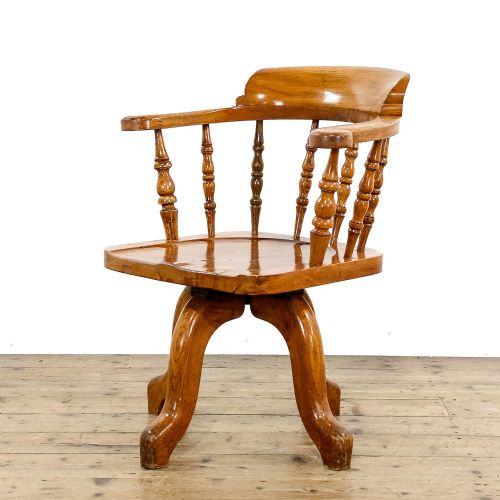

Oak Revolving Armchair
An oak revolving armchair brings sturdy swivel function and historic character to a home workspace, combining solid timber frames with mechanical adjustments.

Oak Revolving Armchair
An oak revolving armchair is primarily found in late Victorian and Edwardian office, desk, or library settings. These chairs combine a robust timber frame with a central swivel mechanism to give mobility at a workspace.
The most common examples on this page date from the 1870s through the 1920s, spanning Victorian, Edwardian, and Arts and Crafts styles. They appear frequently as desk chairs, office chairs, and captain's chairs.
Makers adapted these pieces for institutional, maritime, and domestic use, resulting in variations ranging from plain wooden seats to heavily carved ship chairs and leather-upholstered library seats.
Construction and Materials
Makers built these pieces using solid oak frames combined with leather, cane, or solid wooden seats. Iron, brass, and cast metal provided the internal swivel and height-adjustable mechanisms hidden beneath the seat.
Joinery techniques included steam bending for the curved arms and top rails, particularly on Edwardian bentwood and captain's chair variants. Carved detailing appears on Gothic Revival and maritime pieces, utilising hand-chiselled ornamentation on the crest rails and splats.
Listings feature oak revolving armchairs spanning the Victorian, Edwardian, Arts and Crafts, and Art Deco periods.
Judging Quality and Craftsmanship
Quality rests upon the robustness of the revolving and tilting mechanism and the integrity of the timber frame. Higher-grade examples feature heavy, smooth-operating iron and brass swivel actions that permit both rotation and height adjustment without excessive play.
The choice of upholstery and secondary woods also marks the grade of the piece, with high-quality specimens utilising thick, hand-tacked leather and superior framing timbers such as oak and birch rather than softer utility woods.
Kendrick and Jefferson·Edward William Godwin
The Oak Revolving Armchair Glossary
- Swivel mechanism
- The internal iron and brass assembly mounted beneath the seat that allows the chair to rotate through three hundred and sixty degrees.
- Captain's chair
- A sturdy low-backed armchair designed with a rounded top rail supported by spindles, commonly adapted for office and library use.
- Bentwood
- Wood that has been heated with steam to make it pliable, allowing makers to bend it into curved armrests and hoop backs.
- Bergere
- A traditional upholstered armchair featuring woven cane panels on the backrest or sides.
- Tilt action
- A mechanical function allowing the occupant to lean backward against the chair's backrest while the seat pivots on its central column.
Oak Revolving Armchair: Frequently Asked Questions
How do I date an oak revolving chair?
Dating relies on stylistic clues such as the carved motifs of Victorian Gothic Revival pieces versus the cleaner lines of Edwardian examples. The complexity of the metal swivel mechanism under the seat also indicates the period of manufacture.
Earlier Victorian models often feature heavier cast iron hardware and deeper wood carvings. Edwardian versions commonly introduce bentwood components and simpler adjustment screws.
How were these chairs used originally?
They served primarily as functional seating for clerks, librarians, ship captains, and professionals who needed to turn between desks and filing areas. The swivel and tilt functions allowed the user to reach different parts of a workspace without moving the entire base.
Maritime variants were utilised on ships, whilst library and office versions furnished institutional and domestic workspaces.
Can I use one at a modern desk?
These chairs fit well at standard modern desks, though you should check the height adjustment range before purchase. Many vintage mechanisms provide a modest amount of vertical movement.
The sturdy oak construction and ergonomic curved backrests make them practical for contemporary home offices.